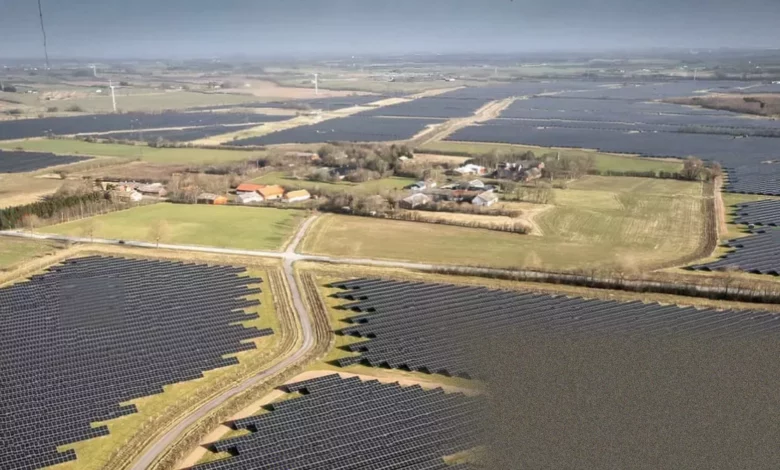
In the run-up to Denmark’s national election, a potent new phrase has come to dominate the political landscape, encapsulating a rural revolt that is testing the nation’s famed consensus on climate action: “jernmarker,” or “iron fields.”
Coined by Inger Støjberg, leader of the right-wing populist Denmark Democrats, the term—selected as the Danish Word of the Year in December—frames the spread of solar parks as an industrial assault on pastoral idyll. “We say yes to fields of wheat,” Støjberg declared in a 2024 speech that has become a rallying cry, “and we say no to fields of iron!”
A Political Vector for Rural Discontent
This narrative has provided, as University of Sussex researcher Lukas Slothuus notes, a “clear vector to articulate discontent politically.” The Denmark Democrats, born from a split in the centre-right Venstre party, have successfully focused on climate action as a key electoral battleground, a tactic increasingly employed by far-right parties across Europe. They target what they frame as an urban elite imposing its green transition on neglected hinterlands.
“Solar panels have become a symbol of the political elite that wants a green transition and doesn’t care about what happens to the countryside,” said Mads Fuglede, a Denmark Democrats politician elected to the council of Ringkøbing-Skjern, Denmark’s solar heartland. “Because that’s not where they live or where their voters live.”
The potency of this message is reflected in polling. While a November survey found 77% of Danes whose vote was influenced by green energy projects supported them, over 80% of voters for the two largest right-wing populist parties—whose base is concentrated in rural regions—were opposed.
From Rhetoric to Reality: Projects Stalled and Scrapped
The political backlash has translated into concrete action at the municipal level. The ripple of cancellations reveals a significant local pushback. The municipality of Køge voted in January to cancel the Vallø Energy Park, a major renewable project with a large solar component.
In Viborg, councillors voted to stop a planned solar farm in Iglsø and approved only the wind and biogas elements of another project in Vinge. The municipality has since cancelled 430 hectares of solar panels planned for Energy Park Tjele. Even on Samsø, an island powered entirely by renewables, councillors from across the spectrum voted to reject a solar park. Other municipalities, like Fredericia, are planning to remove zoning areas earmarked for solar installations.
The opposition centres on claims that large-scale solar farms are aesthetically damaging, creating “barren metal landscapes” that destroy nature and deflate property prices. Drone footage of farmhouses encircled by silicon panels has become a powerful symbol for campaigners.
Some developers and supportive politicians have responded with what Camilla Holbech, Vice-president for renewable energy at industry association Green Power Denmark, calls “green hushing”—proceeding with projects quietly rather than championing them publicly.
Economic Headwinds Compound Political Resistance
Beyond the political and social friction, the solar boom is encountering formidable economic and practical challenges. According to Torsten Hasforth, chief economist at the Danish climate thinktank Concito, the “official expectation is a very large rise in the amount of solar produced” over the next decade. “But that kind of clashes with the reality on the ground – they can’t make money.”
Denmark’s northern latitude means few optimally sunny days, and the surge in renewable capacity has led to a sharp increase in hours with negative electricity prices, cannibalising profits. This is compounded by slow electrification rates and congestion in the electricity grid. Current legislation also prevents the inclusion of batteries in planned projects to manage intermittency.
Investor hesitancy is growing, evidenced by financial difficulties for some developers and a lack of bids for large wind power tenders in late 2024. The business case for major projects is under scrutiny, with one—the Bornholm Energy Island—recommended for abandonment due to poor economics.
A Climate Leader in a Dilemma
This backlash presents a profound dilemma for a nation that is a global renewable energy leader. Denmark generates 90% of its electricity from renewables and aims for 100% renewable electricity by 2030. Solar power alone tripled its share of production from 4% in 2021 to 13% in 2025, with capacity reaching 4,832 MW by the end of September 2025.
The country has a history of pioneering climate policy, including the world’s first tax on agricultural emissions, introduced in June 2024. Its earlier success with wind power was built on community involvement and co-operative ownership models, a contrast to the current dynamic around solar.
Proponents argue the scale of the land-use issue is often overstated. Data from the Danish Solar Association indicates solar panels cover the equivalent of only 0.2% of Danish farmland, with about one-third of total capacity installed on rooftops.
Henrik Stiesdal, an inventor of Denmark’s first commercial wind turbines, points to a fundamental shift in public discourse since the early days of renewables: “The thing that has changed since the first decades is Facebook. Even though the greater population feels things are good, you can get enough local people and enough not-local-but-angry people to provide opinions.”
As Denmark votes, the dispute over “iron fields” raises a critical question for the global green transition: how can even the most ambitious nations maintain public support when the physical infrastructure of change arrives on the doorstep? The answer will determine not just Denmark’s energy future, but could provide a cautionary tale—or a blueprint—for democracies worldwide.