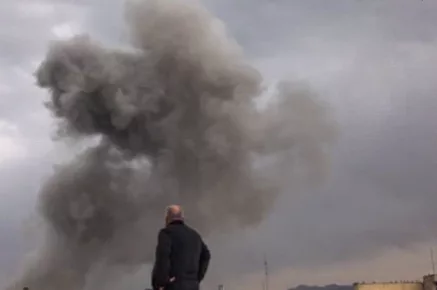
As Iranian drones struck a critical Saudi oil facility this week, the world of international football found itself uncomfortably close to the frontline, both literally and politically. The attack on the Ras Tanura refinery on Monday, March 2, 2026—part of a wave of retaliatory strikes following joint US-Israeli operations—occurred roughly 250 miles from a luxury property in Cascais, Portugal owned by footballer Cristiano Ronaldo, underscoring the surreal intersection of global sport and escalating conflict.
The immediate geopolitical fallout is clear. The UK government has advised British nationals in Saudi Arabia to stay indoors and exercise increased caution following missile and drone activity. The targeted refinery, a major processing and export terminal with a capacity of 550,000 barrels per day, suffered a fire that was contained, with no reported casualties or major damage to core production systems, according to operator Saudi Aramco.
A Tournament Mired in Conflict
This incident throws into stark relief an unprecedented situation for world football’s governing body, FIFA. The co-host of this summer’s World Cup finals, the United States, is currently engaged in military action against Iran, a participating nation. Furthermore, the US is accused of having murdered the head of state of another team in the tournament’s Group G.
Historical parallels are scant. While Britain hosted the 1966 World Cup during conflicts in Borneo and Aden, and Russia was later banned from international sport for invading a sovereign state, the direct involvement of a host nation in active warfare against a participant is without precedent. The question now is how FIFA, which statutorily commits to political neutrality, will navigate the crisis.
The “Peace Prize” and a Compromised Neutrality
Critics argue FIFA’s path has already been chosen, and it leads directly to the door of the White House. The organisation, under President Gianni Infantino, has tied itself with striking zeal to the administration of US President Donald Trump. This relationship was cemented in December 2025 when Infantino awarded Trump the inaugural “FIFA Peace Prize – Football Unites the World” at the World Cup draw in Washington D.C., praising his efforts to bring people together.
Trump described the award as “one of the great honors of my life.” The decision, however, has drawn fierce criticism and a formal ethical complaint. The UK human rights organization FairSquare filed a complaint with FIFA’s Ethics Committee in December 2025, alleging multiple breaches of FIFA’s Code of Ethics regarding political neutrality, specifically citing Infantino’s public support for Trump’s actions.
This award was not an isolated gesture. Trump has been actively involved in World Cup organisation, chairing a “Taskforce” headquartered in Trump Tower. Infantino, who marked his 10th anniversary as president on February 26 with well-wishes from Trump for “another 10, 20, or 30 years,” has been accused of abandoning neutrality to massage the president’s instincts, creating a partnership where FIFA acts as an enabler within a publicity machine.
Gaza and the “Board of Peace”
This collaborative dynamic is manifest in a controversial reconstruction plan for Gaza. FIFA, in a joint effort with Trump’s “Board of Peace,” announced an approximate $75 million investment in the territory through football. The plan includes constructing 50 mini-pitches, five full-size fields, a FIFA academy, and a national stadium for 20,000-25,000 spectators.
Critics have lambasted the project as a form of “public conscience washing,” arguing that in a strip where nearly 80% of buildings are damaged or destroyed and the World Bank estimated .5 billion in damage by late 2024, funds would be better directed to housing, utilities, and transport. The plan’s announcement, featuring imagery of rubble and displaced people, appears doubly absurd given the participation in FIFA competitions of Israel, the nation whose military campaign caused the destruction, which is part-funded by the United States.
World Cup Participation in the Balance
The practical consequences of the US-Iran conflict for the World Cup are now immediate. The Iranian Football Federation has stated it “cannot be expected to look forward to the World Cup with hope.” Complicating matters, the US government has instituted a travel ban prohibiting fans from Iran from entering the country for the tournament, citing national security, though athletes and staff are exempt.
FIFA statutes offer no direct remedy should Iran withdraw, though the executive committee has broad force majeure powers. The United Arab Emirates and Qatar, both struck by Iranian bombs in recent days, were in Iran’s qualifying group, as was North Korea—a nation with its own unique World Cup history, having qualified twice, most notably reaching the quarter-finals in 1966.
As news of the US bombardment broke, FIFA executives were in Wales overseeing a meeting of the International Football Association Board. The organisation now faces a profound test of its governance. While some credit Infantino with bringing financial stability after years of scandal, the political and ethical cost of his alignment with power is under severe scrutiny.
Football, in this case, provides a textbook lesson in how spectacle can be used to flood the zone of public attention. The show, as always, must go on. The World Cup will likely take place, but it will do so under the shadow of a grotesque paradox: a sport pledging unity while its leadership is deeply enmeshed with a host nation at war with a guest, all glossed by the hollow sheen of a invented peace prize.