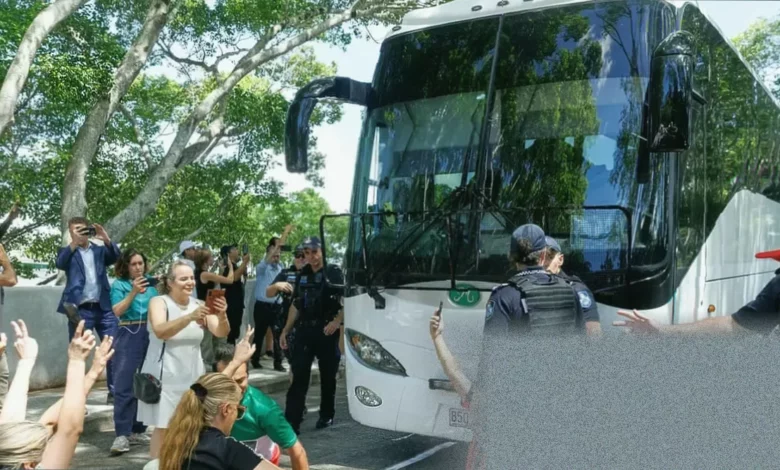
The Iranian women’s football team has departed Australia amidst a high-stakes diplomatic and legal drama, with five players granted asylum while the remainder of the squad flew out under a cloud of alleged coercion and potential criminal investigation.
On Tuesday afternoon, the team left their Gold Coast hotel for the airport, their departure marked by protestors who briefly blocked their bus and by the sight of one player in tears. This came just hours after Home Affairs Minister Tony Burke formally granted protection visas to five players: captain Zahra Ghanbari, Fatemeh Pasandideh, Zahra Sarbali Alishah, Mona Hamoudi, and Atefeh Ramezanizadeh. The group, which broke into a spontaneous chant of “Aussie, Aussie, Aussie, oi, oi, oi” upon receiving their papers, has been offered temporary humanitarian visas providing a pathway to permanent residency.
Advocates believed more players, and possibly some staff, were considering staying. However, the team’s movements have been complicated by the presence of official minders and complex travel logistics. Iranian football officials stated that direct flights to Iran were cancelled due to regional tensions, and the United Arab Emirates reportedly refused transit, forcing plans for a return journey via Malaysia and Turkey.
Exit Trafficking Allegations and Police Involvement
The circumstances surrounding the departure have triggered serious legal concerns. New South Wales Anti-Slavery Commissioner James Cockayne has referred a case of suspected “exit trafficking” to the Australian Federal Police (AFP) for immediate investigation. Exit trafficking involves using coercion, deception, or threats to force someone to leave Australia against their will, distinct from human smuggling.
Commissioner Cockayne called for “accountability” for people “undertaking criminal violations of Australian law while in Australia.” He suggested evidence from team members, CCTV, and eyewitnesses could determine if crimes were committed, but acknowledged “complex geopolitical and diplomatic sensitivities” in any investigation. The AFP confirmed it had been “providing assistance” to Home Affairs officials for three days prior to the departure, but said it would not comment further.
Refugee advocate and former Socceroo Craig Foster stressed the urgent need for independent legal advice for the players before they left the country. “We have a duty of care to these women now,” he told the ABC. Amnesty International Australia’s Zaki Haidari urged border officials at the airport to intervene and remind the team of their right to seek protection, an offer Minister Burke said had been extended to all members.
Security studies expert Kylie Moore-Gilbert suggested the government’s swift action was politically unavoidable given evidence of potential coercion. The players had previously drawn the ire of Iranian authorities by standing silently during the national anthem before a match, an act of protest that led state media to label them “wartime traitors.”
International Pressure and Community Support
The situation attracted significant international attention, amplifying pressure on Prime Minister Anthony Albanese. In the early hours of Tuesday, former US President Donald Trump used social media to urge Australia to grant asylum, warning the players would “most likely be killed” if returned to Iran and offering US asylum as an alternative. Israel’s Minister of Innovation, Gila Gamliel, and exiled Iranian crown prince Reza Pahlavi also made public appeals for the players’ safety.
Mr Albanese described the situation as “delicate,” stating help was available if players reached out. “It is up to them. But we say to them, if you want our help, help is here, and we will provide that,” he said.
Meanwhile, the five players who stayed have been welcomed by the Australian football community. Brisbane Roar’s chief operations officer, Zac Anderson, contacted the international players’ union FIFPRO to extend an open invitation for the players to train with the A-League Women club. “We want them to feel part of the Roar family, and feel welcomed in Australia,” he said.
Elijah Buol, CEO of the Asylum Seekers Centre, described the visas as a “compassionate and practical step” but stressed it should be a beginning, not an end. The players themselves expressed “joy,” “relief,” and were reportedly “excited to embark on a life in Australia.”
Experts have criticised tournament organisers for failing to foresee the crisis. Beau Busch, president of FIFPRO Asia/Oceania, said a human rights assessment should have been conducted before the event, a point echoed by Daniel Ghezelbash, director of the Kaldor Centre for International Refugee Law at UNSW. “It is well-documented that major sporting events enliven significant human rights risks, and a situation like the Iranian women’s team was a foreseeable eventuality,” Ghezelbash said.