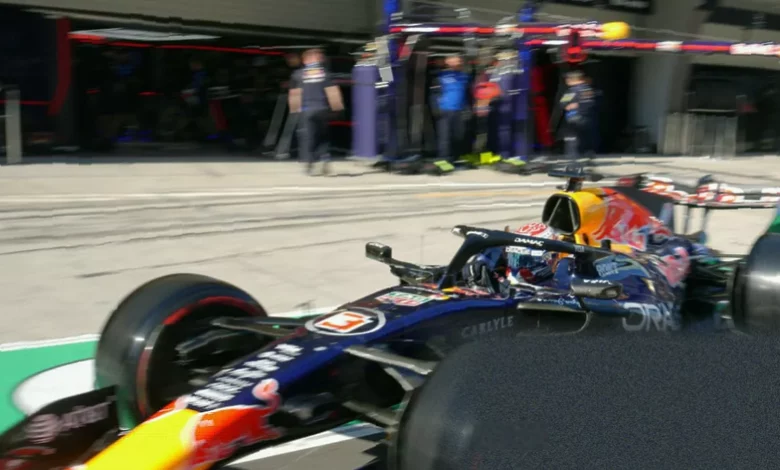
Four years ago, the site at Red Bull’s Milton Keynes campus was little more than empty ground dotted with rubble. Today, that same patch of land houses a gleaming, purpose-built engine manufacturing department that has already delivered a power unit Laurent Mekies, the team principal, says has “clearly exceeded expectations”.
The decision taken in 2022, under the leadership of then-team principal Christian Horner, to stop buying customer engines and instead build their own is widely regarded as one of the boldest steps Red Bull have ever taken. It was a venture into the unknown, with no guarantee of success, but carried the promise of complete independence — making the team master of every aspect of how their cars go racing.
That promise is now being realised. The ability to design engine and chassis in concert, playing to each other’s strengths rather than forcing a chassis around a bought-in power unit, is an advantage that Red Bull believe cannot be overstated. Yet the project was greeted with considerable scepticism. Established manufacturers such as Renault and Honda had found themselves publicly wanting under new regulations, and Red Bull were approaching the task as a startup. Laurent Mekies, who took over as team principal last year and was not involved in the initial engine project decisions, acknowledges that a “ghost” haunted the endeavour: the fear that Red Bull would not have a competitive power unit.
To lead the charge, Red Bull headhunted Ben Hodgkinson from Mercedes AMG High Performance Powertrains in May 2022. A British engineer with 27 years of experience in Formula One engine development, Hodgkinson describes the project as bold and audacious — and says it attracted characters with similar attributes. When he began, he was taking on 25 new personnel a month. His team now numbers around 700. Despite high-profile departures elsewhere in the sport, Red Bull continues to recruit heavily: 120 new employees joined across the engine and chassis departments in the first quarter of this year alone.
Inside the cleanroom: A new standard in engine building
The facility Hodgkinson and his team built from scratch is a technological marvel. Even given the haste with which it was constructed — including the installation of engine dynos housed in large, imported pre-built steel units chosen because they could be on site and operational in the shortest possible time — the level of precision and cleanliness is exceptional.
The romantic image of engine assembly involving spanners and oily overalls has long vanished from modern Formula One, but Red Bull’s assembly rooms set a new standard. There is an almost disarming quiet, a pristine, precise perfectionism. Were an actual spanner to drop, it would echo like thunder in this meticulous atmosphere. The cleanliness is not aesthetic but functional: potential contamination of parts with even the most minute particles is taken incredibly seriously. Components arriving from outside are unboxed in a room entirely separate from the assembly area, cleaned thoroughly before they ever enter the main space.
The same painstaking attention to detail extends to every corner of the operation. There is an entire room dedicated to cleaning crankshafts before they are used. Another room is given over to oil analysis, a process that identifies particulate elements that may be wearing the engine with undue haste. At the end of an engine’s life, it is disassembled in microscopic detail to identify any areas of weakness, helping to prevent failure in future models. The atmosphere, one observer noted, has the air of an especially sparkling kitchen run by a decidedly fastidious chef.
Hodgkinson and his team have leveraged advanced manufacturing techniques to accelerate refinement. Additive manufacturing — 3D printing — allows for rapid design iterations, helping to bridge the experience gap with long-established rivals such as Mercedes and Ferrari. In February 2023, Red Bull announced a strategic technical partnership with Ford Motor Company, contributing expertise in combustion engine development, battery cell and electric motor technology, and power unit control software. The rebranded entity is now known as Red Bull Ford Powertrains.
The project is geared towards the new engine regulations due in 2026, which will place a greater emphasis on pure engine power, remove the MGU-H, and significantly increase the proportion of electric power. The engines will also be required to run on fully sustainable fuels. Red Bull is also constructing a new, state-of-the-art wind tunnel at its Milton Keynes campus, which is reportedly ahead of schedule and expected to be fully operational for the 2026 season, replacing an existing facility near Bedford that has been described as a “Cold War relic”.
Positioned for the future
For all the current travails — including Max Verstappen’s dissatisfaction with the new rule set and his recalcitrant car — Red Bull’s engine has proved an undoubted success story. Mekies acknowledges that this season Mercedes have as much as a two- to three-tenths advantage from their engine, but that Red Bull are so close at their very first attempt is remarkable. The real deficit, he says, is in the chassis. The team has been off the pace of Mercedes, Ferrari and McLaren in the opening three rounds, but Mekies is confident: “We have our own issues. We need to get these tenths back, we need to fix what we need to fix with the car. This, we know how to do. It’s going to happen, not in Miami, but it’s going to happen.”
The engine project, meanwhile, has had a small indirect impact on current car development due to resource allocation, but officials maintain that initial testing has shown impressive reliability. There have also been reports suggesting Red Bull and Ford may consider not implementing performance upgrades if they are not significantly behind the benchmark engine, prioritising chassis development instead.
Mekies credits the foresight of those who made the original decision. “As much as it was a crazy decision, a crazy investment, now it put us into an incredible situation for the next five to 10 years,” he says. “The power unit decision of four years ago that puts you in a position of being completely independent … for years to come, with the support of Ford. The fact that we have this wind tunnel coming some time next year also puts you at a completely different level.” He concludes: “The ghost of the power unit — is Oracle Red Bull Racing going to have a strong enough power unit for the years to come? — has disappeared.”