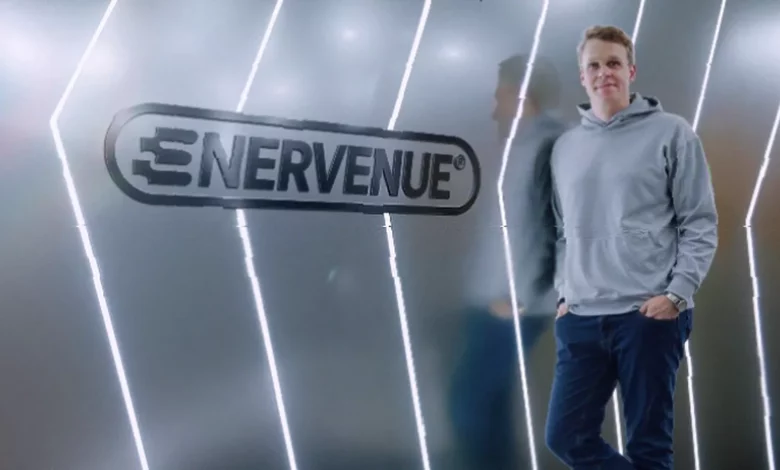
California-based energy storage startup EnerVenue has secured a $300 million investment to scale up production of its non-lithium battery technology, a significant bet on an alternative to conventional lithium-ion systems for large-scale power grids and data centres.
The Series B extension was led by Hong Kong’s Full Vision Capital, the family office of tycoon Peter Lee Ka-kit, and saw participation from the Hong Kong Investment Corporation (HKIC) and previous backer Aramco Ventures, the venture capital arm of Saudi Aramco. The company has now raised a total of $445 million since its founding in 2020.
Funding and a new captain for expansion
The fresh capital arrives alongside a leadership change, with Henning Rath appointed as the new CEO. Rath, formerly of German solar provider Enpal, brings experience in scaling global energy businesses. Dr Yi Cui, the Stanford professor and materials science expert who founded EnerVenue and serves as its chairman, stated Rath played a pivotal role in securing this round. The funding fully finances the company’s near-term manufacturing targets.
Dr Cui is a prominent figure in battery innovation, having previously pioneered work on silicon nanowire anodes for lithium-ion batteries. EnerVenue is one of five companies he has founded to commercialise research from his Stanford lab, where he also directs the Precourt Institute for Energy.
The metal-hydrogen advantage
The core of EnerVenue’s offer is its Aqueous Metal Cell (AMC) technology, a non-lithium, water-based metal-hydrogen battery. The chemistry has aerospace pedigree, having been developed for NASA and used on missions including the International Space Station and the Hubble Space Telescope, before being refined at Stanford University for terrestrial, grid-scale use.
The company positions its product as infrastructure, prioritising safety, longevity, and lifetime cost over maximising short-term energy density. The benefits over lithium-ion batteries are pronounced: the cells carry no risk of thermal runaway—the dangerous chain reaction behind lithium battery fires—and have a design life of 30,000 cycles. This equates to three charge-discharge cycles per day for 30 years, far exceeding typical lithium-ion endurance for such intensive use.
EnerVenue recently bolstered its intellectual property with a US patent for a method to operate these batteries, including monitoring degeneration and regenerating cells affected by oxidation. The technology has also received key safety certifications, including UL1973 and has completed UL9540A tests for stationary storage.
A competitive field beyond lithium
EnerVenue does not see itself in direct competition with lithium-ion giants like Tesla, Fluence, or Enphase. Instead, it operates in the growing niche of long-duration, non-lithium storage, competing with technologies like iron-air systems from Form Energy and flow batteries from ESS Inc. and Invinity.
The market for such alternatives is expanding rapidly, driven by the global push for renewable energy integration and the soaring power demands of artificial intelligence data centres. These sectors require stable, reliable power and face challenges with grid intermittency and stability, creating a crucial role for advanced storage. The broader non-lithium battery market, encompassing sodium-ion and zinc-air technologies, is projected for significant growth, with the stationary storage segment expected to dominate.
Scaling production and global reach
The primary focus of the new investment is to accelerate manufacturing at the company’s facility in Changzhou, China, a hub for battery production expertise. EnerVenue plans to establish a 250 MWh high-volume production line, with construction set to begin in 2026, and aims to eventually reach gigawatt-scale capacity at the site.
Commercial expansion will target Asia, the Middle East, and Europe. A new regional headquarters in Hong Kong will coordinate Asia-Pacific sales, supported by an innovation centre for materials research, while core R&D continues in Silicon Valley. The company’s strategic vision is already translating into pilot projects; German energy giant RWE has purchased its batteries for a renewable storage pilot in the US, and American utility Dominion Energy is set to begin a pilot programme in Virginia in 2027.
The investment philosophy of lead backer Full Vision Capital centres on “doing well by doing good,” focusing on long-term value and social impact. The firm maintains a small, hands-on portfolio with a strong emphasis on green economy technologies, of which EnerVenue—named one of TIME’s World Top Greentech Companies in 2024 and 2025—is a clear example.