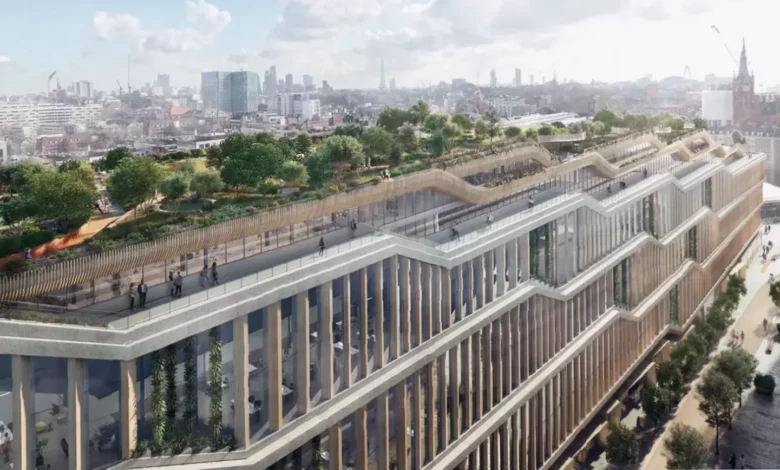
After years of anticipation and construction delays, Google’s colossal new London headquarters beside King’s Cross station is preparing to open its doors, marking a significant milestone for both the tech giant and the regeneration of the area.
The first occupants are expected to move into the building, officially named Platform 37, this summer. When fully operational, the campus will cement its status as Google’s largest office outside the United States, a physical embodiment of its substantial UK investment, particularly in artificial intelligence research.
An AI Legacy in Brick and Glass
The building’s name, Platform 37, is a carefully chosen nod to both its location and Google’s technological ambitions. While it references the site’s adjacency to the railway station, the ’37’ specifically honours a seminal moment in AI history: “Move 37.” This was the unconventional, seemingly illogical play made by DeepMind’s AlphaGo system in its 2016 match against world champion Lee Sedol, a move that confounded experts but secured victory and heralded a new AI era.
Designed by the high-profile architects Thomas Heatherwick and Bjarke Ingels, the structure is an 11-storey “landscraper” stretching 330 metres – longer than the Shard is tall. Its design, developed after Google rejected earlier plans as “too boring,” incorporates an innovative suspended structure. This creates vast, column-free interior spaces that can be reconfigured as needed and allows the building’s mass to be lifted two storeys above the street, creating space for smaller retail units below.
The focus on innovation extends to sustainability. The building utilises low-carbon, local materials, features fully electric kitchens and equipment, and is equipped with a network of devices for real-time energy monitoring. Demis Hassabis, CEO of Google DeepMind, has described Platform 37 as the company’s “most ambitious and innovative building to date.”
From Goods Yard to Tech Hub
The site’s transformation into a global tech hub is the latest chapter in a long history. The land was originally a goods yard and an extension of King’s Cross station, which included the “hotel curve” rail tunnel – now used for utilities. After the demolition of a suburban station, it served for decades as a car park.
Its railway heritage saw a temporary revival in 2015 when it hosted performances of *The Railway Children*. For the past decade, however, it has been dominated by Google’s construction project, which began in 2018 after planning was submitted in 2017.
A Building Designed for People and Public
Platform 37 is designed to house approximately 4,000 to 4,500 staff, contributing to a total campus capacity of up to 7,000 employees. Beyond offices, it includes extensive amenities such as a 25-metre swimming pool on the ninth floor, a multi-use games area, a gym, and cafes.
Significantly, the building will feature a publicly accessible ground-floor space called The AI Exchange, set to host exhibitions, talks, and educational events aimed at demystifying artificial intelligence. Above, a sprawling rooftop garden runs the building’s length, created in partnership with the London Wildlife Trust and Camden Council. Containing an estimated 40,000 tonnes of soil and 250 trees, it includes lawns, wildflower meadows, terraces, and a running track, aimed at boosting local biodiversity – though its construction was reportedly complicated by urban foxes taking up residence.
Delays and Regeneration Impact
The project has faced delays from its original 2024 completion target, with reported contractor issues, though Google maintains these had minimal overall impact. The first staff are now expected to begin moving in from summer 2026.
Google’s commitment has been a driving force in the transformation of King’s Cross, elevating the area into a premier destination for tech and creative firms. This is reflected in office rents, which have risen from below the London city centre average to above it since Google’s investment.
The completion also brings a direct benefit for the public realm. The long-standing hoardings along the pavement linking King’s Cross station to the developments to the north are finally coming down, effectively doubling the width of this busy pedestrian route.
The project involved a large team of collaborators, with Heatherwick Studio and Bjarke Ingels Group as concept architects, BDP as lead consultant, and specialists including AKT II (structural engineering), Atelier Ten (building services), and Gillespies (landscape architecture).