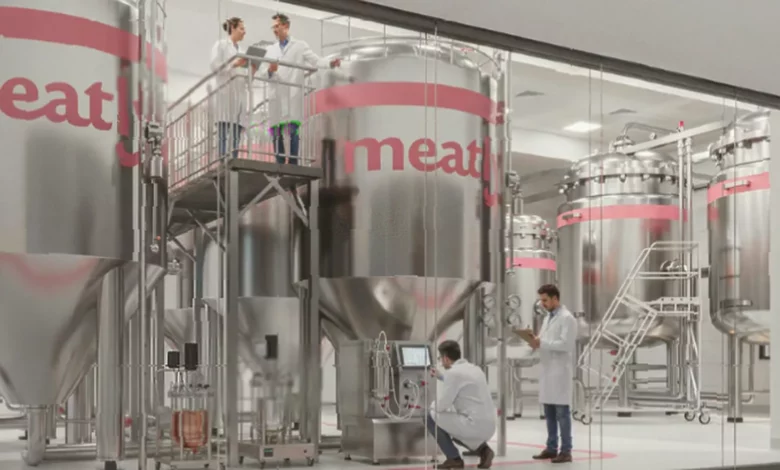
Meatly has secured £10.4m in Series A funding to build Europe’s largest cultivated meat production facility, a 20,000-litre bioreactor site in London that will supply the UK pet food market from 2027.
The round was led by three new institutional investors — Oyster Bay Venture Capital, Clean Growth Fund and JamJar Investments — and brings the company’s total funding to £17.4m, building on £7m in seed backing from Agronomics and Pets at Home. Fit-out of the London facility begins immediately, with commercial products expected to launch in 2027.
How the technology works
Founded in 2022 by Owen Ensor and Dr Helder Cruz, Meatly produces real chicken meat from animal cells without slaughter. The process takes place inside large steel bioreactors, where cells multiply in a nutrient solution until they form meat. The company currently supplies its chicken to UK retailers for pet food, having sold the world’s first cultivated meat pet product in 2025 — a limited release of “Chick Bites” developed in collaboration with plant-based dog food brand The Pack and sold through Pets at Home.
Meatly received UK regulatory approval in 2024, becoming the first company in Europe authorised to sell cultivated meat. The UK’s Food Standards Agency (FSA) and Food Standards Scotland (FSS) have since issued guidance for cultivated meat novel food applications, defining the product as “of animal origin” rather than “meat”. A regulatory sandbox is in place for businesses testing these products, and the FSA is evaluating several applications for human food, with some decisions expected by early 2027.
Scaling up: the cost challenge
The cultivated meat industry has attracted significant global investment but continues to struggle with commercialisation. Most companies remain in research and development, held back by the high cost of cell culture media and bioreactors. Cell culture media alone accounts for 55% to 95% of production costs, with growth factors — the proteins that tell cells to multiply — making up as much as 99% of media cost in some formulations.
Meatly has spent four years systematically tackling these barriers. By 2024, the company had reduced the cost of its chemically defined, protein-free culture medium to £0.22 per litre, having previously achieved a cost of less than £1 per litre. In 2025, it cut bioreactor costs by approximately ten times by manufacturing its own equipment in-house, and successfully completed the first cell growth run in a custom-designed, pilot-scale 320-litre bioreactor.
“Meatly has one focus – to make commercially viable cultivated meat a reality,” said Ensor. “Over the last four years, Meatly’s pioneering team has systematically focused on reducing key costs and building the strongest possible technical foundation for growth. Now we have our own industry-leading technology, and we are ready to scale.”
The company’s approach is pragmatic: getting products to market quickly and gathering feedback. Ensor, a vegan who previously scaled an insect protein business at Sanergy and advised on plant-based food strategies, brings experience from Bain & Co. Dr Cruz holds a PhD in developing a metabolically-optimised serum- and protein-free animal cell bioreactor process and has more than 22 years in cell therapy and biotech, having worked with the inventor of the first cultured meat burger.
Market focus and competitive edge
Meatly is starting with pet food, which offers a shorter path to market and consumer acceptance. A UK consumer survey showed mixed responses to cultivated meat for human consumption, with a significant portion unwilling to try it. For pet owners, the focus is on sustainability: Pets at Home, a strategic investor, has described Meatly’s innovation as a “game-changer” for reducing the environmental footprint of pet food.
Meatly’s emphasis on cost control and vertical integration sets it apart from competitors such as Upside Foods and Eat Just in the United States, which face regulatory and cost hurdles, and from European companies still at the lab stage. The UK government is investing in alternative protein research and development, aiming to modernise regulations and position the country as a global leader in the sector.
“Meatly is not just building a new product – it’s laying the foundations for an entirely new protein category,” said Elise Schumacher, investor at Oyster Bay Venture Capital. “Cultivated meat is emerging as one of the most sustainable and ethical ways to produce meat today. From advancing the science to early retail sales for pets, Meatly has shown a clear ability to move from concept to real-world application, with the foundations to scale across Europe and globally.”
Clean Growth Fund invested because Meatly is demonstrating the possibility of producing real meat cost-competitively with a fraction of the environmental impact. JamJar Investments, focused on early-stage consumer companies, joined the round alongside founding backers Agronomics, a leading AIM-listed clean food company, and Pets at Home.
The capital will go directly into building the London facility, enabling Meatly to continuously produce cultivated chicken at scale for the UK pet food market. The facility will house a 20,000-litre bioreactor — the largest in Europe.