BP is reportedly considering a full or partial exit from its North Sea operations, a move that has left Scotland’s First Minister “very concerned” and prompted fresh criticism of the UK Government’s tax regime on the oil and gas sector.
The oil giant has begun an internal strategic review of its UK offshore business, according to a report by Bloomberg, with no final decision yet taken. Sources familiar with the matter have indicated that any potential divestment could be valued at approximately £2 billion ($2.7 billion). The review comes as BP’s new chief executive, Meg O’Neill, who took over in April 2026, focuses on reducing debt and reallocating capital towards higher-return global projects, with the company targeting around $20 billion in divestments by the end of 2027.
BP has been steadily shrinking its presence in the North Sea over the past decade, having sold its stake in the Shearwater field and the Forties pipeline system. It retains a 45% interest in the Clair Field, the largest oil field on the UK Continental Shelf.
Swinney blames windfall tax
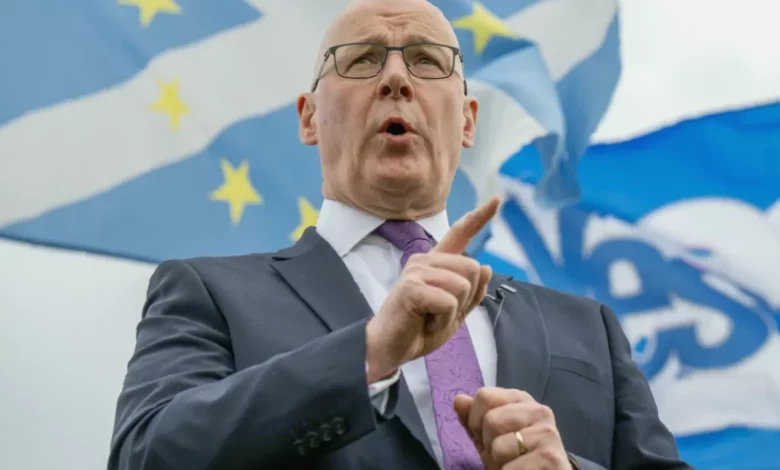
Speaking to the Press Association on Saturday during a campaign stop in Glasgow, John Swinney said the reports of a possible BP exit were driven by a “hostile taxation approach” from the UK Government through the energy profits levy (EPL).
“I’ve seen the reports and I’d obviously be very concerned about that,” the First Minister said. “What will be driving this is the hostile taxation approach of the United Kingdom Government through the energy profits levy, and I’ve told the Prime Minister to his face that the energy profits levy is causing significant economic damage to Scotland and the North Sea oil and gas sector. It’s accelerating the decline of the sector and I made it clear to the Prime Minister he should remove that energy profits levy, and the speculation about BP I think should prompt early action from the UK Government.”
Swinney accused Sir Keir Starmer of being distracted by the scandal surrounding the hiring and firing of former US ambassador Lord Peter Mandelson. “But, as with so many questions of the challenges that we face, the Prime Minister is distracted by his own failures and can’t take the proper actions to protect jobs and employment within Scotland, and that’s an example of the weakness and the failure of a Labour Government,” he said.
Lord Mandelson was appointed as UK ambassador to Washington despite failing security checks and was later fired because of his friendship with Jeffrey Epstein. Starmer acknowledged making a poor judgment, saying he would not have proceeded with the appointment had he been aware of the security concerns, and blamed Foreign Office officials for not informing him. His former chief of staff, Morgan McSweeney, admitted to making a “serious mistake” in recommending Mandelson for the role.
The energy profits levy and its impact
The energy profits levy, commonly referred to as the windfall tax, was introduced in May 2022 as a temporary measure to capture “excess” profits during global price spikes triggered by the conflict in Iran. However, its rate has been increased multiple times. It began at 25%, rose to 35% in January 2023, and currently stands at 38%. Combined with the existing headline rate of corporation tax, this has resulted in an effective marginal tax rate of 78% on North Sea profits — one of the highest for upstream oil and gas in the world.
Industry bodies, including Offshore Energies UK (OEUK), have warned that this fiscal regime is uncompetitive and deters investment. OEUK estimates that around 1,000 North Sea-linked jobs have disappeared per month under the current government. The North Sea Transition Authority (NSTA) has published forecasts indicating that around 10% less production is expected for 2025 compared to pre-EPL projections. The number of exploration and appraisal wells drilled in 2024 reached a record low, with many drilling rigs having left the North Sea entirely.
Energy Secretary Ed Miliband previously described BP’s first-quarter profits — which more than doubled to $3.2 billion compared with $1.38 billion a year earlier — as “morally and economically wrong” in a now-deleted social media post. The Aberdeen & Grampian Chamber of Commerce criticised the remark as a “deliberately dishonest narrative”, arguing that most of BP’s profits came from global operations, not the North Sea, and that the 78% tax rate was rendering the basin uninvestable.
BP’s profits for the first quarter of 2026 were largely attributed to global oil trading, with only a small proportion derived from North Sea production. Nevertheless, the high tax burden and broader policy uncertainty — including the UK Government’s decision to end new oil and gas exploration licensing rounds under its “North Sea Future Plan” — are cited as central factors in the company’s strategic review.
Future of the tax regime
The UK Government has stated its intention to replace the energy profits levy with a new Oil and Gas Price Mechanism (OGPM) by March 2030. This mechanism would apply only during periods of high prices, with a 35% rate on revenues above certain thresholds. Industry groups, however, have expressed concern that the timeline is too long and that faster reform is needed to unlock investment. Some analyses suggest that reforming the EPL earlier could actually increase tax receipts in the long term.
Other major oil companies, including Chevron, ConocoPhillips, Shell, ExxonMobil and TotalEnergies, have also divested or restructured their North Sea operations in recent years, pointing to a broader reassessment of the region’s attractiveness for investment. The potential decline of the North Sea is expected to increase the UK’s reliance on gas imports, with forecasts suggesting imports could rise from around 14% of supply to over a quarter by 2030 and almost half by 2035, leading to higher import bills, greater energy price volatility and a loss of skilled employment.
The UK Government has been contacted for comment.