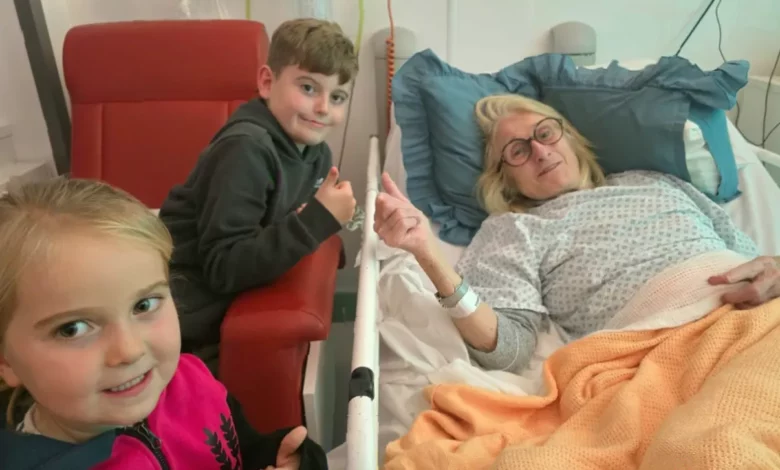
A 74-year-old woman has been left with catastrophic brain damage after her symptoms of a life-threatening brain condition were repeatedly mistaken for a simple urine infection.
Helen Edwards, a fit and active grandmother from Aberystwyth, first visited her GP in September 2025 with flu-like symptoms and nausea. She was sent home with antibiotics for a suspected urinary tract infection (UTI). When her condition deteriorated days later—her whole body shaking—a second GP visit yielded the same diagnosis. Her family watched in horror as she rapidly declined, becoming so confused and disoriented she could not navigate her own home.
“She had gone into the toilet thinking it was her office, and then was using a notepad and pressing it as if it was a phone,” her daughter, Jane Richards, told The Independent. After a 10-hour wait in A&E at Ysbyty Bronglais, Ms Edwards was sent home, her strange behaviour attributed to delirium from a UTI. She was only admitted after being found shaking and confused in her bed the next day, and was given intravenous antibiotics for the presumed infection.
A critical delay and a devastating diagnosis
The correct diagnosis came a week after her first symptoms, and only after a consultant on rounds noticed her shaking and ordered a CT scan. Helen Edwards was suffering from viral encephalitis—a serious inflammation of the brain. In her case, it was caused by the herpes simplex virus type 1 (HSV-1), the common cold sore virus, despite her having no recollection of ever having a cold sore.
Encephalitis, which affects approximately 6,000 people in the UK each year, is a medical emergency where early recognition is critical. According to Encephalitis International, which is supporting the family, global awareness is dangerously low, with almost 77 per cent of people unaware of the condition. This contributes to delays that can lead to irreversible injury or death.
The initial symptoms often mimic common ailments: a headache, fever, and nausea. As the inflammation progresses, more severe neurological signs emerge, including confusion, seizures, personality changes, and difficulty speaking. A significant and dangerous pitfall, particularly for older patients, is the misattribution of confusion and altered behaviour to a UTI.
“Too often, HSV‑1 encephalitis in older people may result in the early symptoms being mistakenly attributed to something less serious such as a UTI,” said Dr Ava Easton, chief executive of Encephalitis International. She stressed that the condition requires urgent treatment, with antiviral drugs like aciclovir most effective within 48 hours of symptom onset to reduce the risk of severe disability.
A fight for recovery and a call for awareness
For Helen Edwards, the delayed diagnosis had life-altering consequences. She spent 12 weeks in hospital before being discharged in late November, but the brain damage led to a slow and arduous recovery. Despite intensive physiotherapy and occupational therapy, she returned home unable to recognise rooms or understand how to use everyday objects.
“She didn’t know what anything was or how to do anything,” Ms Richards explained. “She has no recollection and she can’t navigate places.” The family now takes turns providing full-time care. In a further complication, Ms Edwards developed autoimmune encephalitis in February this year—where the immune system attacks the brain—and is receiving treatment at Swansea’s Morriston Hospital.
Her case underscores the diagnostic challenges of a condition whose symptoms overlap with many others. Mark Henwood, a medical director for the Hywel Dda health board, acknowledged this difficulty, stating: “Encephalitis is a rare and serious condition that is difficult to diagnose because the symptoms are similar to several other conditions.” The board said its staff are trained to high standards to respond to a wide range of conditions.
Encephalitis International advocates for greater awareness through tools like the “FLAMES” acronym, highlighting key signs: Flu-like symptoms, Loss of consciousness, Acute headache, Memory problems, Emotional or behavioural changes, and Seizures. For Jane Richards, the message is clear: “If someone is behaving strangely, if they’ve got flu-like symptoms, medics just assume a lot of the time, with older people particularly, that it is a UTI.” She urges both the public and medical professionals to learn the signs, stressing that with encephalitis, “time is of the essence.”