Consent Required for Search
Google Search requires user consent to function. On this news website, readers who want to look up information using the built‑in search tool must first agree to load Google Custom Search, a service that may use cookies or similar technologies. Without that consent, the search box remains inactive. The prompt, which appears as a pop‑up, asks users to click “Allow and Continue” before they can enter any query. This requirement is explained in the site’s privacy policy, which details how data from the search tool is collected and handled.
Consent is needed because Google Custom Search, like many online services, relies on cookies and similar tracking mechanisms to operate. When a user agrees, cookies may be placed on their device to remember preferences, personalise results, or analyse usage. The request for permission is a direct consequence of data‑protection rules – including the UK’s post‑Brexit data regime – that mandate clear, informed consent before any non‑essential tracking can begin. Without this step, the search feature cannot lawfully run. The website therefore blocks the tool until the user explicitly chooses to allow it.
How the Search Feature Works
Once consent is given, the Google Custom Search function becomes active. Readers can then type in terms – for example, “liver disease treatment” or “cell therapy trial” – and results are served by Google’s search infrastructure, integrated directly into the page. The feature is designed to help users find content within the site quickly, but because it uses Google’s technology, it also transmits search queries and basic browser information to Google’s servers. That data exchange is what triggers the initial consent requirement.
The search field is a standard tool on many news sites, but its underlying mechanism involves third‑party code. This means the website operator cannot guarantee that no data leaves the site without the user’s permission. The consent notice is therefore both a legal safeguard and a practical gate: without it, the search bar remains greyed out, and the reader cannot proceed. Those who do not wish to allow cookies or similar technologies can simply ignore the prompt and continue browsing the site manually, using navigation menus instead.
Privacy Implications
The privacy policy linked from the consent notice outlines what data Google Custom Search may collect, how it is used, and whether it is shared with third parties. Typical practices include the use of cookies for session management, personalisation of advertisements, and analytics. Because the search feature is provided by a third party, the website cannot fully control what Google does with the information. Users who are concerned about their privacy are advised to read the policy carefully before clicking “Allow and Continue”. The option to withhold consent is always available – the site does not force acceptance, but it does prevent access to the search tool.
This trade‑off between functionality and privacy is a common feature of modern web design. In the context of a news website, the search tool can be essential for readers trying to locate specific articles, especially on complex subjects such as medical breakthroughs. One such story that users might want to find involves a pioneering cell therapy for liver disease developed by scientists at the University of Edinburgh, in collaboration with the Scottish National Blood Transfusion Service. The therapy reprograms a patient’s own white blood cells into mature macrophages, which are then re‑injected. These engineered cells travel to the liver, where they break down scar tissue (fibrosis), reduce harmful inflammation, and promote the regeneration of healthy liver cells.
The therapy was first tested in the MATCH clinical trial. In that study, 26 patients received the macrophage treatment, while 24 received standard care. After four years, 70% of treated patients were living without the need for a liver transplant, compared with only 40% in the standard‑care group. Among the treated group there were eight deaths and no liver transplants; in the standard‑care group there were nine deaths and five liver transplants. No serious side‑effects were reported among those who received the cell therapy. Earlier one‑year data from the MATCH phase 2 trial showed that none of the 26 treated patients experienced severe liver‑related complications or deaths in the year following treatment, while four out of 24 patients in the standard‑care group had severe complications, and three died – two from liver‑related causes.
A new, engineered version of the therapy – known as RTX001 – is now being tested in the EMERALD clinical trial for patients with advanced liver cirrhosis. The trial was approved by the UK’s Medicines and Healthcare products Regulatory Agency (MHRA) and began enrolling patients in September 2025, with the first dose administered in Edinburgh. The EMERALD study aims to recruit 25 patients across the UK and Spain, and initial clinical readouts are expected in 2026. The therapy is being commercialised by Resolution Therapeutics, a spin‑out company founded in 2020 by Professor Stuart Forbes of the University of Edinburgh’s Institute for Regeneration and Repair, with support from Edinburgh Innovations. Professor Forbes has been a key figure in this research for more than a decade.
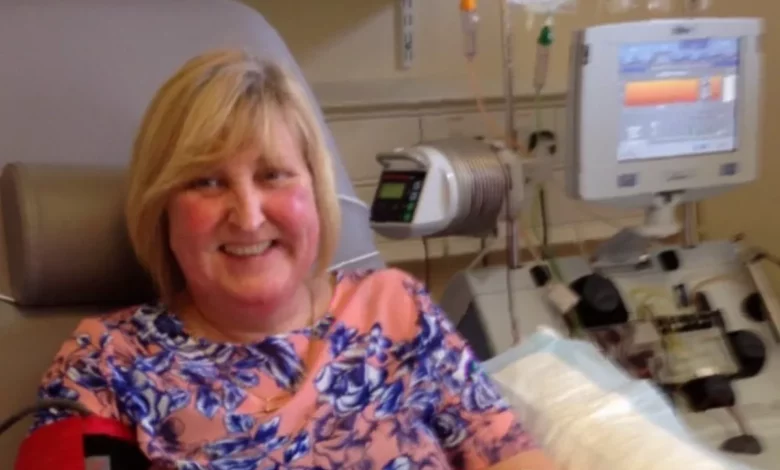
One patient who took part in the MATCH trial is Sandra Watson, a 61‑year‑old woman from West Lothian, Scotland. She was diagnosed with primary biliary cholangitis two decades ago and received the therapy in October 2016. Ten years later, she remains transplant‑free and reports significant relief from symptoms such as itching and jaundice. She described the treatment as a “godsend” and said it has given her “so much more freedom”. The British Liver Trust has noted that, for people living with cirrhosis, such results offer “real hope” in a field where hope has been scarce, and that being told a transplant may be the only option – and that one may never come – is devastating.
Liver disease is a growing health crisis in the UK. More than 11,000 people die from it each year – one source puts the figure at over 12,000, and official data records 12,367 deaths UK‑wide in 2023. Liver disease is the only major disease in which death rates are rising; deaths have quadrupled over the last 50 years. Premature deaths from liver disease in England increased by almost 40% between 2001 and 2022, reaching a rate of 21.9 per 100,000 population under 75 in 2023, up from 15.4 in 2001. More than three‑quarters of people are diagnosed with cirrhosis at a point when effective treatment is no longer possible. Cirrhosis can lead to liver failure, and at present a liver transplant is the only curative option for end‑stage disease – but transplants are limited by donor availability, cost, and suitability for only a small subset of patients, and many die while on the waiting list.
The causes of liver disease are multiple. Alcohol‑related liver disease accounts for over 60% of all liver disease deaths in the UK, and premature deaths from alcoholic liver disease in England have risen significantly over the past 20 years. Obesity and non‑alcoholic fatty liver disease are major concerns, with one in three adults in the UK affected by NAFLD. Hepatitis B and C are also significant contributors. Liver disease is closely linked to inequality and deprivation: mortality rates are around five times higher in the most deprived areas compared with the most affluent, and the North East of England has the highest mortality rate. Alongside the macrophage therapy, other approaches are being researched, including the use of mesenchymal stem cells – which have anti‑inflammatory and immunomodulatory properties – and regulatory T‑cell therapy, which aims to harness immune‑suppressing capabilities to prevent immune‑mediated liver injury. A study at King’s College London has modified MSCs to improve their ability to reverse liver scarring and activate regeneration.
For readers who want to explore these topics further – whether searching for “MAC trial”, “liver cirrhosis treatment”, or “Sandra Watson Edinburgh” – the consent gate remains the first step. Only after clicking “Allow and Continue” can the search feature deliver the relevant articles, including the full details of the cell therapy, the patient story, and the wider context of liver disease in the UK. The website’s privacy policy, accessible from the consent notice, provides the full explanation of how that search data is handled – a necessary disclosure in an era when every query carries a privacy cost.