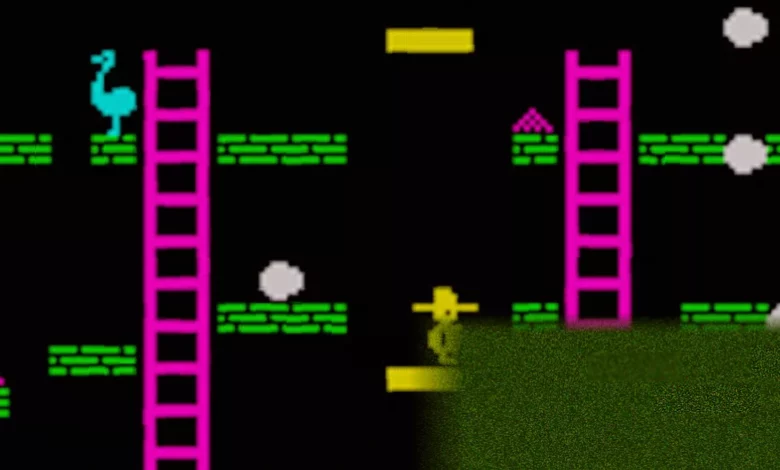
Long before ‘boss battles’ were a staple of gaming lexicon, players of a certain British home computer classic were being introduced to the concept by a relentless, pixelated duck. In the 1983 platformer Chuckie Egg, reaching the eighth level unleashed this formidable fowl from its cage, transforming a frantic egg-collecting run into a tense game of survival. This feathered antagonist, stalking the player with missile-like precision, provided a template for climactic showdowns years before they became commonplace.
The Ubiquitous Hit
For a generation of UK schoolchildren in the early 1980s, Chuckie Egg was inescapable. Originally released in the autumn of 1983 for the ZX Spectrum, BBC Micro, and Dragon 32, it shot to the top of the charts. Its publisher, the small Manchester-based A&F Software, swiftly capitalised on its success by porting it to as many machines as possible. Around 11 conversions followed, reaching owners of the Commodore 64, Amstrad CPC, Acorn Electron, and Atari 8-bit computers. It became a foundational thread in the fabric of British 8-bit culture, played in school libraries and living rooms with equal fervour.
The game’s premise was simple but fiendishly addictive. Players took on the role of Hen House Harry, a name conceived by A&F for the cassette inlay card, who had to collect a dozen eggs on each level before a timer ran out. Piles of seed could be gathered for extra points and to momentarily freeze the clock, but patrolling hens posed a constant threat. A single touch from a hen, a fall through a gap, or the timer hitting zero would cost a life. This combination of dexterity, speed, and strategy created what Elite Systems co-founder Steve Wilcox later described as a “trance-like experience,” a fluid, mastery-driven gameplay loop that stood in contrast to more puzzle-oriented platformers of the day.
Arcade Inspiration and Technical Ingenuity
The genesis of this homegrown hit lay not in other computer games, but in the noisy arcades of the era. Its creator was Nigel Alderton, a 15-year-old Saturday boy at A&F Software’s computer shop in Denton, Greater Manchester. On his bus journey home, he would spend his wages in an arcade, becoming enamoured with titles like Nintendo’s Donkey Kong and, particularly, the earlier platformer Space Panic. He set out to create his own take, a fusion he described as a “cross between Donkey Kong and Space Panic” and which initially bore the working title “Eggy Kong.” Alderton himself admits that side-by-side screenshots of his game and Space Panic are “embarrassingly similar.”
The now-iconic visual style was born not from artistic flourish, but from strict hardware limitations. Alderton, who had taught himself machine code on a ZX81, needed the game’s enemies to fit a specific pixel footprint. “I needed enemies to be two characters high and one character wide, and that dictated how they looked. You had to keep it simple – you didn’t want a complicated shape,” he explained. This constraint gave birth to the game’s distinctive tall, patrolling hens. The surreal hen house theme was only applied later, fitting perfectly with the eccentric tone of other home computer hits like Manic Miner.
Alderton dedicated immense effort to perfecting the feel of the game, a process he compares to Shigeru Miyamoto’s meticulous work on Super Mario Bros. “I spent a lot of time tweaking the speed – not too quick, not too slow,” he recalled. The movement speed of the enemies was calibrated so the player could just outrun them, and the jump length was finely tuned to be useful but not overpowering. This relentless iteration resulted in the satisfying, fluid control that became a hallmark of the game’s appeal.
A Lasting Legacy
The impact of Chuckie Egg extended far beyond its initial chart-topping run. It is widely credited, alongside titles like Miner 2049’er and Lode Runner, with helping to develop and popularise the platform genre on home computers. While Space Panic predates it as an early platformer and Donkey Kong established a key template, Chuckie Egg’s accessible, score-attack design cemented its place in gaming history. Its success spawned a sequel, Chuckie Egg 2, two years later, though this multi-screen adventure never achieved the same iconic status as the original.
The game has never truly faded away. It has consistently been ranked among the top games of all time by publications like *Your Sinclair* and *GamesMaster*. Veteran publisher Elite Systems has kept the flame alive, releasing recreated versions for modern platforms including Android and iOS. Most recently, the company announced a new smartphone version featuring 3D graphics, a testament to the title’s enduring appeal.
As for Nigel Alderton, he left the intense world of game development after stints at Ocean and Elite Systems, and now works as a forecaster for a global firm. Yet, his teenage creation continues to find him. He recounts a boiler serviceman seeing a framed Chuckie Egg t-shirt and expressing fond memories of the game. “I told him I wrote it – he couldn’t believe it,” Alderton said. “People still remember it 40 years later. It’s lovely. It’s very flattering.” The game that was shaped by the limits of 8-bit hardware has proven, definitively, to be limitless in memory.