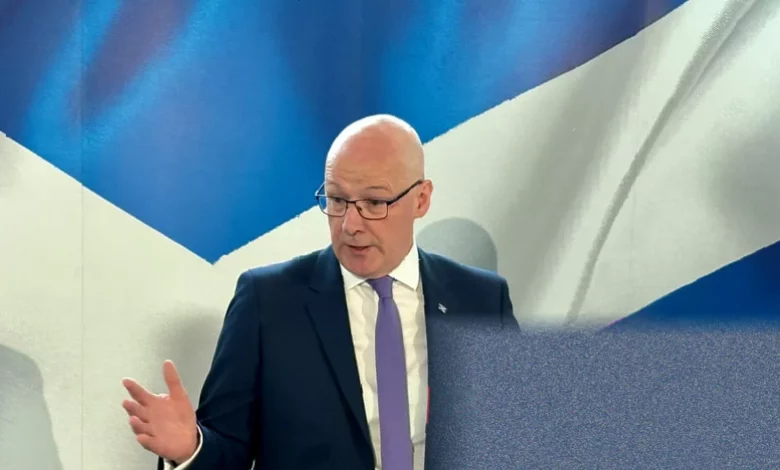
France’s national cybersecurity agency, Viginum, has accused the Israeli tech company BlackCore of orchestrating a campaign of foreign digital interference aimed at Scotland’s First Minister, John Swinney, and the Scottish National Party (SNP) during this year’s Scottish parliamentary elections.
According to Viginum, BlackCore deployed a network of proxy social media accounts on the platform X to target Swinney, the SNP and the Scottish government on four separate occasions between 6 January and 8 May. The agency said the operation involved the “coordinated posting” and mobilisation of at least 256 accounts, which together generated roughly 1,400 comments aimed at the three targets. Swinney’s own account was hit 652 times, the SNP’s account 338 times and the Scottish government’s account 112 times.
Marc-Antoine Brillant, Viginum’s head of digital interference, announced the findings at a press conference alongside the French prime minister, Sébastien Lecornu, on Thursday. Brillant said his agency had been able to identify BlackCore as the perpetrator but had not yet determined who had commissioned the company. “Our investigations did not make it possible to identify the sponsor or sponsors, if indeed they exist, behind this foreign digital interference,” he said.
Brillant emphasised that the same modus operandi had been used not only in France — where BlackCore is suspected of running a smear campaign against candidates from the hard-left France Unbowed party — but also in other countries. “It also appears to have been used to carry out foreign digital interference operations in other countries or regions, such as Angola, Togo, the elections in Scotland, and the 2025 municipal election in New York,” he told reporters.
BlackCore has previously described itself as “an elite influence, cyber and technology company built for the modern era of information warfare”. It claimed to offer governments and political campaigns “cutting-edge strategies, advanced tools and robust security to shape narratives”. Investigative reports by Le Monde and Le Canard Enchaîné had earlier linked the firm to a disinformation campaign targeting a French left-wing party, and Reuters reviewed internal BlackCore documents that claimed credit for a social media operation on behalf of an unnamed African government. After Reuters contacted the company for comment, BlackCore removed its website and LinkedIn page, and has not responded to subsequent requests.
Motives and political context
The alleged interference in Scotland comes against a backdrop of strong criticism from John Swinney and other SNP ministers of the Israeli government’s military operations in Gaza and the West Bank. The devolved administration has imposed a form of sanctions on the Israel Defense Forces by withholding state grants to arms firms that supply the IDF and freezing support for exports to Israel. Similarly, the New York mayoral election targeted in the same period was won by Zohran Mamdani, an outspoken supporter of the Palestinian cause. In France, the suspected BlackCore campaign was aimed at candidates from an anti-Israel party.
French Prime Minister Sébastien Lecornu confirmed that his government had contacted Israel to request explanations and assistance in identifying the sponsors behind BlackCore’s activities. Speaking in general terms at the press conference, Lecornu warned that next year’s French presidential election could be vulnerable to international interference and disinformation, noting that “the entire political class” could be a target.
The Israeli government said it was waiting to receive the full French report before deciding whether to open its own investigation, and denied having any interest in interfering in other countries’ elections. Israel’s embassy in Paris confirmed that France had made contact and that further details were awaited.
UK and Scottish responses
John Swinney called the revelation “clear evidence that orchestrated disinformation campaigns and foreign election interference are issues which need to be taken seriously”. He said online disinformation posed “a real and present threat” to democracy and urged the UK government to treat hostile state interference as a far higher priority, in line with recommendations from a recent review led by Sir Philip Rycroft. That review, commissioned in December 2025 and published in March 2026, concluded that foreign interference in British politics was “a persistent problem” that had become “arguably more acute”. It called for clear ministerial accountability, tighter regulations on online political advertising, a ban on foreign-funded adverts, and greater transparency in digital imprints.
Viginum — created in July 2021 under the authority of the French prime minister and attached to the General Secretariat of Defense and National Security — is tasked with detecting and identifying the sources of massive foreign information manipulation aimed at destabilising the state. The agency has previously exposed a network of 193 false information sites targeting Ukrainian and European populations linked to a Russian technical provider, and a separate network of 13 counterfeit Chinese news websites spreading pro-China propaganda.
Both the Scottish government and the UK Cabinet Office have been approached for comment.