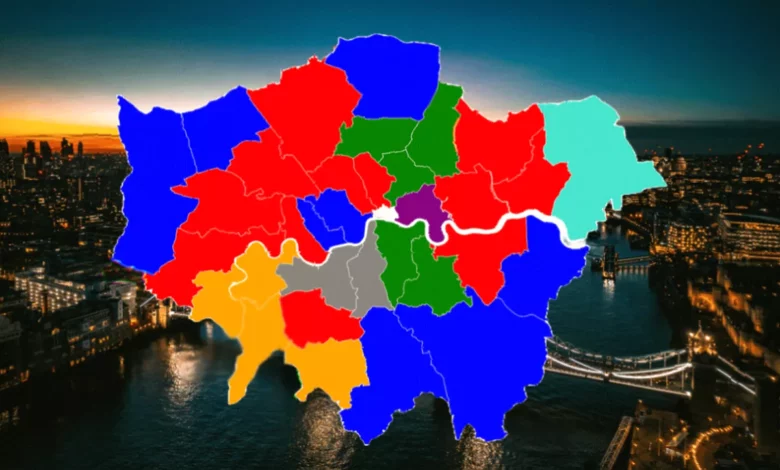
London’s local government map has been redrawn, with the Green Party emerging as the leading force in five boroughs following a seismic shift in the capital’s council elections. The party now heads administrations in Hackney, Lewisham, Waltham Forest, Southwark and Haringey, either through outright control or by leading minority and coalition arrangements.
Election results overview
Labour suffered heavy losses on 7 May, losing control of 11 town halls across London. The Conservatives regained Westminster, while seven other boroughs — Brent, Enfield, Barnet, Wandsworth, Haringey, Southwark and Lambeth — moved from Labour control to no overall control. The results reflect a more fragmented political landscape across the capital, with smaller parties making significant gains at the expense of the two main parties.
In some areas with large Muslim populations, Labour’s vote share fell markedly, a decline that has been linked by analysts to the party’s stance on the conflict in Gaza. The Conservatives also suffered heavy losses nationally, with their overall performance described as historically poor for a governing party.
Council-by-council outcomes
Hackney, Lewisham and Waltham Forest all fell to the Green Party. In Lewisham, the Greens took the mayoralty from Labour, with Liam Shrivastava — a former Labour councillor who switched parties — winning 40 per cent of the vote.
Southwark is now led by a Green minority administration. Labour remains the largest single party with 29 councillors, but lost 22 seats and its majority. The Green Party’s 22 councillors and the Liberal Democrats, who won 12 seats, intend to form a joint administration at the council’s annual meeting.
Haringey is under a Green-led minority administration. Green councillor Mark Blake has been elected leader of the council. The Liberal Democrats’ Dawn Barnes was elected mayor, and Labour councillor Makbule Gunes was confirmed as deputy mayor. The previous Labour leader, Peray Ahmet, lost her seat. The 2026 Haringey local elections saw the Greens win 28 seats, Labour 21 and the Liberal Democrats eight, marking a substantial shift in power.
Westminster was wrestled back by the Conservatives, while Wandsworth moved to no overall control after Labour lost its majority following a single term. In Wandsworth, the Conservatives won the most seats with 29, Labour secured 28, leaving the council hung.
Enfield is now a Conservative-led minority administration. The Tories won 31 seats, one short of a majority, Labour took 27, and the Greens won five. At a council meeting this week, the Green councillors abstained during leadership votes, allowing Conservative Alessandro Georgiou to be elected leader of the town hall. Tory nominations for mayor and deputy mayor were also approved. The decision ended 16 years of Labour control in the borough. Michael Rye OBE was appointed deputy leader, and Emma Supple was elected ceremonial mayor.
Barnet is a Labour-led minority administration. Both Labour and the Conservatives won 31 seats each, with the Greens holding one. Labour narrowly retained control through a co-operation arrangement — not a formal coalition — with the Conservatives. Barry Rawlings was re-elected leader with 31 votes in favour, 31 abstentions and one vote against. In the previous 2022 elections, Labour had held 41 seats to the Conservatives’ 22.
Brent is also a Labour-led minority administration. Labour won 26 of the 57 seats, falling three short of a majority. The Conservatives and Liberal Democrats each won 11 seats, while the Greens secured nine. At the council meeting last week, Conservative councillors abstained during leadership votes, allowing Labour to retain control and re-elect Muhammed Butt as council leader. Tory Amer Agha was chosen as deputy mayor.
How the Green Party is shaping council leadership
The Green Party’s strategic use of abstentions and alliances has proved decisive in determining who runs several London boroughs. In Enfield, the five Green councillors chose not to support either Labour or the Conservatives in leadership votes, instead abstaining to allow the Tories to form a minority administration. The move followed an agreement between the Greens and Conservatives to oppose controversial building plans in the area, including Tottenham Hotspur’s new training ground and thousands of homes planned by the government.
In Southwark, the Greens opted for a joint administration with the Liberal Democrats, forming a coalition that locked Labour out despite it remaining the largest single party. In Haringey, a Green minority administration took power directly, with Mark Blake as leader after Labour’s previous leader lost her seat.
Elsewhere, Green abstentions were not needed — in Barnet, it was the Conservatives who abstained to allow Labour to retain control, while in Brent, Tory councillors abstained to let Labour keep the leadership. In both cases, the Greens held too few seats to be the decisive factor, but their presence contributed to the hung councils that forced cross-party arrangements.
The party’s rise has been fuelled by a notable shift of former Labour voters, with analysis of the 2026 local elections suggesting that a significant proportion of Labour supporters switched to the Greens — more so than to Reform UK. Reform UK, which campaigned heavily on immigration, attracted votes from both Labour and Conservative supporters. The broader trend has seen the Green Party secure three seats on the London Assembly, while the Liberal Democrats won their first-ever constituency seat on the Assembly in the 2024 elections. Sadiq Khan was re-elected as Mayor of London for a third term in those same elections.