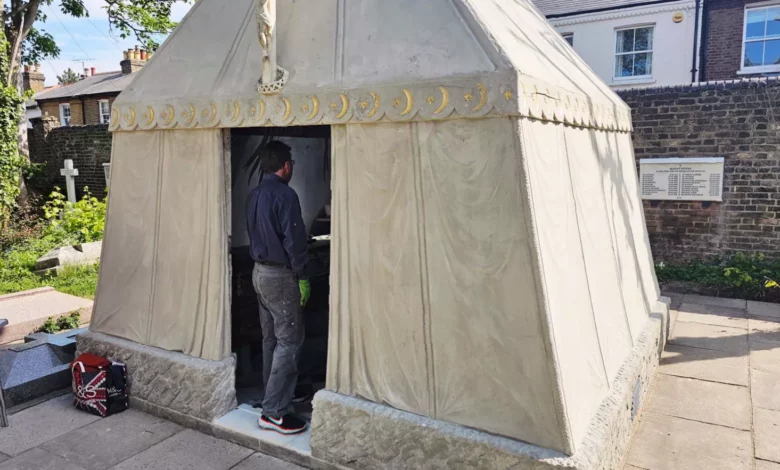
The Burton Mausoleum, a tent-like monument of Carrara marble and Forest of Dean stone sealed shut for more than seven decades, has reopened to the public in the churchyard of St Mary Magdalen in Mortlake.
Sealed for 70 years, a Victorian mausoleum opens its doors
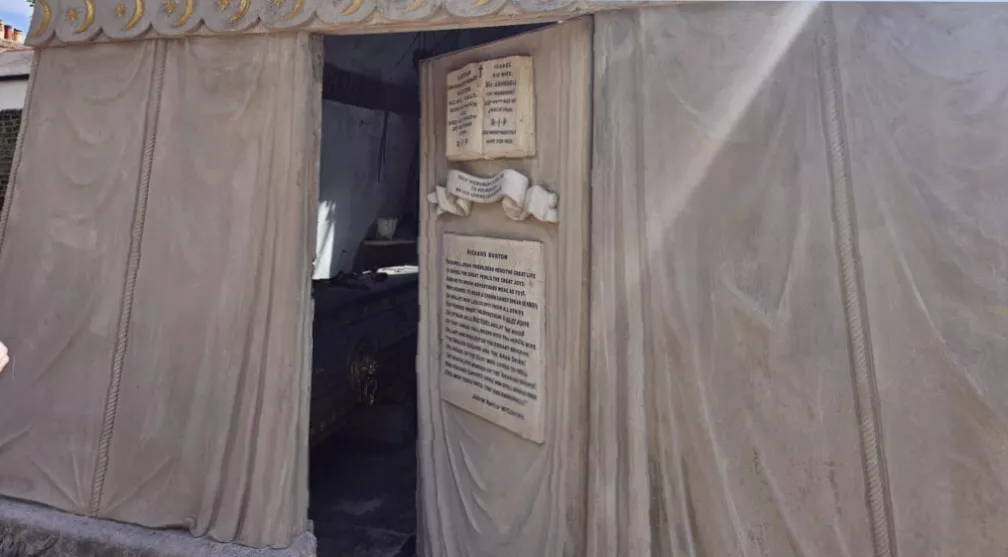
Over the weekend, members of the public crossed the threshold for the first time in living memory, entering a space that for years could only be glimpsed through a rear window by ladder. The restoration, carried out by the charity Habitats and Heritage with support from a National Lottery Heritage Fund grant, has cleaned and conserved the structure while finally reinstating access to the long-locked entrance.
The mausoleum houses the remains of Sir Richard Francis Burton, a Victorian explorer of towering achievement and deep contradiction, alongside his wife, Isabel. Born in Torquay in 1821, Burton served in the Bombay Army, mastered an estimated 29 languages, and embarked on expeditions that pushed the boundaries of European geographical knowledge — including being the first European to discover Lake Tanganyika and participating in the search for the source of the Nile alongside John Hanning Speke.
The explorer, the outcast, and the devoted wife
Yet Burton was no conventional imperial hero. He developed a profound fascination with the Islamic world, famously disguising himself as a pilgrim to enter Mecca during the Hajj in 1853 — a journey that required meticulous preparation, including undergoing circumcision, and which he later chronicled in a bestselling account. His translations of The Arabian Nights and The Kama Sutra, along with his unexpurgated edition of The Perfumed Garden, deliberately challenged Victorian moral codes with their frank discussions of sexuality and cultural practices.
Even by the standards of his own era, his views on other cultures were considered controversial, with his detailed writings on tribal rituals and fetishism leading the Foreign Office to view him as eccentric or even dangerous. Some scholars have suggested he may have written some works under his wife’s name. His bitter public dispute with Speke over the source of the Nile — which ended with Speke’s death the day before a scheduled debate — further complicated his reputation. When he died in 1890 expecting a grand funeral, official enthusiasm was markedly limited.
It fell to Isabel Burton to secure his legacy. Born into a prominent Roman Catholic family, she met Richard in 1851 and married him a decade later against her parents’ wishes. A writer and adventurer in her own right, she accompanied him on many of his postings, including to Damascus and Brazil. Using family connections, she secured a burial plot at St Mary Magdalen Catholic Church in Mortlake — a Gothic Revival church designed by Gilbert Blount and built in 1852 — and commissioned a mausoleum inspired by the Bedouin tents the couple had used during their travels in Syria.
A tent of stone: The architecture of a marriage
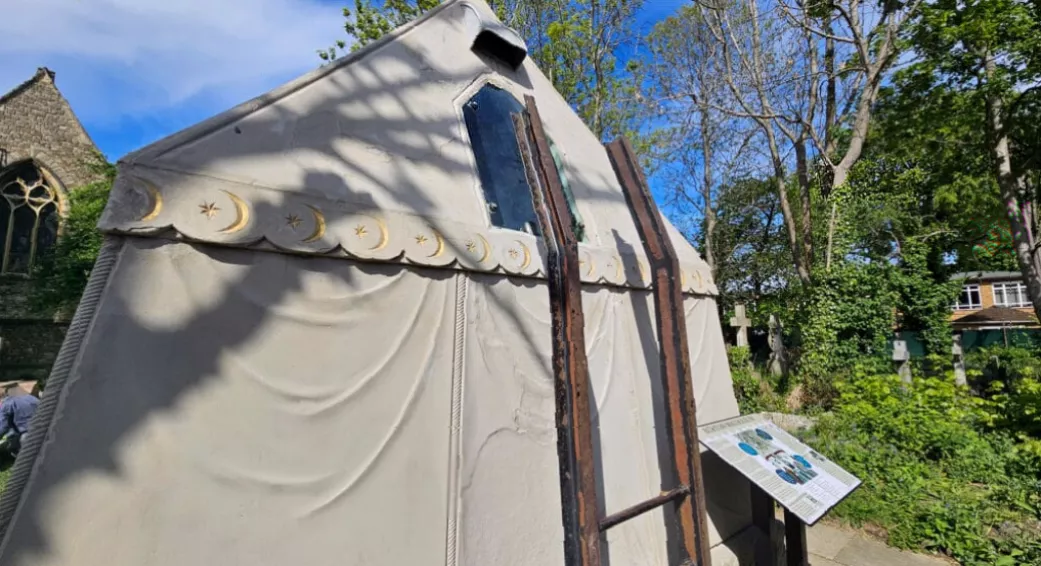
The mausoleum’s true power lies in the extraordinary decorative tension held within its stone walls. Here, the symbology of two different worlds, two different faiths, and two strong-willed individuals meet in a confined space. The exterior mimics an 18-foot high Bedouin tent, a direct reference to Islamic culture and Burton’s travels. Inside, this theme continues with eastern-style lamps — though manufactured in London — hanging from the ceiling.
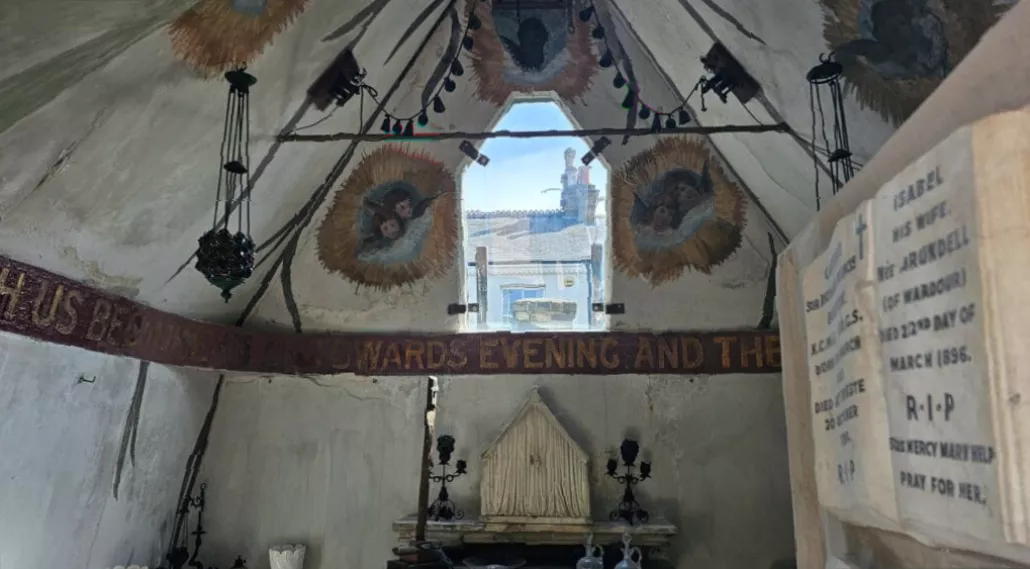
Yet above these lamps, cherubs adorn the ceiling, and small bells chime softly when the door moves. A mirror, added later, reflects light from a rear window, casting illumination across the scene. This contrast is most starkly represented in the two coffins lying side by side: one is richly decorated with an oriental influence, reflecting Burton’s scholarly pursuits and adopted identities, while the other is notably simpler, adhering strictly to Catholic traditions — a testament to Isabel’s devout faith and her role in shaping his posthumous image.
After her husband’s death, Isabel dedicated herself to preserving his legacy, burning some of his manuscripts — including a revised translation of The Perfumed Garden — fearing they would portray him negatively. She also wrote his biography and commissioned a stained-glass window in his memory for St Mary Magdalen Church. The mausoleum was completed in time for Burton’s funeral in 1891, designed with a door that allowed Isabel to step inside and pray beside him. She was interred there alongside him in 1896.
Stepping inside: What visitors will find
To stand inside the heart of the mausoleum is to feel the strange fusion of two daring adventurers from very different backgrounds and faiths, united in love, life, and death. The recent conservation work by Habitats and Heritage — a charity dedicated to preserving the historic and natural environment of south and west London — has focused on reversing decades of weathering and disrepair, ensuring that the sculpted folds of the stone tent and the intricate interior fittings are preserved for the future.
The mausoleum is located on North Worple Way in Mortlake, a short walk from the station in an area that traces its history back to the Domesday Book of 1086 and was once home to the Elizabethan mathematician and astronomer John Dee. The churchyard of St Mary Magdalen, where the mausoleum stands, opened in 1853.
The next open days are scheduled for Saturdays: May 16th, May 23rd, and May 30th, 2026. For decades, the interior could only be glimpsed through a ladder propped against the rear window. Now, the entrance is open — and visitors can cross the threshold to stand beneath the chiming bells, between the lamps and the cherubs, before the two coffins that speak silently of a remarkable and contradictory union.