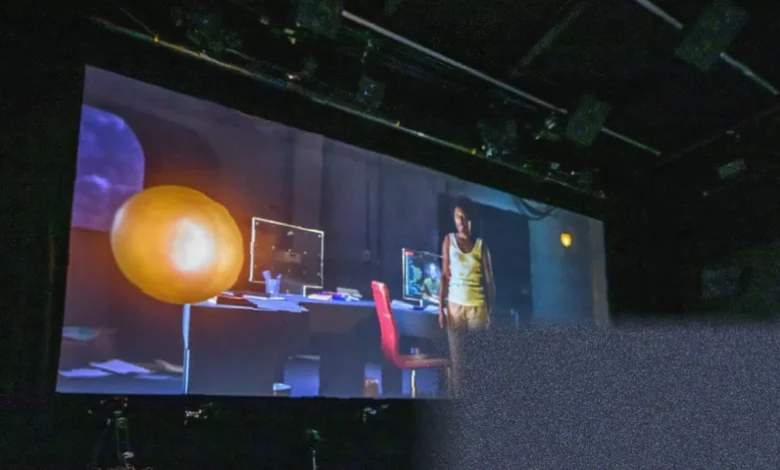
Bristol University has opened a unique cinema that monitors audience brain activity, heart rate and even blinks to understand exactly when viewers are most gripped by what they see on screen. The “Smart Cinema” – formally known as the Instrumented Auditorium – is the first fully equipped facility of its kind in the world, funded by a £400,000 grant from the Wolfson Foundation and housed within the university’s MyWorld creative technology hub.
Inside the Smart Cinema
At first glance the auditorium resembles any high-end theatre: booming surround sound, a razor-sharp 4K projector and rows of reclining seats. But instead of popcorn, audience members are fitted with an EEG headset that records brain activity, a heart rate monitor strapped around the arm, and infrared cameras that track every blink, fidget and eye movement. Sensors also measure the electrical properties of the skin, giving researchers a multi-layered picture of the body’s responses to what unfolds on screen.
“It’s a cinema, but for me it’s also a research lab where the technology is turned on the audience to understand at what points are they completely immersed,” said Professor Iain Gilchrist, a neuropsychologist at the University of Bristol who is leading the project. The cinema is part of a broader collaboration that includes the University of Bath, with Professor Danae Stanton Fraser, and industry partners such as the BBC, Aardman, Netflix and Google.
How synchronised signals reveal engagement
The researchers are less interested in any single viewer’s biometric readings than in the moments when those signals become most synchronised across the whole audience. When heart rates rise and fall in unison, brain activity patterns align and people stop fidgeting at the same time, it indicates a shared, deeply immersive experience. “The data we are collecting here will allow us to understand how the audience’s understanding of the story is shaped by particular scenes and inform decisions about the most impactful edit,” Gilchrist said.
The approach builds on Gilchrist’s earlier work, including tracking heart rates during live performances at the Bristol Old Vic and studying eye movements and body language at a research concert. That previous research found that people who attended a live music performance reported feeling more immersed than those watching via a live stream, and their heart rates synchronised more closely with one another – a clear sign of shared engagement.
This week audiences were invited into the Smart Cinema for the first time to watch Reno, a short science-fiction film that explores humanity’s relationship with artificial intelligence and themes of trust and manipulation. The film, directed by Rob Hifle – CEO and creative director of VFX studio Lux Aeterna, whose credits include Squid Game: The Challenge and The Crown – was produced using virtual production on MyWorld’s experimental studio stage. Different groups were shown alternative cuts of the movie, with one version significantly reducing the screen time of a central character. The findings will help Hifle refine the final edit before the film is submitted to festivals.
“It’s going to be really interesting to see how the audience engages with the characters, and whether I’ve got the story beats in the right place,” Hifle said. “Some of what emerges may be things I hadn’t even conceived of, which is exciting, because it could determine how I change the cut.” He stressed that the process is not formulaic: “We’re not treating this as a paint-by-numbers thing. It’s about using the data to help the film resonate better with the audience. Normally, when you’re editing a film it’s just you and the editor. But it’s essential to get more data to see if it sinks or swims.” Hifle said he could see the technology proliferating across the industry, adding that “everything relies on audience data now, whether it’s a product or a film.”
Industry divided on data-driven filmmaking
Not everyone is convinced that such tools address the real challenges facing modern media. Professor Amanda Lotz, who specialises in television and streaming industries at Queensland University of Technology in Australia, questioned whether the approach could solve the industry’s core difficulty. In today’s highly fragmented media landscape, she argued, success often depends less on engineering something with universal appeal and more on identifying and reaching the right audience. “Separate from whether a cross-section of individuals react the same way, media users come to it for different reasons. What you select to relax is likely different from when you want something intense or challenging, or when you are watching with family.” Lotz also highlighted a tension between using audience reaction data to optimise content and creating genuinely original storytelling. “Original storytelling prioritises craft and story, not a formula of ‘50% of tested audience members want X’,” she said.
Other experts see the Smart Cinema as a transformative development. Professor Tim Smith, based at the University of the Arts London and president of the Society for Cognitive Studies of the Moving Image, said the project marks an important step forward. “For the whole history of cinema, film-makers have sought to understand how the decisions they make during a film’s creation impact audience responses, but the methods at their disposal have been too coarse and imprecise,” he said. “This represents a radical scientific advancement that can provide precise, moment-by-moment insights and give film-makers the insights needed to craft the future of cinema.”
Gilchrist believes the technology has applications well beyond cinema. He has already used heart rate monitoring to study live music audiences and sees potential in advertising – particularly for longer-form content such as the John Lewis Christmas advert, which typically has a narrative arc – as well as in education. “Typically, I stand in front of 300 students, some of whom are half asleep or not as engaged as they could be,” he said. “There’s a real opportunity to get a sense, moment by moment, of how engaged they are with what I’m telling them. There may also be a future where that feedback is live.” Researchers also plan to launch a commercial spin-off company to sell Smart Cinema services to media, entertainment and advertising clients, and they see future possibilities in linking individual differences in response to mental health conditions such as anxiety and depression.
Ultimately, Gilchrist hopes the technology will encourage creatives to be more adventurous. “Mainstream television, whether it’s a streaming service or terrestrial, tends to be relatively conservative because making it is quite high risk,” he said. “We want to de-risk that process and give directors the creativity to try something different. If we test it and the audience loves it, we can push that out and everyone can see it. It’s not about telling a director: this is what you should do. Rather, it’s: here’s another tool in your kit to determine what might and might not work.”