A civil case brought by three victims of IRA bombings against former Sinn Féin president Gerry Adams has been abruptly discontinued, with the claimants stating that a judge’s intervention left them facing the “devastating” prospect of crippling legal costs.
The claim, for symbolic damages of just £1 each, was dropped on March 20, 2026, by John Clark, Jonathan Ganesh, and Barry Laycock. The men were injured in IRA attacks: the 1973 Old Bailey bombing, the 1996 Docklands bombing, and the 1996 Manchester bombing, which collectively killed three people and injured scores more.
A case derailed by a legal risk
According to the claimants’ solicitors, McCue Jury & Partners, the decision to end the case was forced by a procedural move from the trial judge, Mr Justice Jonathan Swift. The judge repeatedly raised the question of whether the personal injury claim was being used improperly as a vehicle to conduct a “protracted, wide-ranging public-inquiry-style examination” of Mr Adams’s alleged role in the IRA over decades, which could be deemed an “abuse of process.”
This judicial intervention had a critical financial consequence. While the claimants had a costs protection order shielding them from Mr Adams’s legal bills if they lost, the judge’s focus on abuse of process meant that order could be reviewed or removed if the case was ultimately deemed abusive. The claimants’ legal team stated this created, “for the first time, a real risk that the claimants, vulnerable victims of terrorism, could face devastating personal liability for legal costs.” Faced with this risk, they said they had no realistic choice but to accept an offer from Mr Adams’s team to “drop hands” and end the case.
“True self has been seen in court”
Despite the legal defeat, the claimants and their lawyers framed the proceedings as a form of victory. Their solicitors argued that the evidence presented meant Mr Adams’s “true self has been seen in court,” and described the outcome as “deeply unfair” due to the procedural hurdle. Barry Laycock, a victim of the Manchester bombing, said he was devastated but felt that “the fair trial we sought, getting Mr Adams into the dock for the first time, was achieved.”
The action had been crowdfunded, with supporters donating £110,000 to pursue it.
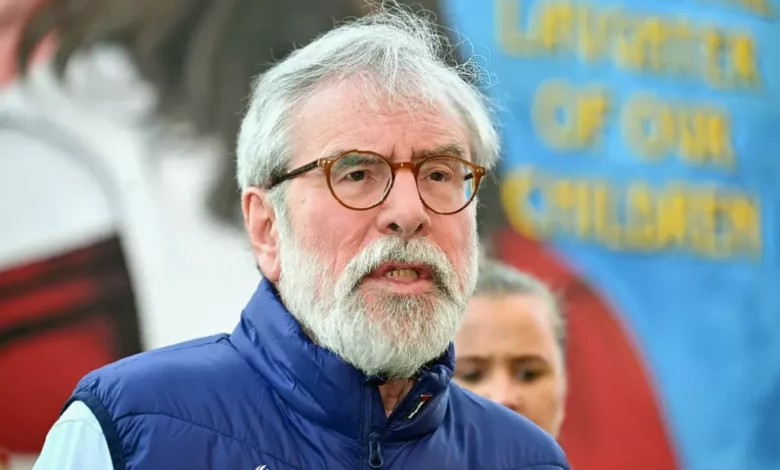
Adams: “A show trial”
Gerry Adams welcomed the discontinuation, stating the case “should never have been brought” and labelling it a “show trial.” He attended court, he said, out of respect for the victims. Mr Adams has consistently denied ever being a member of the IRA or its Army Council, and denied any involvement in or advance knowledge of the bombings. He has never been found guilty of IRA membership.
His legal history includes having convictions for attempting to escape jail in the 1970s quashed by the UK Supreme Court in 2020, and winning a libel case against the BBC in 2025 over allegations he authorised the killing of an informant.
Broader context of unresolved legacy
The case unfolded against the fraught backdrop of dealing with the legacy of the Troubles, the conflict which claimed over 3,600 lives before largely ending with the 1998 Good Friday Agreement, which Mr Adams helped to broker.
It also intersected with the controversial Northern Ireland Troubles (Legacy and Reconciliation) Act 2023. That legislation, which aimed to halt most legacy inquests, civil cases, and prosecutions, has been ruled by courts in Northern Ireland to breach human rights obligations and is also subject to a challenge by the Irish government. A proposed Remedial Order in December 2024 included provisions to reinstate civil proceedings, highlighting the ongoing political and legal turbulence surrounding how to address the past.
The discontinuation of this high-profile claim underscores the complex legal and financial barriers facing victims seeking accountability through the courts, even as the political structures designed to address the Troubles’ legacy remain deeply contested and unresolved.