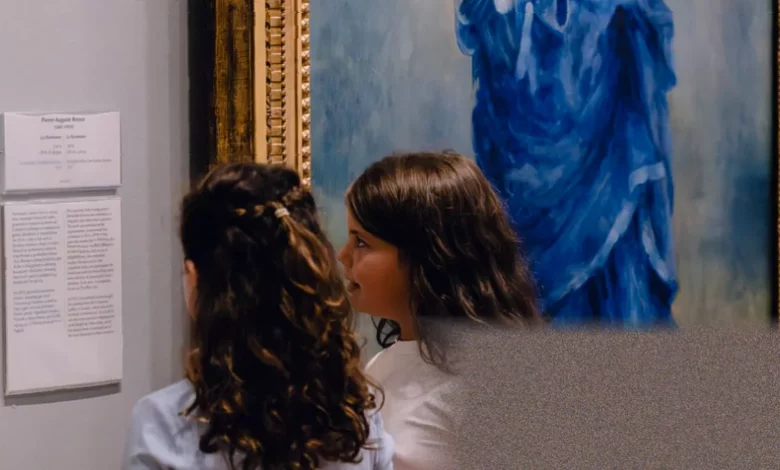
A three‑year‑old girl peered at a J.M.W. Turner seascape in the National Museum Cardiff and announced, without hesitation: “A fish.” Her father, Neil Osborne, had brought Daisy for their second visit to the museum. She adored the dinosaur galleries downstairs – “more kid‑friendly”, he said – but the quieter upstairs art rooms had a different effect. “She actually started whispering when we got up here,” Osborne said. “She likes seeing the paintings and saying what they look like.” The foaming waves crashing against a cliff, rendered in Turner’s characteristic broad brushstrokes and dazzling light, had become a fish in Daisy’s imagination. For her father, that was the point.
Osborne is not alone among parents who wonder whether a gallery visit for a child under five can be something more than a way to kill an afternoon. Emma Kempster, a former NMC employee, regularly brings her son Sebby. “We start with the dinosaurs and natural history, then he likes to see the paintings to finish,” she said. Like Daisy, Sebby seemed to notice the shift in atmosphere upstairs. “I think he finds it a bit spooky because it’s quieter than the other spaces, but he also seems to like the change of scene. We look out for dogs in the paintings, things like that.” When asked whether the trips were about fun or learning, Kempster smiled. “It’s more about fun right now. Though, I mean, he is a brilliant artist.”
Rhian Evans first brought her daughter Cari to the museum when Cari was a baby. “I was worried about coming before, but now I know it’s well set up for kids,” she said, pointing to one of the creative carts scattered across the galleries – trolleys packed with paper, pencils, bilingual books and soft toys. “I’d like her to start saying certain words: animals, colours. We come and point out things in the paintings in the same way we do at home with books.” Evans contrasted the museum with play cafes, which often charge entry. “If we come here I think there’s a chance she’ll learn something as opposed to just throwing balls around.”
‘Every engagement is a learning engagement’
Catrin Rowlands, who spent 24 years as a school teacher before becoming head of learning at NMC, is responsible for making that chance a reality. NMC is one of seven national museums that make up Museum Wales – the largest provider of learning outside the classroom in Wales – and it is committed to welcoming families. Its permanent collection ranges from fossilised bones to Impressionist canvases. “Every engagement with the museum is a learning engagement,” Rowlands said. The museum has a large learning centre – “to the left of the mammoth” – with a play area at one end and a classroom setup at the other.
It is in that learning centre that the “Mini Wonders” programme takes place. NMC is one of fifteen museums across the UK partnering with Art Fund and Nesta on the fully funded, £1 million initiative, which examines how access to art and culture can support child development and increase readiness for school. Families from disadvantaged backgrounds with children aged between two and four are invited to take part in a free eight-week course designed to make parents and children feel comfortable in the museum and encourage repeat visits – much like a local library. The programme is halfway through a two‑year research and development journey, with the ultimate ambition of creating a scalable, evidence‑informed model that can unlock the social value of museums for more families.
Each child in Mini Wonders is given a digital camera. By the end of the course they have a scrapbook of photographs, documenting their own journey through the museum’s collections. Once they are comfortable in the learning centre, they are encouraged to venture out into the galleries. The programme blends creative, playful family experiences with evidence‑based parenting strategies: naming and expressing feelings, giving praise, and emphasising the importance of routines. Art, Rowlands said, “invites children to explore and discover a vibrant and colourful world which is both entertaining and a foundation for early and lifelong learning”.
“Introducing art for under‑fives is as much about capturing their imagination as it is about learning – a space where wonder, surroundings and play spark curiosity before the formal structure of a traditional school setting,” she added. The Clore Discovery Centre, an interactive gallery filled with hundreds of touchable objects from the museum’s collection, is another dedicated space for hands‑on exploration. Alongside Mini Wonders, NMC runs Family Saturdays – monthly themed sessions such as “Dino Discovery Day” and “Under the Sea” – and “Little Museum Explorers”, a one‑hour session for one‑ to five‑year‑olds in the Clore Discovery Centre where children can even try sorting objects like a curator. For the very youngest, “Babis Bach Babies” combines live music with interactive storytelling in English and Welsh, supporting early‑years language learning. These sessions are described as “relaxed” and suitable for children with autism, sensory sensitivities or learning disabilities. NMC also works with partners including Flying Start, Ty Hafan and the Welsh Refugee Council to support families facing barriers to accessing the museum.
Throughout the year, special events target toddlers. Free sketching classes take place in the galleries. In April, an early‑evening event of music and storytelling beneath a sculpture of the moon in the main hall encouraged language learning in both Welsh and English. At the end of May, a paint‑along inspired by Gwen John’s love of cats will take place – John, a British painter celebrated for her serene depictions of felines, was the subject of a recent exhibition at NMC marking her 150th birthday. The museum’s creative carts – with paper, pencils, bilingual books and soft toys – are left unsupervised. “We’re not policing these little trolleys, and we just replenish them if something ends up going home,” Rowlands said. “It’s part of the memory, isn’t it?” She widened her eyes. “Not that we’d encourage that!”
Other museums across the UK are running similar initiatives as part of the same Mini Wonders partnership, including the Young V&A in London, the Hepworth Wakefield, and the Ashmolean Museum in Oxford. Research suggests that museum visits can develop transferable skills such as observation, visual literacy and creative thinking – all of which are valued in higher education and the workplace. Art helps children identify colours, shapes and patterns, complementing literacy and numeracy. It provides a risk‑free environment for self‑expression, building confidence and emotional literacy. Children who experience museums with their families are more likely to become future visitors, making informal learning programmes like Mini Wonders crucial for fostering a lifelong interest in culture.
Neil Osborne watched his daughter Daisy stare at Turner’s waves and call them a fish. “She likes seeing the paintings and saying what they look like,” he said. He asked her what she made of the Turner. She replied: “A fish.”