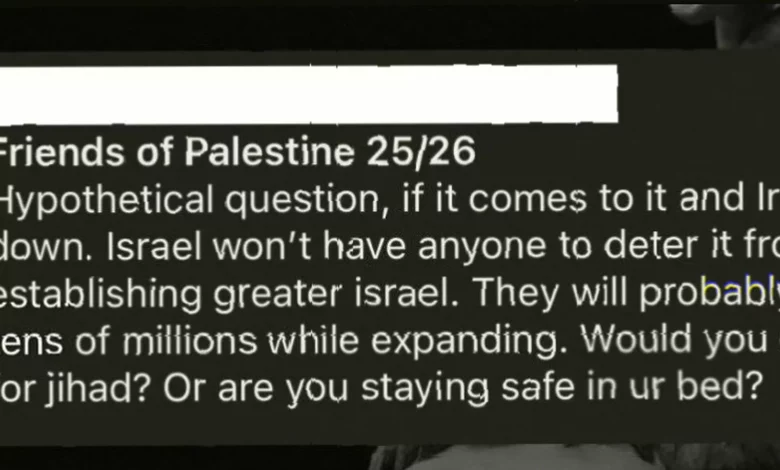
A student society chat at Royal Holloway, University of London became the forum for a stark hypothetical question shortly after the outbreak of war in the Middle East, with members asked if they would “go for jihad” in defence of Iran.
The exchange occurred in the “Friends of Palestine” society’s group chat in the wake of the 2026 Iran War. One member, framing Israel as a “rabid dog that needs to be put down”, posed a scenario where a defeated Iran could no longer deter Israeli expansion. “Would you guys go for jihad? Or are you staying safe in your bed,” they asked. The term ‘jihad’, meaning ‘struggle’ in Arabic, carries complex religious interpretations but in this context appeared to invoke armed conflict.
The question prompted immediate caution from another participant, who replied, “Imma say don’t answer that here,” with a following message agreeing, “Makes sense.” The original query was later edited, replaced with a question about going to eat ‘dolma’, a Middle Eastern dish. Other chat messages saw members downplaying reports of the death of Iran’s Supreme Leader, Ayatollah Ali Khamenei—who was reportedly killed in a US-Israeli airstrike on 28 February 2026—with one suggesting “the Jews” were “spreading panic” and another claiming the leader was “most likely fine”.

‘An environment where people can reasonably feel intimidated’
For Jewish history student Evaldas Barstys, the chat logs reveal a disturbing climate. “I don’t believe you need to be Jewish to feel uneasy or unsafe after reading messages like these,” he said. He highlighted the involvement of the Islamic Revolutionary Guard Corps (IRGC), the powerful Iranian military force established to safeguard the regime. The IRGC, a major funder of Hamas and Hezbollah, is designated a terrorist organisation by the US but is not proscribed as such in the UK, a point of ongoing political debate.
“When students openly express sympathy for such a regime in a university setting, it creates an environment where people can reasonably feel intimidated or at risk, regardless of their background,” Barstys stated. He found the cautionary reply to the jihad question particularly telling, noting the word “‘here’ seemed to imply that the issue wasn’t the content itself, but rather that it shouldn’t be discussed in that specific group chat”.
Barstys contrasted the university’s response to these messages with its handling of a separate incident involving Brodie Mitchell, a second-year politics student. Mitchell, who identifies as a non-Jewish Zionist, faced suspension and a police investigation after a confrontation at the Freshers’ Fair with Huda al-Jamal, president of the Friends of Palestine society. Mitchell commented that al-Jamal’s keffiyeh looked like a “kitchen towel”, a remark he later called “poorly expressed and inappropriate” but intended as political, not racial. He is now suing the university, alleging unfair disciplinary action, with a High Court hearing scheduled for June.

This, Barstys argues, illustrates a “two-tier reality” on campus. He decried a situation where discussion of going for “jihad” is met with “crickets”, while a “light-hearted response to antisemitism results in immediate suspension and potential charges”. He added, “Universities scream about ‘safe spaces’ while student societies openly push antisemitic tropes.”
University investigation and policy framework
In response to the reported chat messages, a spokesperson for Royal Holloway said: “We are aware of the claims being made and they will be investigated through the appropriate channels. We are not in a position to comment further at this time.” The university, like all UK higher education institutions, operates under the Prevent Duty, a legal requirement to have policies to prevent people from being drawn into terrorism.
A spokesperson for the university’s Friends of Palestine society defended the chat’s discussions. “This hypothetical was immediately debated by other members of our group chat, as have hundreds of differing opinions that have been challenged in academic ways,” they said, citing a “belief in the British values of free speech”. They added: “Hate speech has never and never will be accepted in our society.”
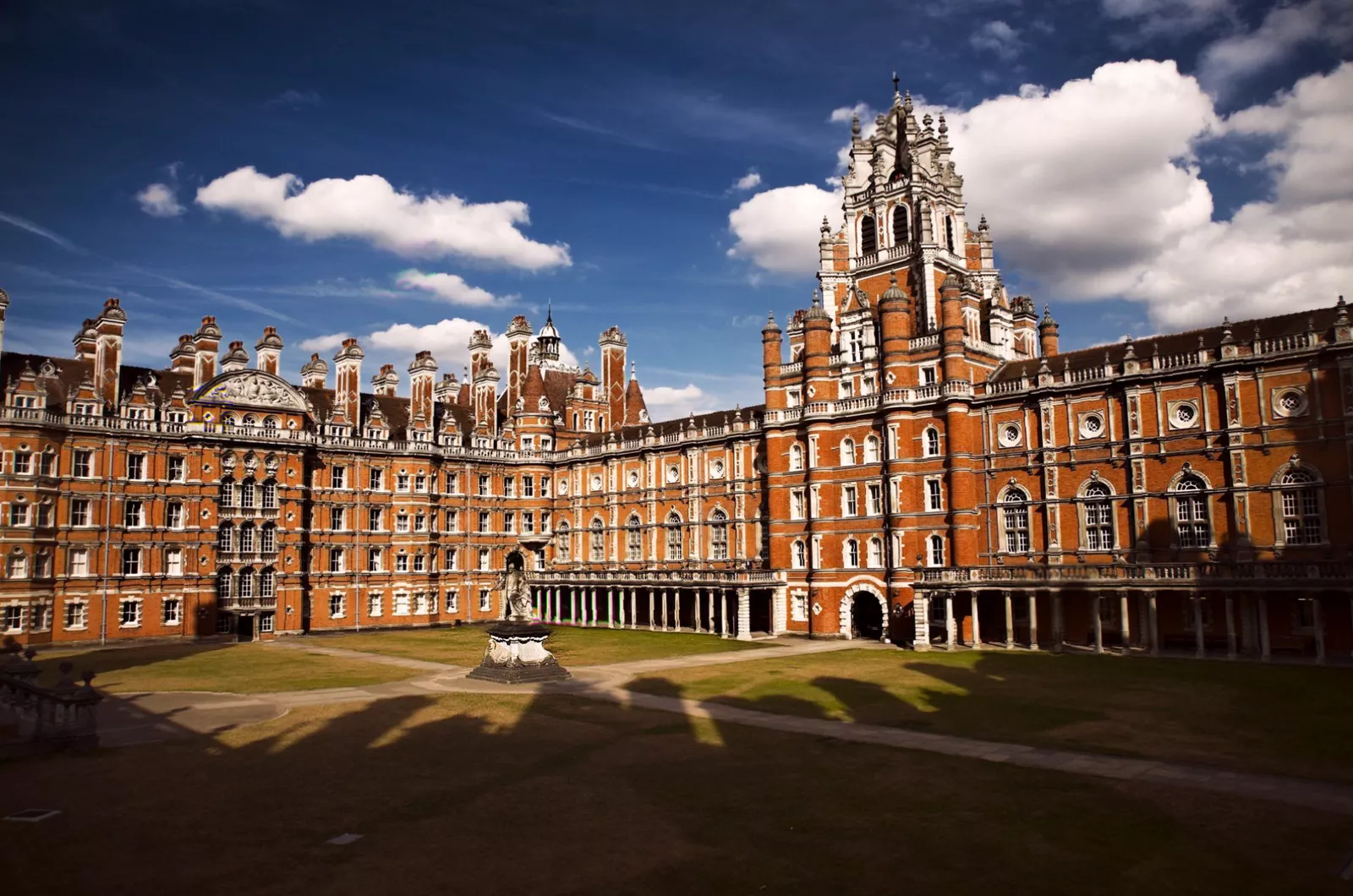
The incident occurs against a backdrop of existing tension; in mid-2025, the same society petitioned against the ratification of an Israel Society at Royal Holloway, gathering over 800 signatures, though the bid was unsuccessful.
A Department for Education spokesperson said: “Extremism and intimidation have no place in our universities – we are committed to protecting free speech, but that does not mean the freedom to incite hatred.” The spokesperson pointed to strengthened measures to monitor universities’ Prevent duties, the legal framework for preventing radicalisation. The government is also developing a “Campus Cohesion Charter” to set clearer expectations for conduct and shared values in higher education.