School playground now usable after severe flooding transformed by rain gardens
For years, the play area at St John’s Church of England primary school in Barnet, north London, was so badly flooded that children could not even be dismissed from the tarmac. The school sits in a natural basin with clay foundations, causing rain to pool on the grey surface and sit there for days. “It would get so bad that the children couldn’t be dismissed from the playground,” said Macci Dobie, the headteacher. “We had to dismiss them from different parts of the school or, literally, parents were stepping into puddles to lift their children out of the classroom.”
That began to change when Sarah Taggart, a parent governor, spearheaded the school’s climate action plan. Recognising that St John’s lies in a high flood-risk area, Taggart secured funding from the Department for Education for a larger project to rip up some of the impermeable tarmac. She enlisted Trees for Cities, a charity that specialises in transforming urban school grounds into climate-resilient spaces, to design and install a sustainable drainage system.
How the rain gardens work
The centrepiece of the transformation is a series of rain gardens – planted beds that function as a sustainable drainage system (SuDS). Alfie Davies, the landscape architect at Trees for Cities who led the design, said the key was to balance function with play. “You’re taking space away from the kids, but kids are kids, it’s got to be functional,” he said. “They have to be able to use it or otherwise they won’t be interested or won’t want to look after it.”
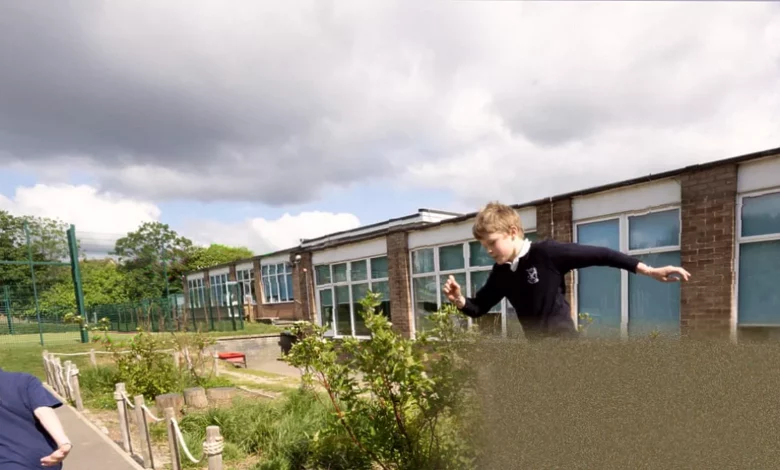
Davies installed stepping logs that run through the rain gardens, allowing children to jump over the planting beds. The beds themselves contain ornamental grasses, shrubs and perennial flowers, designed to absorb and filter rainwater. “It’s transformed our area outside,” said Dobie. “There is still some excess water when it rains heavily, but it clears up in 10 minutes.”
The system is tailored to both the topography of the site and the broader challenges of heavier rainfall and hotter summers driven by the climate crisis. Among the plants selected is a bird cherry tree, a native species that tolerates waterlogged ground but is also drought resistant. Davies emphasised that the gardens also help mitigate the urban heat island effect, which intensifies summer heatwaves in built-up areas. London experiences a significant urban heat island effect, with materials like concrete and metal trapping heat, and studies have shown that children in inner-city schools are particularly vulnerable.
Trees for Cities has worked with more than 200 schools across UK cities through its “Trees for Schools” programme, which aims to create “Healthy Playgrounds” by introducing trees, forest gardens, and wildlife habitats. The charity’s work addresses flooding, urban heat, and declining biodiversity. The Department for Education’s Sustainable Drainage Systems (SuDS) in Schools initiative provides up to 50% of project costs for schools to install such systems, with successful applications required to demonstrate wider benefits such as improved access to green space and reduced inequality.
In Barnet, the council has already invested in flood alleviation, including a £500,000 scheme at Friary Park that created a wetland and ponds, and a £1.3 million Sustainable Urban Drainage Scheme at Halliwick Recreation Ground. Councillor Alan Schneiderman, Cabinet Member for Environment & Climate Change for Barnet Council, has said the authority is committed to minimising the impact of changing weather patterns.
The bigger picture: protecting children from extreme heat
The project at St John’s is part of a wider recognition that school playgrounds need to adapt to a warming world. In 2024, the United Nations issued a call to action on extreme heat that specifically demanded children be protected from heat stress, noting that their developing physiological systems make them more vulnerable than adults. Paris has run its Oasis Schoolyards programme since 2018, transforming asphalt playgrounds into green, climate-resilient spaces that also serve as public cooling areas on weekends. In 2020, the Standards Council of Canada published a report on thermally comfortable playgrounds, urging planners to adopt climate-responsive design.
At St John’s, the impact has been immediate. Pupils no longer endure “wet breaks” stuck inside. “We used to have wet breaks where we had to sit inside the classroom and just draw,” said Juliet, a pupil. “But now because of the rain gardens, you get to have more play. It affected our learning as well because when you’re stuck inside, your brain gets all wrong, but when you go outside it makes you feel better.” Another pupil, Ronnie, said: “It’s put the joy levels up of the school. It’s prettier and calmer; the nature environment, that’s what you feel around it.”
Educational benefits built into the design
Trees for Cities runs a year-long engagement programme with schools after the playground remodelling, linking science lessons directly to the new outdoor space. Grace Walker, a senior landscape architect at the charity, said children study the water cycle, how plants support soil infiltration, and why the drainage system was built the way it was. “They will look at everything from the water cycle, how it supports the plants and infiltration of the soil itself to the actual implementation of why we’ve done things on these sites,” she said.
At St John’s, the pupils have been watering the rain gardens during warmer months and going on tree identification walks in a nearby park. The school already has its own pupil-led climate action plan, which focuses on reducing emissions, improving energy efficiency, and fostering a culture of sustainability, and has achieved the Eco-Schools Green Flag Award with Distinction. Sarah Taggart, whose four children have all attended St John’s, said the legacy aspect has been special. “The year 5s have been doing a project about pollinators and bees this term and it’s great because they can see it happening in their playground.”
Davies added: “Engaging the kids is probably the most valuable thing we do. The kids love it. They want to be outside, looking at plants. They might be a bit weirded out looking at worms, at first, but they love it.”