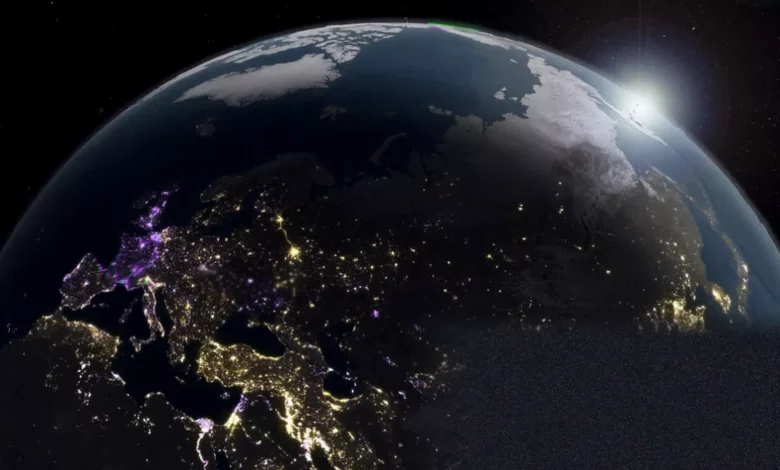
Earth’s nights are getting steadily brighter, with a significant net 16% increase in artificial light between 2014 and 2022, according to a major new analysis of satellite data. Yet this global figure, tracked by researchers at the University of Connecticut (UConn), paints a deceptively simple picture, concealing a volatile and flickering human story of growth, collapse, policy, and conflict playing out in real-time across different continents.
A Dynamic and Flickering Planet
The research, published in the journal Nature and supported by NASA, processed over 1.1 million daily images from the space agency’s Visible Infrared Imaging Radiometer Suite (VIIRS). Zhe Zhu, director of UConn’s Global Environmental Remote Sensing Laboratory and a co-author of the study, described the methodology as akin to giving satellites “smart glasses” to filter out moonlight and clouds, allowing detection of the finest changes. “It is a dynamic portrait of a species reshaping its environment in real time, building, destroying, conserving, and collapsing, often all at once,” he said. “The world is not simply getting brighter. It is flickering.”
This detailed approach revealed that a substantial 34% overall rise in global radiance was partially offset by pronounced dimming in specific regions. The trend continues a pattern identified in a 2017 study, which found Earth’s lit areas grew by about 2% annually in the preceding five years, but the new data exposes far greater complexity and regional volatility.
Regional Stories: Bright Growth and Deliberate Dimming
Asia led the world in brightening, with night-time light surging in China and northern India alongside relentless urban development. In the United States, a 6% net increase masked a clear east-west divide: West Coast cities glowed brighter with growing populations, while parts of the East Coast and Midwest dimmed, a shift researchers linked to the widespread adoption of energy-efficient LEDs and broader economic restructuring.
Europe presented the most striking contrast. The continent as a whole dimmed by 4%, driven by stringent efficiency regulations and energy-saving initiatives. France experienced a 33% reduction in night-time light, aided by measures like switching off streetlights late at night. The UK and the Netherlands saw dimming of 22% and 21% respectively. This trend accelerated sharply in 2022 during the regional energy crisis triggered by the Russia-Ukraine war, which left “visible signatures” of conflict in the form of dramatically reduced lighting.
Elsewhere, the causes of dimming were more tragic. Venezuela lost more than 26% of its night-time light amid a catastrophic economic collapse, with studies correlating the loss of urban illumination with the country’s plunging oil production and exchange rates. Similarly, conflict drove drastic reductions in Yemen, Afghanistan, and Lebanon. In Ukraine, the national night-time light area fell by 50% in the first week of the full-scale invasion and 75% by the fifth week, a stark satellite indicator of widespread destruction and disruption.
The Volatile Drivers: Pandemic, Policy, and Economic Shock
The volatile changes observed over the nine-year study are attributed to a confluence of three major factors: the Covid-19 pandemic, light pollution regulations, and acute economic pressures.
The coronavirus pandemic caused a temporary but detectable dimming in many areas through lockdowns, reduced industrial activity, and the near-total collapse of tourism. Studies in cities like Granada, Spain, recorded decreases in light pollution during lockdown periods, though researchers note that satellite passes late at night may not have captured the full scale of changes in human activity.
Deliberate policy, particularly in Europe, has proven a powerful counter-trend to global brightening. Energy efficiency directives and local measures to reduce skyglow have successfully lowered emissions, demonstrating that regulatory action can directly alter the planet’s night-time footprint.
Finally, economic shocks—from Venezuela’s collapse to the energy crisis in Europe—are immediately visible from space. These events suppress lighting demand and capability, creating sudden, steep declines in radiance that offset growth elsewhere, contributing to the planet’s uneven, flickering glow.
The Flaring Signature of a Boom
The study also lifted the lid on a significant source of light unrelated to urban illumination: the intense, cyclical burn-offs of natural gas, known as flaring, from US energy fields. Satellite imagery revealed these flaring hotspots over central US regions, particularly the Permian Basin in Texas and North Dakota’s Bakken Formation, coinciding with a period of record domestic oil and gas production.
Deborah Gordon, senior principal of the Rocky Mountain Institute’s climate intelligence program, emphasised the value of this public data. “Understanding where gas is being wasted around the globe, and to have this data be public, is huge for energy, and economic and environmental security,” she told NASA. The research provides a tool to hold operators accountable for this wasteful and polluting practice.
Scientists warn that the ongoing brightening trend has profound ecological consequences, disrupting nocturnal ecosystems, animal migrations, and human circadian rhythms. The data, now capable of capturing fine-scale and short-term changes, serves as a powerful tool for verifying policy impacts, tracking economic stability, and assessing the immediate human and environmental cost of conflict.