A tracking device fitted to the humpback whale known as Timmy has failed, leaving marine biologists and rescue coordinators unable to determine the animal’s whereabouts or condition three days after its release into the North Sea.
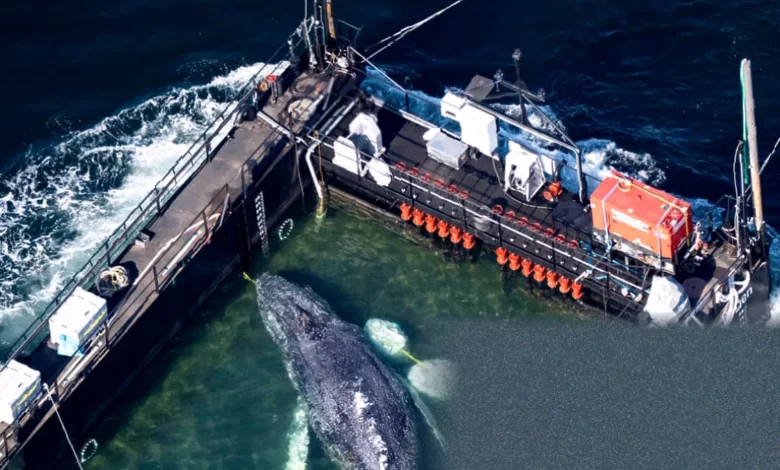
The young male whale was transported from Germany’s Baltic coast on a water-filled barge towed by a tugboat and released off the Danish port of Skagen on 2 May. But the GPS tracker, which its backers claimed would also transmit the whale’s vital signs, is no longer functioning, according to Karin Walter-Mommert, one of the multimillionaire funders of the rescue. She confirmed the failure to German media on Tuesday.
The lack of data has prompted fierce criticism from whale experts, who argue that the entire €1.5m (£1.3m) operation may have been pointless. “If it turns out that device doesn’t yield any information, it would be an all-round catastrophe, for the whale and the rescue team,” said Fabian Ritter, a whale researcher with extensive experience at the International Whaling Commission (IWC). He added that if it is impossible to determine whether the whale died, the intervention will have been in vain.
Tracker failure and disputed capabilities
Walter-Mommert had previously claimed the tracker would monitor the animal’s heart rate and other physiological indicators. That assertion was disputed by experts and environmental activists, including Greenpeace. Danish marine biologist Peter Madsen told the German Press Agency that no commercially available GPS transmitter can provide a whale’s vital signs, and that such claims are untrue. “It appears data was being guarded by a small group of people, including the initiators of the operation and the environment ministry for the state of Mecklenburg-Vorpommern,” Madsen said, calling the situation “very strange and unprofessional.”
Neither the private rescue initiative nor the state environment ministry responded to requests for information about which tracking device was used. The ministry said it was still waiting to receive data from the operation, along with any information about the whale’s condition. Without that data, experts cannot assess whether Timmy survived the journey, is able to feed, or has fallen victim to the low-salinity Baltic waters that are not a natural habitat for humpback whales.
The whale was first seen near Germany’s Baltic coast on 3 March, then stuck on a sandbank near Lübeck on 23 March. It freed itself but became stranded repeatedly in shallow waters near the city of Wismar. Its health deteriorated as unsuccessful coaxing attempts were livestreamed around the world. The environment minister for Mecklenburg-Western Pomerania, Till Backhaus, gave the green light for the private rescue despite warnings from the scientific community.
After Danish authorities said they would make no attempt to rescue the whale if it was again found in difficulty—arguing nature should take its course—the mammal was last photographed swimming in the Skagerrak strait. Its fate remains unknown.
Expert criticism and controversy
The German Oceanographic Museum in Stralsund said it believes the whale is “highly likely” dead and called on organisers to release tracker data so the operation can be assessed. Its director, Burkard Baschek, described the intervention from the outset as “pure animal cruelty,” stressing the likelihood that the whale would drown if it was not strong enough to swim in deep waters. The IWC had also criticised the rescue attempts as “inadvisable,” warning that the whale was severely compromised and that stress from the operation offered little ultimate benefit.
Tensions within the rescue team have also come to light. Veterinarian Kirsten Tönnies, who was on board one of the rescue ships, the Fortuna B., said she was barred from witnessing the final release attempts and disagreed with the decision to release the whale backward from the barge without her medical all-clear. Another veterinarian, Dr Jenna Wallace, reportedly left the operation earlier, citing bad decisions and interference from individuals she described as having an “ego” over the whale’s wellbeing.
The ship’s operators could not be reached for comment, and the Fortuna B.’s tracking signal appears to have been switched off, according to authorities and vessel trackers. In a joint statement, financiers Walter-Mommert and Walter Gunz, co-founder of a leading electronics chain, distanced themselves from the manner of the release. “We hereby expressly distance ourselves from the events and the manner in which the whale was abandoned,” they wrote, calling for “any consequences” to be borne “by the owner, the operators, and any crew members of the ships Fortuna B and Robin Hood.”