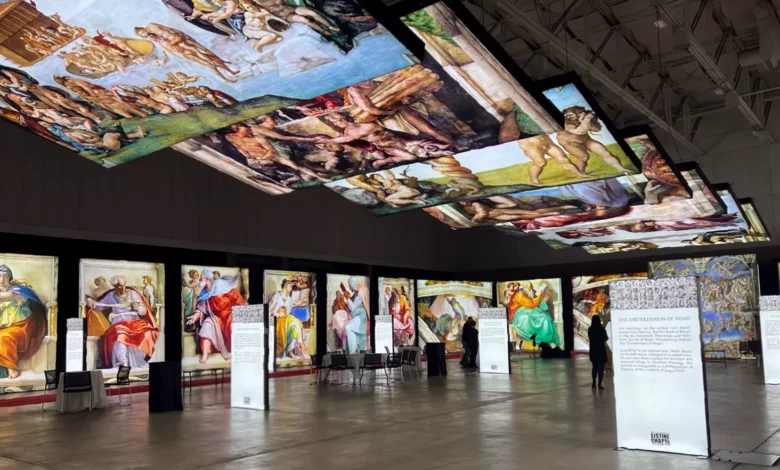
London will host a replica Sistine Chapel exhibition this summer, offering visitors the chance to see Michelangelo’s frescoes from just feet away — a perspective impossible in the Vatican. The exhibition, titled Michelangelo’s Sistine Chapel: The Exhibition, runs from 18 May to 6 September 2026 at 1 America Square, a recently refurbished office and venue space a few minutes’ walk from Tower Hill tube station.
Presented by SEE, the exhibition features full-scale, highly detailed canvas reproductions of all 34 frescoes from the chapel ceiling. Unlike projection-based alternatives, these are physical reproductions created using “cutting-edge technology, professional expertise and special printing techniques,” according to the organisers. Visitors can examine the artworks from a few feet away, revealing intricate details — such as the strain in Adam’s hand or the delicate folds of drapery — that are often lost when viewed from the chapel floor. The reproductions are displayed at eye level and overhead, designed to be an immersive experience that lets people “step inside” the masterpiece.
The close-up vantage point is a deliberate selling point, but the organisers acknowledge that Michelangelo never intended his frescoes to be seen that way. The artist painted the ceiling between 1508 and 1512 for Pope Julius II, working from an extensive scaffold in a physically demanding position, often craning his neck. Using the buon fresco technique — painting on wet plaster — he completed the work in just four years. The ceiling itself measures approximately 40 metres long and 13 metres wide, covering around 500 square metres, with nine scenes from the Book of Genesis at its centre, surrounded by figures of Prophets, Sibyls, ancestors of Jesus and the Ignudi (naked youths). Michelangelo later added The Last Judgment on the west wall behind the altar, painted between 1534 and 1541 for Pope Paul III. The frescoes are considered among the greatest achievements of Western painting, celebrated for their dramatic storytelling and revolutionary depiction of the human form — remarkable given that Michelangelo considered himself primarily a sculptor.
The exhibition venue, 1 America Square, sits in the heart of the City of London. The building’s recent refurbishment includes eight flexible rooms, with the largest holding up to 270 people theatre-style and space for up to 18 exhibition stands. A unique feature is the historic Roman London Wall that runs through the venue, providing a distinctive backdrop. The space is fully accessible, with wheelchair-friendly entrances, facilities, restrooms and lifts to all rooms. Nearby attractions include the Tower of London, All Hallows-by-the-Tower church, HMS Belfast and the Monument, as well as further remnants of the Roman London Wall. The nearest tube stations are Tower Hill (Circle and District lines), Aldgate (Metropolitan and Circle), Fenchurch Street (National Rail) and Liverpool Street (Central, Metropolitan, Circle, Hammersmith & City).
Tickets are priced at £19.50 for adults, £13.50 for children aged 8–15, and £15.50 for concessions. Some sources note peak and off-peak pricing, with peak tickets at £19.50 and off-peak at £17.50 — a figure comparable to the €20 admission fee for the original Sistine Chapel. Tickets are available to purchase now. The exhibition has previously toured internationally, with stops in Sydney, Shanghai, Chicago, Vienna, Berlin, Melbourne and other cities, and now brings a rare close-up view of the frescoes to London.
A chapel-like alternative — Goring-by-Sea
For those who prefer to see the Sistine Chapel in a more chapel-like setting, a full replica exists in Goring-by-Sea, West Sussex, a relatively cheap train ride from central London. The replica is housed at English Martyrs’ Church, a Roman Catholic parish church consecrated in 1970. The exterior is a functional 1970s rectangular edifice, but inside the ecclesial character is unmistakable thanks to the painted ceiling.
The replica was created by Gary Bevans, a sign-writer and parishioner, who was inspired after visiting the Sistine Chapel in Rome in 1987 and noticing that the width of the Vatican chapel matched that of his parish church. He began the project that year and completed it in 1993, working evenings and weekends alongside his full-time job — a total of five and a half years. The replica is painted in acrylic on plywood panels, which were attached to the church’s vaulted wooden ceiling. The painted surface covers approximately 325 square metres (3,500 square feet), about two-thirds the scale of the original, and the colours are said to match the newly cleaned ceiling in Rome. Parishioners helped finance the project by “adopting a panel”.
This is described as the only known reproduction of Michelangelo’s Sistine Chapel ceiling in the world. A previous replica in France was whitewashed. The church is typically open from Easter to the end of October, with specific weekday hours, and visitors are advised to contact the church in advance due to possible closures for services. It is far easier to visit than the original in Rome, and less crowded — and, crucially, it is free to enter.