Guardian readers have saved Cornish boat engineer Steve Green’s mission to haul rotting, abandoned fibreglass yachts out of Cornwall’s secret creeks. “We are still pinching ourselves,” Green said, sounding emotional. “It’s beyond comprehension. Guardian readers have saved us. They really have.” Within an hour of a story about his work appearing on the Guardian website, donations began pouring into his crowdfunder and have not stopped. The pot now stands well over £23,000, with individual gifts ranging from £2.50 to £1,000.
Many donors sent personal messages of thanks and encouragement. One donor, Dan, wrote: “Read about you in the Guardian. A proper hero.” A pensioner in middle England said: “Just read about your beautiful project in the newspaper. You give me joy in my heart with your brave endeavours.” Others who had holidayed, sailed or paddled in Cornwall’s waters wanted to see the rivers protected. “Great work cleaning up the creeks I spent my childhood on, so glad someone cares enough to be doing something about it,” one wrote. Even readers who had never visited Cornwall were moved to help. A donor called Liz, from the Yorkshire coast, said: “To my shame I had no idea what happened to unwanted boats.”
The environmental toll of forgotten yachts
The abandoned boats Green targets are far more than an eyesore. The 166 forgotten fibreglass yachts he aims to remove from the Helford and Fal rivers leak toxins – fuel, oil and anti-fouling paint – into the water. More insidiously, as the fibreglass degrades, it releases microscopic shards. Marine biologists have compared these “javelins” of fibreglass, found embedded in the flesh of sea creatures near wrecks, to the noxious fibres of asbestos.
Dr Corina Ciocan, a marine biologist at the University of Brighton, has researched the problem extensively. Her work found more than 11,000 shards of fibreglass per kilogram of oyster in Chichester harbour. She argues that abandoned boats should be classified as hazardous waste and that boat builders should have a duty of care for their products at end of life. The issue is not confined to Cornwall. The boom in fibreglass boat construction in the 1960s and 70s means many of these vessels are now reaching the end of their lifespan. Unlike wood or steel, fibreglass does not decompose easily, and the UK has no comprehensive plan for dealing with the growing stock of end-of-life boats. With no requirement to licence a boat in coastal waters, owners can simply abandon a yacht and disappear.
The scale of the problem is vast: more than a million boats are owned by UK households, raising acute concerns about their eventual ecological impact. Across the country, harbour authorities have some powers under the Merchant Shipping Act 1995 and the Harbour, Docks and Piers Clauses Act 1847 to remove abandoned vessels that pose a danger or obstruction, but the process is costly and time-consuming. Falmouth Harbour, for instance, can remove abandoned boats but must cover the cost from harbour revenues. France has a more established system, with free-to-use scrappage yards and a national boat registration scheme funded by a producer levy and annual boat tax – a model that has led to the dismantling and recycling of thousands of vessels.
One man’s crusade with a camper van called Cecil
Steve Green, a boat engineer, runs a tiny non-profit organisation called Clean Ocean Sailing with his wife, Monika Hertlova. They have been active since at least 2017, originally collecting plastic waste from coastlines using their restored 113-year-old schooner The Annette – a former Dutch icebreaker that children call a pirate ship and that Green has lived on for nearly two decades. Since 2017, Clean Ocean Sailing has collected more than 55 tonnes of marine litter, much of it recycled into items such as sea kayaks. This work earned the couple a Points of Light award in 2021 from Prime Minister Boris Johnson.
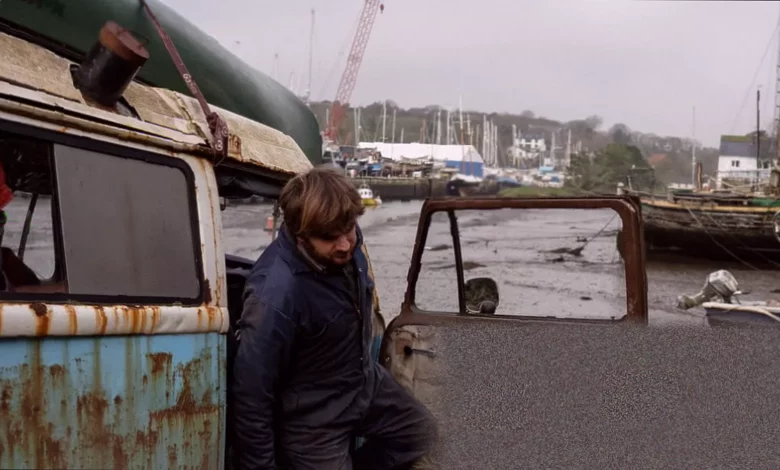
For the yacht removal mission, Green relies on a 1972 Volkswagen camper van named Cecil. Cecil runs on donated chip oil from local pubs, minimising its carbon footprint, and has clocked up nearly one million miles. Green, a mechanic, maintains the van himself. It is equipped with a crane and a winch, making it instrumental in hauling out abandoned boats. Green admits he thinks cars can have a spirit of their own, much like the Herbie films he admired as a child.
Every boat that Green and Cecil drag out costs his organisation between £1,000 and £3,000 to dispose of. The vessels end up in landfill at Truro Recycling Centre – the only scrapyard in Cornwall licensed to recycle old boats, capable of dismantling vessels up to 500 tonnes. Last year, when charitable funding grants fell short, Green ran up £8,000 in debt on personal credit cards to cover the cost of boats he had already towed.
Putting the donations to work
Green has wasted no time in using the flood of donations. He has placed legal notices on about 20 abandoned yachts, giving owners 30 days to come forward and claim them before they are removed. Usually this is a formality. “Most don’t want to be found,” Green said. However, the owner of one 24-foot yacht has already responded, emailing to apologise and explaining it was “a project that went wrong”. That means Green can now start clearing rubbish from the vessel, bailing it out and floating it to a place where it can be winched on to Cecil’s trailer or pulled upstream to Truro by Annie. But the owner is not offering to pay the disposal fees.
A few days after the Guardian story was published, Green assembled what he called “a small army” of local volunteers and pulled seven small boats – including abandoned dinghies – out of the water, knowing that for once he could afford a skip to put them in. “It’s amazing to be able to do that,” he said. “We’ve been so limited in what we could do because of money. Getting stuck in, getting all these wrecks out, is just wonderful.”
The forum Wreck-Free Fal and Helford has been mapping the problem, logging over 130 abandoned boats in the two estuaries. Green’s goal is to remove all 166 from his list. With the crowdfunder now exceeding £23,000, he has the means to make a serious dent in that number. He laughed and then said quietly: “Thank you. It feels like we aren’t doing this on our own any more.”