A decade-long secret revealed: newts discovered in a garden pond. For weeks, the household has been abuzz with the realisation that they have been custodians of palmate newts for far longer than anyone ever suspected. Judging by the numbers present and the age of the pond, the creatures have likely been there for at least ten years. Yet neither the neighbours nor the previous owners of the property had any inkling.
Surprise in the Garden
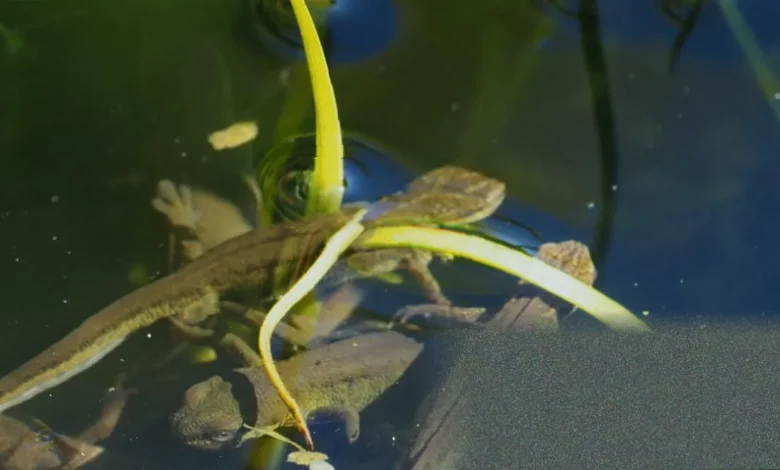
The discovery began with a chance observation. A gloop of air rising at the pond surface caught the eye, prompting a few minutes of scrutiny. There it was: a palmate newt. A hasty purchase of a net followed, and several days later, at the first speculative sweep of the mesh—with which the owner had hoped to catch at least a single example—it came up with nine. The newts have been the talk of the house ever since.
A Creature of Subtle Distinction
The palmate newt (Lissotriton helveticus, formerly Triturus helveticus) is the smallest of Britain’s three native newt species, typically measuring up to 9 cm in length. In terms of scarcity it sits in the middle of the national trio, between the common and the great crested. It is smaller than its relatives, and the male is significantly smaller than his partner. Males also acquire fewer of the extravagant colours or corrugated frills that adorn the tails and mantles of the other species.
During the breeding season, the male palmate newt develops distinctive black webbing on his hind feet—the feature that gives the species its name (“palmate” refers to the webbing between the toes). He also grows a filament at the tip of his tail and a low, smooth crest along his back. His standout detail, aside from the black flanges between the hind toes, is a lovely, intense pale stippling across his face and neck, bordered by a dark eye-stripe.
The female is much harder to distinguish from the smooth newt. A key difference is the throat: palmate newts have an unspotted pink or yellow throat, whereas smooth newts have a spotted throat. The most prominent feature on a female, aside from her swollen, egg-filled belly—200 per mother, apparently—is her incredibly ancient-looking, pale-gingery wrinkled skin. Both sexes have smooth skin, typically olive-green or brownish, with a yellow or peachy-yellow belly that may have small dark spots. A dark stripe often runs along the head and through the eyes.
The larvae, known as efts, hatch with feathery external gills. They grow their front legs first, unlike frog and toad tadpoles. Juvenile palmate newts have a dorsal line running from their neck to their tail, distinguishing them from juvenile smooth newts, which have a dorsal line from neck to front legs.
A History of Overlooking
Perhaps what is most significantly overlooked, in the welter of new newt discoveries, is the central mystery of how the household managed not to see them until now. But then no one had ever, anywhere, recognised a palmate newt until the Swiss naturalist Razoumowski did so in 1787. Nor had anyone knowingly seen one in Britain until 1843, when Bell identified the species after its discovery by a Mr. Baker near Bridgewater in Somerset. Even as late as 1863, some authorities still considered it merely a variety of the smooth newt.
Given this history of obscurity, it is perhaps no surprise that a garden pond could harbour the species unnoticed for a decade. Palmate newts are found across Great Britain—from Scotland down to the south coast of England—but their distribution is patchy. They are absent from Ireland, the Isle of Man, and some Scottish islands. They show a distinct preference for shallow ponds on acidic soils, which is why they are most common on heathland in the south and west of England, and on moorland and bogs in the north. They can tolerate drier conditions and poorer water quality than smooth newts, and are often found further from water during their terrestrial phase. They can even inhabit pools with extreme pH levels.
Outside the breeding season—which typically runs from February to May—they spend most of their time on land, sheltering under logs, rocks, in compost heaps, or in rough grassland, woodland, and hedgerows. They are primarily nocturnal, being most active at dawn, dusk, or on humid nights, and they hibernate over winter, usually from November to late February or March, hiding in damp, sheltered places such as log piles, under stones, or buried in mud.
Their diet is carnivorous: they feed on zooplankton, small crustaceans, freshwater shrimps, water fleas (Daphnia), leeches, caddis fly larvae, frog tadpoles, small worms, slugs, snails, crane flies, mites, and springtails. They are known to exhibit occasional cannibalistic behaviour, preying on smaller newts or even their own larvae. They use a sticky tongue to capture prey, and their vomerine teeth help retain prey while swallowing it whole.
Despite being listed as “Least Concern” globally and in Great Britain by the IUCN, palmate newt populations are thought to be declining nationally due to habitat loss and fragmentation caused by agricultural intensification, development, pollution, and changes in land use. They are protected under the Wildlife and Countryside Act 1981 from sale and trade in any form. Conservation efforts, often led by organisations such as the Freshwater Habitats Trust, Amphibian and Reptile Conservation (ARC), and the Newt Conservation Partnership, focus on creating and restoring ponds and improving terrestrial habitats. Citizen science projects—using platforms such as iRecord, iNaturalist, and Nature’s Calendar—play a crucial role in monitoring populations and gathering distribution data.
As the owner watches clusters of eight or nine palmate newts wafting so elegantly in the misty water column, the reflection that comes to mind is one Henry Miller captured: “The moment one gives close attention to anything, even a blade of grass, it becomes a mysterious, awesome, indescribably magnificent world in itself.”