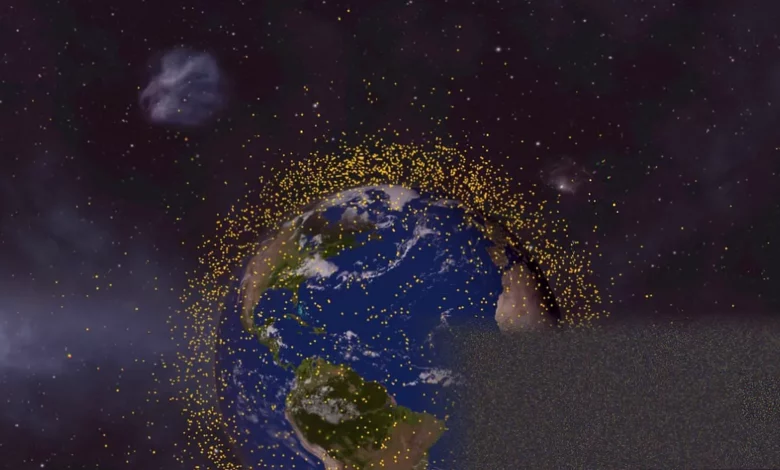
Earth’s orbit, once a vast and empty frontier, is now congested with over 14,000 satellites, a stark symbol of humanity’s rapid transition from space exploration to occupation. This bustling orbital highway, essential for modern life, is becoming dangerously crowded, raising urgent questions about sustainability and safety far above our planet.
The Congested Orbital Environment
The scale of the change is staggering. At the end of 2024, 11,539 satellites were operational in Earth orbit, a dramatic increase from just 3,371 in 2020. In that year alone, a record 259 launches deployed 2,695 new satellites. This explosive growth is set to continue, with projections from Goldman Sachs Research suggesting up to 70,000 low Earth orbit (LEO) satellites could be launched in the next five years, and total new spacecraft potentially exceeding 100,000 by 2030. This surge is driven by a booming commercial satellite industry, which accounted for $293 billion of the $415 billion global space economy in 2024.
Environmental Risks and the Domino Effect
The environmental consequences of this activity are multi-layered and extend beyond mere congestion. The most immediate danger is the accumulation of space debris—defunct satellites, discarded rocket stages, and collision fragments. Over 35,000 objects are currently tracked in orbit, with only about a quarter being active satellites. More critically, the number of debris pieces larger than 1 cm, each capable of catastrophic damage due to their immense speed, exceeds one million.
This debris field has already led to collisions. In 2007, a Chinese anti-satellite weapon test created a dangerous cloud of fragments. Two years later, a collision between a US and a defunct Russian satellite generated nearly 2,000 pieces of shrapnel. The great fear, articulated by scientists, is the Kessler Syndrome: a cascading, domino effect of collisions where each impact creates more debris, triggering further collisions until Earth’s orbit becomes a perilous minefield of high-velocity metal, potentially rendering vital orbits unusable. The United Nations Committee on the Peaceful Uses of Outer Space (COPUOS) has endorsed Space Debris Mitigation Guidelines, but these are voluntary.
Meanwhile, rocket launches are polluting the upper atmosphere. Studies indicate roughly 10% of particles in the stratosphere—which houses the protective ozone layer—now contain metals from space activities. A report from the National Oceanic and Atmospheric Administration (NOAA) suggests a tenfold increase in certain rocket launches could significantly damage the ozone layer and alter atmospheric circulation. Scientists worry this could undermine decades of progress in ozone recovery. Furthermore, the re-entry of thousands of ageing satellites is expected to deposit particulate pollution into the stratosphere at a rate potentially comparable to the natural meteoritic background by 2040.
The proliferation of satellites is also drowning out the stars. Satellite mega-constellations are causing significant light pollution, contaminating images from ground-based observatories and even space telescopes like Hubble. Organisations like the Royal Astronomical Society (RAS) have voiced strong opposition to proposed projects, such as Reflect Orbital’s mirror satellites or potential future mega-constellations, fearing they could permanently brighten the night sky and obscure celestial objects.
Visualising the Problem
To comprehend the scale of orbital congestion, the Guardian developed an immersive interactive visualisation, charting how Earth’s orbit has been populated decade by decade. Ashley Kirk, the visuals editor who oversaw the project, stated the main challenge was sourcing reliable historical and current data, which was cross-checked by renowned astronomer Jonathan McDowell.
Frederick O’Brien, a journalist and software developer at the Guardian, built the interactive piece, which required weeks of work. “This piece reveals a significant problem which, if left unchecked, could disrupt some of humanity’s most important services such as the internet,” says Kirk. The tool makes visible the complex web of over 14,000 individual satellites—each with different heights, speeds, and trajectories—now circling the Earth, upon which we depend for navigation, communication, weather forecasting, and monitoring environmental changes on our own planet.
In response to these mounting challenges, space agencies are developing new strategies. The European Space Agency (ESA) has adopted a “Zero Debris Approach” aiming to limit new debris generation in Earth and lunar orbits by 2030, involving updated design requirements and active debris removal missions like ClearSpace-1. NASA’s Orbital Debris Program Office leads similar research. However, international law lacks explicit provisions for debris removal or object abandonment, highlighting an “urgent need for sustainable practices” as underscored in a recent UN report.