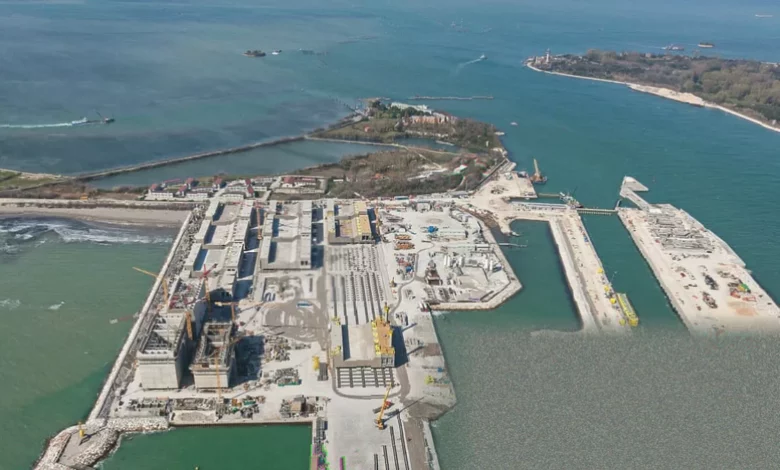
Venice’s celebrated flood defence system, Mose, faces an existential threat from the very crisis it was built to mitigate: rising sea levels. The sophisticated network of mobile barriers, operational for just five years, is at risk of becoming a victim of its own necessity, with climate projections suggesting it could be rendered obsolete within decades.
A Modern Marvel in a Historic Dockyard
For Venetians long plagued by devastating acque alte, or high waters, the Mose system has delivered something close to a miracle. Since its inauguration in October 2020, its 78 massive floodgates have been activated 154 times, successfully shielding the city from flooding. Housed within the historic Arsenale shipyard—where the Venetian Republic once produced a warship a day—the system’s high-tech control room, with its wall of meteorological screens, operates with the precision of a well-oiled machine. The technical director, Giovanni Zarotti, explains the team monitors tides constantly, making the decision to raise the barriers three hours before a forecast flood. “Venetians now take the Mose for granted,” says Zarotti, noting that many no longer even own waders.
This success followed a fraught half-century journey from concept to reality, catalysed by the catastrophic flood of November 1966, which submerged 80% of the city under 194cm of water. The project, whose name stands for Modulo Sperimentale Elettromeccanico (Experimental Electromechanical Module), was delayed for decades by bureaucracy, environmental concerns, and a major corruption scandal. In 2014, the then-mayor, Giorgio Orsoni, was among over 30 people arrested; investigations revealed a network of bribery and cronyism that inflated the final cost to approximately €6 billion, far exceeding initial estimates.
The Climate Crisis Closes In
Yet, despite its operational success, city authorities are already urgently seeking a ‘Plan B’. The accelerating pace of climate change means the barriers must be raised ever more frequently, creating a cascade of economic and ecological problems. Each activation costs upwards of €200,000 and halts maritime traffic through the critical Malamocco inlet to the Marghera port. During the 2024 Carnival alone, 26 activations in three weeks cost over €5 million.
The greater threat, however, is to the delicate lagoon ecosystem. The tides naturally exchange water and sediment between the Venetian lagoon and the Adriatic Sea. When the Mose barriers rise, they block this flow. This stagnation encourages excessive algae growth; as the algae die and decompose, they suck oxygen from the water, killing fish and marine flora. Studies indicate that in the short time since operations began, Mose activations have already reduced vital marsh deposition by up to 12%, threatening the salt marshes that are the lagoon’s lungs. The system may also be favouring the resuspension of sediments and the burying of large canals.
“With a metre more, you would have to close the Mose barriers on average 200 times a year, which means it’s practically always closed,” warns Andrea Rinaldo, head of the scientific committee for the newly appointed Lagoon Authority, which now manages Mose and its future. “When this happens, the lagoon loses its nature of being a transitional environment. It would become a filthy pond.”
Professor Rinaldo, a renowned hydraulic engineer, underscores that this grim future is not distant speculation. Climate projections for Venice indicate a sea-level rise of between 32 and 110 cm by the end of the century under severe scenarios, with some high-end estimates linked to polar ice melt reaching 180cm. A rise of just 22cm by 2050 could triple the frequency of high-water events. This alarming acceleration represents a “death knell for the city,” Rinaldo states, insisting the time for action is now. “We can’t wait.”
Reimagining the Lagoon’s Future
The search for a successor to Mose has begun in earnest. Rinaldo is championing a global call for ideas, seeking proposals from leading thinkers across disciplines from art and economics to history and science. The goal is to fund multidisciplinary teams to devise viable strategies within a year. “Venice is a test bed for how we cope with these systems in the future,” he says, acknowledging the problem cannot be solved by engineering alone.
Scientific studies are already exploring radical alternatives, from constructing ring dikes around critical islands to the permanent closure of the lagoon’s inlets. One proposal involves injecting seawater underground to raise the city’s terrain—a concept that could be less costly than Mose. In the most pessimistic scenarios, the unthinkable option of abandoning the historic city is being considered.
For Rinaldo, any lasting solution must also involve a fundamental reimagining of Venice itself, redirecting its economy away from a reliance on mass tourism, which he sees as a threat comparable to the rising waters. He believes the survival of this “jewel of artistic heritage” depends on this dual approach. The race is on to prevent the very system that saved Venice from contributing to its slow ecological suffocation.