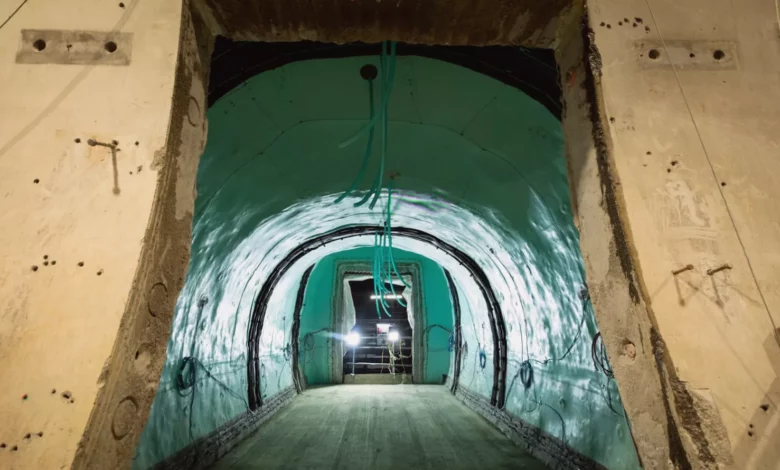
Deep beneath west London, teams of engineers have finished hand-digging 34 connecting tunnels between HS2’s twin railway bores, completing the final passage this week and moving the project a major step closer to commissioning.
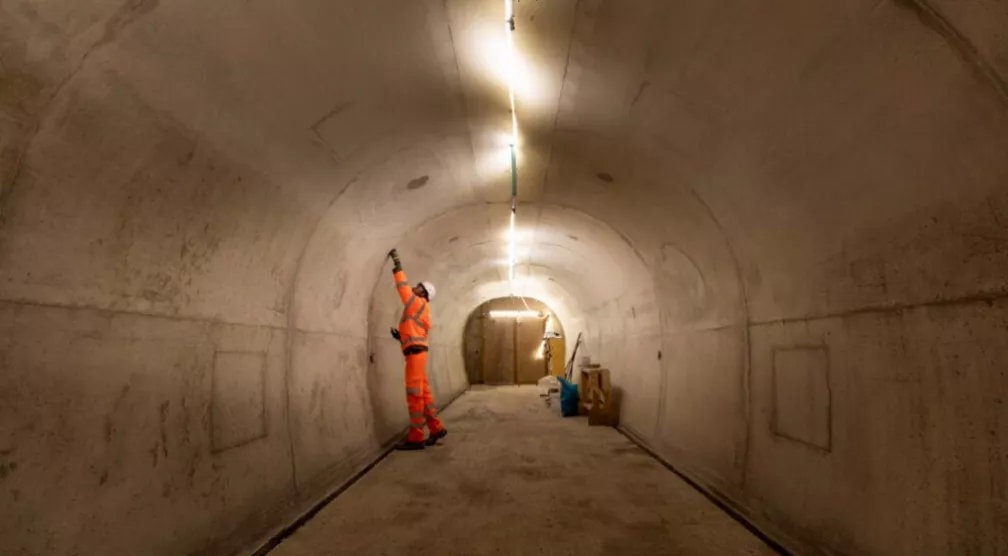
The short tunnels — known as cross passages — are spaced at intervals of up to 20 metres along the 8.4-mile (13.5 km) route from West Ruislip to Victoria Road in Ealing. Their purpose is critical: they provide passenger and staff access between the two main tunnels in an emergency. The passages are typically 15 to 20 metres long and located approximately every 500 metres in bored sections of the line.
The two main tunnels, which run at depths of up to 35 metres, were excavated by four tunnel boring machines (TBMs) — Sushila, Caroline, Emily and Anne — built by German tunnelling specialists Herrenknecht and weighing around 1,700 tonnes each. But the connecting passages could not be dug by the TBMs. Once each TBM had passed through and left a concrete-lined bore, workers broke through the tunnel walls at 34 locations and began digging by hand.
Sprayed concrete lining and the challenge of ground freezing
The cross passages were constructed using sprayed concrete lining (SCL), a technique in which small excavators gradually cut through the ground between the tunnel bores — which are spaced between 6 and 20 metres apart — while freshly exposed surfaces are immediately stabilised with sprayed concrete. Once excavated, each passage is lined with a waterproof membrane and a secondary concrete layer.
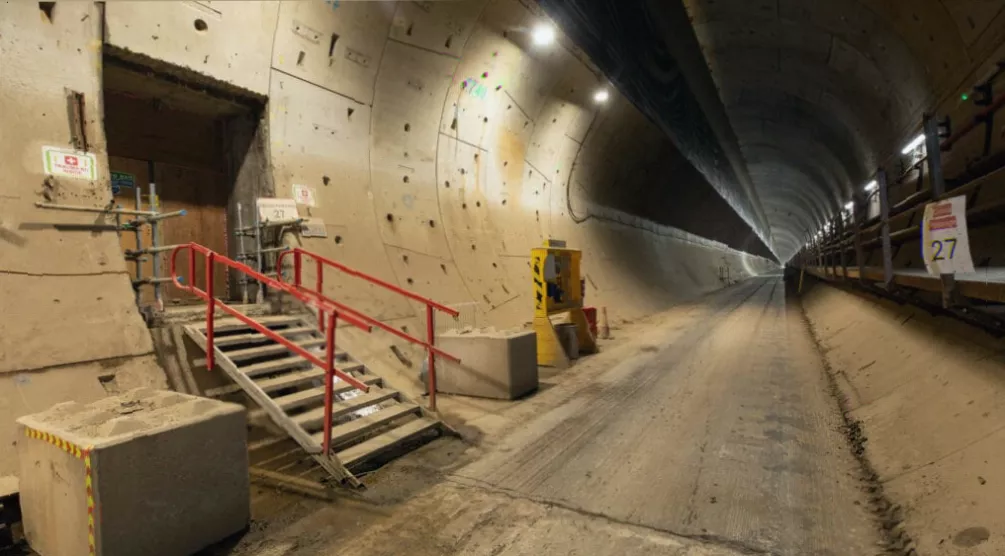
Construction of the western section of the Northolt Tunnel, which runs for approximately 5 miles (8 km) and was completed by TBMs Sushila and Caroline, presented far more challenging conditions. Eleven of the 34 cross passages had to be built using ground freezing, a technique designed to stabilise water-bearing soils before excavation could begin. This involved inserting pipes into the tunnel lining and circulating a coolant to create a two-metre-thick frozen wall around the zone to be excavated. The frozen ground provided a temporary but extremely strong barrier against water ingress, allowing workers to dig safely through soils that would otherwise have been unstable.
Workers used a combination of hand excavation and small machinery to remove the frozen material, with the process adding significant time and complexity compared to passages built in more stable London Clay. The technique is well established in tunnelling but is rarely required on such a scale within a single project. The frozen wall had to be maintained continuously until the sprayed concrete lining was in place and had gained sufficient strength.
The wider tunnel itself was excavated from 4,160,000 tonnes of London Clay, which is being transported to HS2’s London Logistics Hub and then by rail for beneficial reuse in biodiversity schemes and landscaping across the UK. The tunnel is lined with 14,300 concrete rings — made from 94,233 concrete segments — produced at two factories: the eastern section’s segments were manufactured in Hartlepool by STRABAG, while the western section’s came from Kent by PACADAR UK, with both transported to site by rail. The internal diameter of the tunnel varies: 8.10 metres in the east and 8.80 metres in the west, with the wider sections designed to accommodate the higher train speeds that generate increased air pressure changes.
Malcolm Codling, Project Client for HS2, said: “The progress made to construct the Northolt Tunnel demonstrates the commitment of our teams to deliver this vital infrastructure efficiently and safely. Completing the construction of the cross passages is an important step towards finishing the civil engineering on the tunnel which will allow us to ultimately begin rail systems work including laying track.”
The works are being delivered by the Skanska Costain STRABAG (SCS) joint venture, which is responsible for constructing the HS2 route from Hillingdon to Camden and bringing the line into Euston.
With the cross passages now finished, engineers will move on to installing reinforced concrete collars, which will form the permanent openings for fire-rated sliding doors. These doors — produced by Bolton-based Booth Industries — are designed to withstand pressure changes caused by passing high-speed trains and provide two hours of fire resistance for both integrity and insulation. Booth Industries is also providing fire safety doors for HS2’s Old Oak Common station, a major interchange hub that will connect HS2 with the Elizabeth Line and National Rail services, and previously supplied doors for the Crossrail project. The company holds a significant contract with HS2, having also worked on HS1.
The HS2 programme as a whole has faced significant cost increases and delays since its initial plans were unveiled in 2009 with an estimated cost of £32.7 billion, which has since ballooned to potentially over £100 billion. The project is currently undergoing a “reset” aimed at establishing a more stable path with greater certainty around costs and completion dates. The Northolt Tunnel excavation itself was completed in June 2025. Old Oak Common station, where construction is ongoing, is set to become one of the UK’s busiest rail hubs.