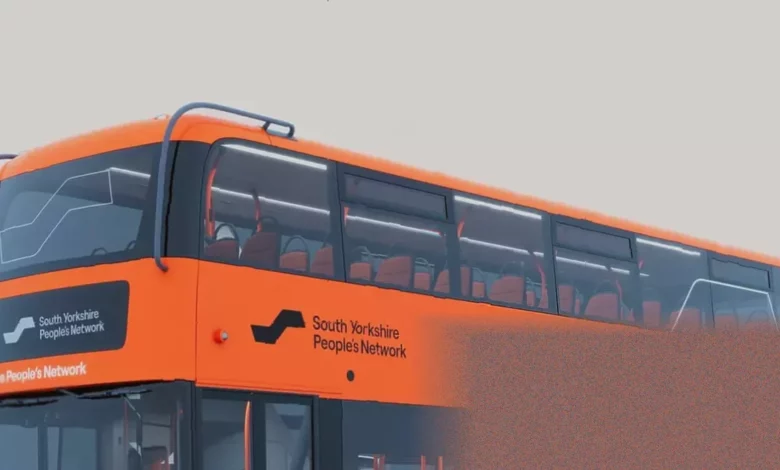
In a move that marks the most significant shift in the region’s transport landscape in nearly four decades, South Yorkshire is set to bring its buses, trams, and bike hire under a single, publicly controlled system. The newly unveiled “People’s Network” represents a direct reversal of the bus deregulation that began in 1986 and a multi-billion pound bet on a greener, more connected future.
A Unified System Rooted in Heritage
Announced by South Yorkshire Mayor Oliver Coppard, the network will be branded in “molten orange” and “asphalt black” – colours chosen to reference the area’s industrial heritage of coal, steel, and ingenuity. Its logo, a stylised ‘S’ with four lines, represents the four boroughs of Barnsley, Doncaster, Rotherham, and Sheffield.
“The vision for that transport network is joined up. It’s sustainable. It’s one that puts people at its very heart,” Mayor Coppard said, describing it as a “once in a generation change”. He referenced growing up in the so-called “People’s Republic of South Yorkshire” as inspiration for the network’s name and ethos.
The Return to Public Control
The core of the plan is the franchising of bus services, bringing them under the direct control of the South Yorkshire Mayoral Combined Authority (SYMCA). This process will begin in Sheffield and Doncaster in September 2027 and extend to all four boroughs by 2029. The SYMCA will manage depots, fleets, service standards, fares, and ticketing.
This shift joins the Supertram network, which was brought back into the combined authority’s hands in 2024. A massive £630 million is allocated for the renewal and enhancement of Supertram, including 25 new trams and reliability upgrades. A new tram-train station at Magna in Rotherham is under construction and expected to open in early 2026.
Investment and Infrastructure
Overall, the plan is backed by approximately £1.5 billion of devolved funding over the next five years. Alongside the tram investment, £350 million is earmarked for buses. The bus fleet is set for a green revolution, with around 70% expected to be zero-emission at the start of franchising in 2027. Funding is already confirmed for 186 electric buses in Sheffield, and the SYMCA has launched a procurement process for a new fleet designed with public input on accessibility and safety.
The region’s connectivity is also set for a major boost from the wider £45 billion Northern Powerhouse Rail (NPR) investment. This will fund electrification and upgrades on the Leeds-Sheffield line for four fast trains per hour, enhance cross-Pennine links to Manchester, improve capacity at Sheffield station, and deliver a new mainline station at Rotherham.
Further major infrastructure revival is planned for Doncaster Sheffield Airport, which closed in 2022. A separate £160 million funding package aims to reopen it in 2028 as a sustainable aviation and advanced manufacturing hub, with limited activity possible by winter 2027. Mayor Coppard argued that integrating tram or train links to the airport would improve its long-term viability.
Fares, Tickets, and Active Travel
While specific fares for the People’s Network are yet to be confirmed, Mayor Coppard has expressed a hope to offer free travel to under-18s. A current scheme already provides free bus travel for 5-18 year olds in Barnsley for journeys within the borough. The authority plans to introduce simplified and integrated bus and tram tickets, with validations on both franchised and non-franchised services during the transition.
The network’s scope extends beyond motorised transport, with a pledge to integrate walking, wheeling, and cycling. Coppard has vowed to make South Yorkshire the best place in the country for children to use these active travel modes, with plans centred around schools. Existing city bike hire schemes will be rebranded in the new network colours next year.
A Regional Trend and Personal Mission
The People’s Network follows the model of Greater Manchester’s Bee Network and the planned Weaver Network in West Yorkshire, forming a trend of northern regions seeking integrated, publicly influenced transport systems.
For Mayor Coppard, a South Yorkshire native re-elected in May 2024, the project is personal. Having previously worked on low-carbon regeneration and contested Sheffield Hallam in the 2015 general election, his platform has long focused on improving public transport and addressing regional inequality. He has spoken of witnessing the impact of industrial decline and privatisation firsthand.
The plan has garnered support from regional figures. Lord David Blunkett, former Sheffield council leader and Home Secretary, stated: “We have a real opportunity to transform the way people travel, improving connections to support economic growth.” Henri Murison, chief executive of the Northern Powerhouse Partnership, added that a functional network was essential to connect people to better-paid jobs, an area where the region “currently is falling short.”