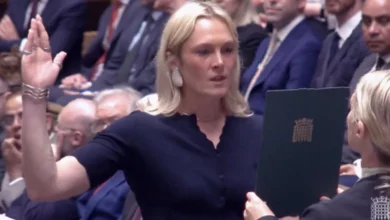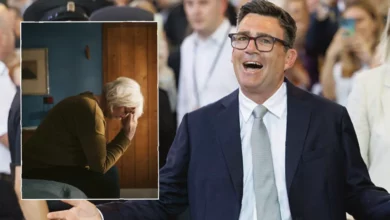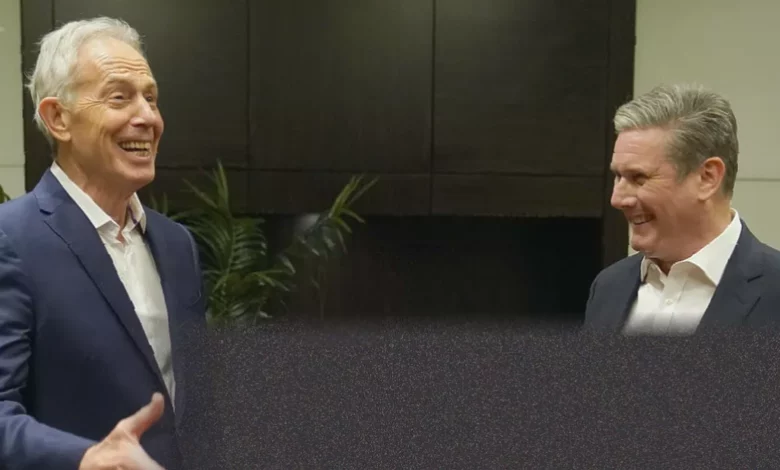
Tony Blair has been out of power for nearly two decades, yet a Guardian analysis of last week’s national newspapers found he attracted three times the coverage of the serving home secretary, Yvette Cooper, and the foreign secretary, Shabana Mahmood, combined. The man who left Downing Street in June 2007 continues to command headlines, set the terms of political debate and draw responses from across Westminster – a dominance that raises questions about the Labour party’s enduring fixation with its own past.
Blair’s latest intervention came in the form of a lengthy essay, followed within days by a report on youth unemployment from his former health secretary Alan Milburn. Simultaneously, his ally Peter Mandelson engaged in a public exchange with Pat McFadden, another carrier of the Blairite torch, over Labour’s economic strategy and its response to the rise of Reform UK. The summer’s political narrative is already shaping up as a contest between Andy Burnham – whom Blair called “an outstanding member of my government” – and Wes Streeting, an unabashed admirer. To an outside observer, the scene might suggest that Britain is still governed by its former prime minister.
The living archive of New Labour
The roll call of figures pressed into service to bolster the current government reads like a reunion of the 1997 administration. Harriet Harman and Gordon Brown have been called into Downing Street for photo opportunities after the local election losses. Jonathan Powell, Blair’s chief of staff, now serves as the UK’s National Security Adviser and was appointed as a special envoy to resolve the Chagos archipelago sovereignty dispute. Michael Barber remains a byword for delivery. Liz Lloyd, once Blair’s deputy chief of staff, is a Parliamentary Under-Secretary of State for science and technology. Tim Allan, Blair’s former deputy press secretary, is now director of communications for Keir Starmer.
This reliance on figures from a government that ended in 2010 has prompted a comparison to a historical analogy: the Old English poem The Ruin, which describes the remains of the Roman city of Bath as if built by an extinct race of superhumans. The parallel, as one commentator put it, is that the present is treated as merely a coda to a golden age – the ancients were giants, the current generation are Lilliputians with a photocopier. More years now separate the present from the start of the New Labour era than separated New Labour from Harold Wilson’s premiership, yet no one imagines Wilson appointing his own former press secretary Joe Haines to a comms role, or making Barbara Castle his wages tsar. Today, such recycling is worn as a badge of seriousness.
The argument against ancestor worship
Critics argue that the Labour party’s fixation on Blair’s legacy is a fundamental misreading of both past and present. Leaving aside the wars in Afghanistan and Iraq, Blair’s tenure oversaw the loss of a million manufacturing jobs, a steep fall in council housing and the creation of a historic financial bubble. The credit crunch that began in 2007 – triggered by the collapse of the US housing bubble and the securitisation of subprime mortgages – blew apart the central justification of the Blair project: that letting finance rip would fund public services and sustain a knowledge economy. Within months of Blair leaving Downing Street, Britain faced a banking run followed by the biggest financial collapse in living memory. The moment called for a total rethink of the country’s political economy and of Labour’s purpose. Two decades on, the argument goes, neither has advanced far.
The exchanges between Mandelson and McFadden this week have done little to suggest any rethinking among the Blairites themselves. McFadden suggested Labour MPs ask only one question: “Who can we tax in order to pay benefits to others?” Mandelson’s reply to his plea about how to fight Reform UK was: “You rally people round winning for Britain.” Neither, critics note, offers serious policy. Mandelson has urged Starmer’s team “to embrace Knowledge and Risk on everything that will help grow the economy”, citing meetings with the chief executives of the fund managers Blackstone and Bridgewater – the same mindset, it is argued, that produced the banking crisis.
The irony is sharp: a government led by a man with the political nous of Rishi Sunak, still scared of the ghost of Liz Truss, and beholden to a set of figures who themselves lived in the shadow of Margaret Thatcher. Reform UK, whose policies include scrapping net zero commitments and cutting taxes, continues to gain ground. The home secretary, Shabana Mahmood, a self-identified “Blue Labour” social conservative who cites Margaret Thatcher as an idol, adds another layer of confusion.
The question that lingers is not whether Blair’s views deserve attention – he gives plenty, from his opinions on Iran to digital ID and net zero – but why the political and media classes treat him as a sage. Polling suggests the public judges him less worth listening to than Boris Johnson. Yet the man who delivers more encores than Bruce Springsteen remains the unseen chair of the islands’ political conversation, while the Labour party remains trapped in the ruins of its own past.