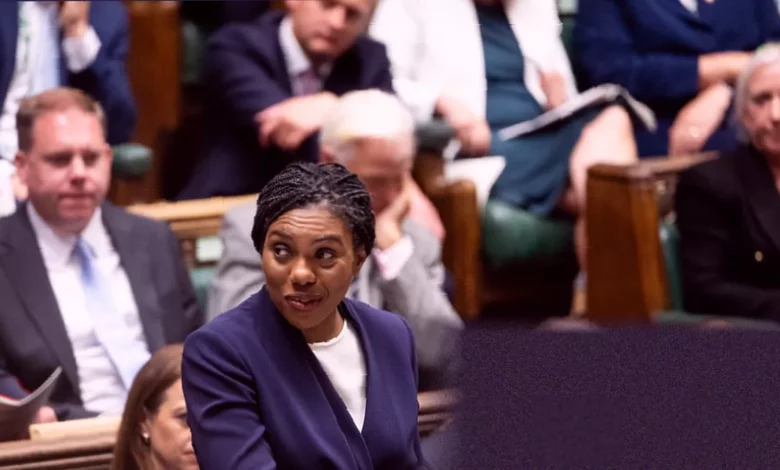
Kemi Badenoch, a politician who has built her reputation on combative culture-war interventions, struck an uncharacteristically measured tone at Prime Minister’s Questions on Wednesday – so much so that Sir Keir Starmer felt moved to thank her for it. But the Conservative leader’s call for unity, prompted by the murder of 18-year-old Henry Nowak and the rioting that followed, masks a far less conciliatory analysis of the case, one rooted in years of conviction that identity politics is corrupting Britain’s institutions.
“It is the responsibility of everyone in this house to bring people together, not divide them,” Badenoch told the Commons. Starmer replied: “Can I just first thank her for her approach and her tone in relation to this?” The moment was striking, given Badenoch’s history of sharp attacks on what she calls “the orthodoxy of anti-racism”. Yet her call for calm was also a deliberate act of political differentiation. Nigel Farage, the Reform UK leader, had been widely condemned for demanding “pure cold rage” over Nowak’s death, and Badenoch accused him of “playing identity politics” and being a “rabble-rouser”. Nowak’s father, Mark Nowak, had explicitly urged politicians not to use his son’s death “to create further division, hatred or tension”.
The case that forced this debate is harrowing. Henry Nowak, a university student, was stabbed five times by 23-year-old Vickrum Digwa in Southampton on 3 December 2025, sustaining a fatal chest wound. When police arrived, Digwa falsely accused Nowak of assaulting him and of racism, claiming the teenager had pulled off his turban. Bodycam footage shows Nowak repeatedly saying he had been stabbed and could not breathe, while an officer responded: “Don’t think you have, mate.” Nowak was handcuffed and died shortly afterwards. Hampshire and Isle of Wight Constabulary has apologised, acknowledging that officers were investigating a false racism claim rather than the victim’s pleas that he had been stabbed. The Independent Office for Police Conduct (IOPC) is investigating. Digwa was convicted of murder and possession of a bladed article on 28 May 2026 and sentenced to life imprisonment with a minimum of 21 years. His mother, Kiran Kaur, was convicted of assisting an offender for hiding the weapon and is due to be sentenced later this month.
The wake-up call and the CRED report
Badenoch told the Commons that the circumstances of Nowak’s wrongful arrest had to be “a wake-up call to the entire country and our institutions that every life matters”. She later called the police handling of the case “a seminal moment for Britain on a par with the murder of Stephen Lawrence”. But she has not waited for the IOPC to finish its work. In a Daily Mail article on Wednesday morning, she went further, arguing that the police actions were “the fault of identity politics, in part the result of the Black Lives Matter movement”. She called for a root-and-branch purge: “root out all identity politics from state institutions”.
This is not a new position. It is the logical extension of a worldview Badenoch has championed since her time as equalities minister in the last Conservative government. In that role she oversaw the Commission on Race and Ethnic Disparities (CRED) report, published in 2021, which largely downplayed the role of institutional and structural factors in racial disparities. Badenoch hailed it as a “positive agenda for change”. A mass of academics and organisations, including the British Medical Association, criticised it as oversimplistic and at times misleading. Badenoch defended it, saying it did not deny racism but found no institutional racism in the areas examined. This is the lens through which she now views the Nowak case: a system captured by what her spokesperson called “a series of more and more extreme anti-racism measures” that officers signed up to during the Black Lives Matter era.
Asked after PMQs why Badenoch could be so certain of the lessons, her spokesperson pointed to her experience as equalities minister. But he also cited a personal reaction to the bodycam footage: “Her reaction to it was one of a mother who imagined her son, when he is older, being in that situation, and it really hit home.” The trial judge, however, offered a more cautious view, saying that in the dark and amid much confusion it was perhaps understandable that officers did not immediately fully assess the situation.
Badenoch’s approach stands in stark contrast to the official government line. Starmer has urged the public to wait for the IOPC inquiry before reaching conclusions. Badenoch has already reached them, and they are firmly tied to her long-held critique of identity politics.
Political positioning and the Farage factor
The Nowak case has become a flashpoint in a broader political struggle on the right. Reform UK, led by Nigel Farage, has accused the police of “two-tier policing” and called for a response of “pure cold rage”. Badenoch has explicitly rejected that framing, accusing Farage of “playing identity politics” and arguing that his rhetoric was “just the flip side” of the BLM movement, aiming to “make people get angry and start lashing out”. She condemned his approach as not befitting someone aspiring to be prime minister. The contrast is deliberate: Badenoch is trying to position herself as the responsible conservative – offering firm conclusions about institutional capture without inflaming street-level disorder.
Yet the political arithmetic is uncomfortable. The Conservatives are currently polling second to Reform UK, and still below the ratings Badenoch inherited when she became leader. Supporters insist she is doing well in a fragmented system and point to her improving personal poll numbers. Critics are less sure. Lee Cain, formerly Boris Johnson’s communications chief, wrote in Conservative Home last month that Badenoch was “failing as leader” and likened her to William Hague – someone with high personal ratings who failed to take the party with him. “The country doesn’t elect leaders on the basis of PMQs, and personal approval ratings only take you so far when the party itself has nothing to say,” Cain wrote. The Nowak case may test whether Badenoch can convert her cultural-war convictions into a compelling offer, or whether she is simply giving Farage his next target.
Meanwhile, false information about the officers involved in Nowak’s arrest has circulated online, leading to threats against them. And the victim’s father has made his plea clear: “We do not want his death to be used to create further division, hatred or tension. We want his story to make our streets safer for everyone.”