The Billionaire Boom: How the UK’s Richest 200 Families Came to Hoard 22% of National Income
The numbers are stark. In 1989, the wealthiest 200 families in Britain – the top 0.001% of the Sunday Times Rich List – owned assets equivalent to roughly 5% of the country’s annual gross domestic product. Today, that same elite group controls 22% of GDP, a share worth more than £660 billion on a national output that topped £3 trillion in 2025. The data comes from Gabriel Zucman, a professor of economics at the University of California, Berkeley and the Paris School of Economics, whose latest book, We Need to Tax Billionaires, published last month, lays out the arithmetic of how a tiny fraction of the population has captured an ever-larger slice of the nation’s wealth.
Zucman’s research, which builds on the work of fellow inequality scholars Thomas Piketty and the late Sir Tony Atkinson, shows that western societies have become dramatically more unequal. While the vast majority of earners pay 40% to 50% of their income in tax, billionaires face an effective rate of 25% at most. The disparity in wealth is even starker. In the UK, the bottom half of households owned less than 5% of total wealth in 2021, while the top 10% held 57%, and the top 1% commanded 23%. The ratio of national wealth to income has more than doubled, rising from 2.3 to 1 in 1948 to 5.7 to 1 in 2020. Between 2011 and 2019, the average household gained just £4,000 in wealth; those in the top 10% became £280,000 richer – a 50% widening of the wealth gap in eight years. Fewer than 50 families now own more than the poorest half of the country combined.
Zucman’s answer is a straightforward, low-rate wealth tax – and he wants individual nations to press ahead without waiting for international coordination from the OECD or the United Nations. The target is anyone with assets exceeding $100 million. The rate: just 2% annually. Crucially, there would be no exemptions, drawing a sharp line with earlier European wealth taxes that were riddled with loopholes and eventually abandoned. To prevent the super-rich from simply moving to Monaco, Dubai or Milan, Zucman proposes that the UK pass a law deeming long-term residents to remain tax-resident for five or ten years after departure. The proposal has the backing of half a dozen Nobel prize-winning economists.
The fairness argument, Zucman contends, is hard to refute. Most of those on the rich list do little manufacturing or wealth creation, instead trading in property and financial assets. Their vast fortunes, he argues, are built on the infrastructure, education and public services funded by the state – and on the skills of workers. “Megabusiness owners are not islands,” the economist writes. Entrepreneurs who amass more than £100m have been “extremely lucky”, benefiting from national amenities and labour that the rest of the country pays for. A 2% tax on that excess wealth, he says, would minimise the need to raise taxes on the middle and professional classes.
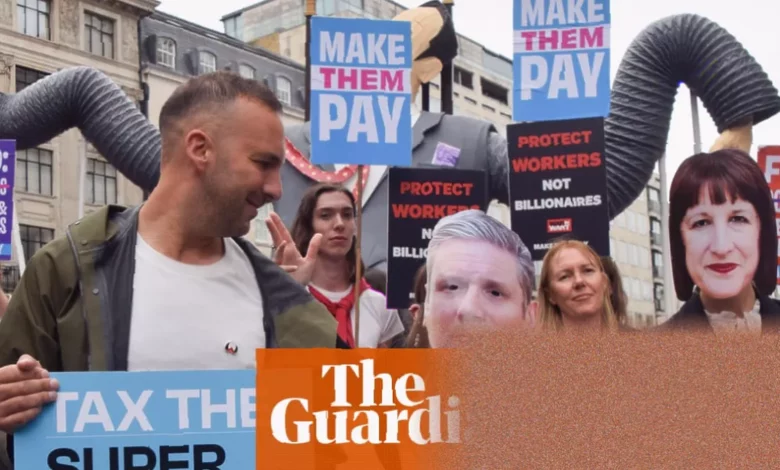
Yet within Labour, the idea is already causing jitters. Andy Burnham, the frontrunner to become prime minister if he wins this month’s Makerfield byelection, and shadow health secretary Wes Streeting have both hinted they would favour “a tax of some kind on the wealthy” – a move widely seen as an attempt to blunt the popularity of the Green Party’s Zack Polanski, who has proposed a 1% levy on assets above £10 million and 2% above £1 billion, which he estimates could raise between £15 billion and £25 billion a year. The Conservatives and business-friendly media have pushed back hard. The Daily Telegraph ran a front-page headline declaring “Britain needs more wealth creation, not a tax war on billionaires,” while the Financial Times warned that “Wealth tax fears reignited by UK leadership uncertainty.”
Mechanics, Risks and the Politics of a 2% Levy
At the heart of Zucman’s case is a conviction that a wealth tax can be made to work if it is designed simply and backed by political will. The 2% rate on assets above $100 million is low enough, he argues, to avoid the capital flight that plagued France’s wealth tax, which was blamed for an exodus of millionaires. The exit tax – treating emigrants as residents for up to a decade – is intended to close that escape route. Zucman also points to strong public support: three-quarters of the British public, and a significant proportion of millionaires themselves, back higher taxes on wealth. The UN tax committee has now agreed on guidance for designing wealth tax laws, a blueprint endorsed by many global South countries and taken up by the G20.
Opponents, including the OECD and some economists, warn of practical hurdles. The Wealth Tax Commission estimated that even a narrow-based system would cost HMRC £579 million to set up, and valuing illiquid assets such as private businesses, art and land is notoriously difficult. Critics say a wealth tax could discourage savings and investment, distort the economy, and amount to double taxation on income that has already been taxed. Some experts suggest reforming capital gains and inheritance taxes instead – noting that inheritance and gifts have doubled in two decades and are projected to double again by 2040.
Despite the opposition, the political momentum is growing. The recent SpaceX stock market launch, which pushed Elon Musk’s net worth to an estimated $1.1 trillion after the company raised a record $75 billion, has provided a vivid contemporary symbol of extreme wealth concentration. And with the UK’s Gini coefficient for household wealth at 0.59 – far higher than the 0.36 for disposable income – the gap between what people earn and what they own has never been wider. The richest 1% now hold at least £3,121,500 each; the poorest 10% have £16,500 or less. More than 40% of household wealth sits in property, 35% in private pensions, 14% in financial assets and 10% in physical goods.
Burnham, if he becomes Labour leader, will have to decide whether to back a full-blown wealth tax or a more modest levy. The Greens have already staked out territory. The question is whether the middle classes can be convinced that taxing the super-rich will spare them from higher bills – and whether entrepreneurs can see that a 2% tax on future fortunes above £100 million is no bar to building a business. As Zucman puts it, the rich should “acquire some” civic pride and patriotism. The nation, he argues, has endured 40 years of ridiculously unequal wealth that has undermined the fabric of a once-contented society. A 2% tax on billionaires is, in his view, the least radical fix that might actually work.