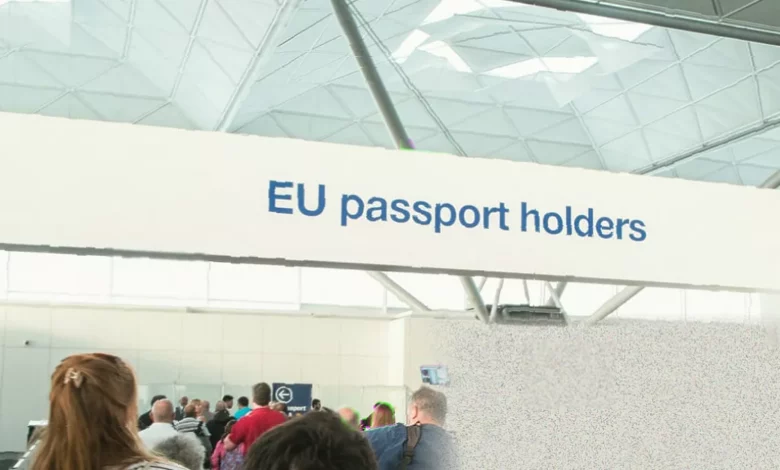
The UK government is seeking to cap the number of young people from the European Union who can enter the country under a proposed post-Brexit youth mobility scheme at fewer than 50,000, as negotiations with Brussels remain deadlocked over the fundamental design of the programme.
According to sources familiar with the talks, the current ballpark figure being discussed is between 40,000 and 50,000, down from a mooted cap of 70,000 when reset negotiations opened a year ago. The shift reflects what officials describe as Labour’s wider anxiety about immigration numbers. The government has refused to comment on a specific limit, stating only that it would be in the “tens of thousands”.
The EU has rejected any fixed cap outright. Instead, it wants an unlimited scheme with an annual review of numbers and an “emergency brake” mechanism that would allow temporary restrictions to be imposed if politically desirable. EU officials argue that preserving an uncapped scheme is essential to maintaining the spirit of cultural exchange, rather than framing it as a migration programme.
What a 50,000 cap would mean for EU applicants
The implications of a cap set below 50,000 are significant for young EU citizens hoping to work, study, au pair or travel in the UK. Ben Brindle, a researcher at the Migration Observatory, said a 50,000 limit would be “similar to the Australian YMS”, referring to the UK’s existing youth mobility scheme with Australia. However, he warned that the comparison was misleading because “EU applications for youth mobility visas would be far more likely to hit the cap, because the young EU population is considerably larger than Australia’s”.
Under the UK’s existing youth mobility arrangements with 13 non-EU countries — including Australia — visas are capped and time-limited, and require a visa fee and a health surcharge. For example, the UK-Australia scheme had 45,000 places in 2024 and 42,000 in 2025, but actual grants have been far lower: only 8,200 visas were issued in 2025 against a quota of 45,000. Brindle noted that the length of any EU youth mobility visa would be critical. “The shorter it was, the less time EU citizens would have to find jobs eligible for work visas, or meet a British partner and switch to a family visa,” he said.
Professor Catherine Barnard, an expert in EU law at the University of Cambridge, said the negotiations remained “very tricky”. She added: “I have heard nothing to the contrary to suggest it was going any better than a month ago.” Barnard pointed to legal complications: work visas remain a matter of national competence for individual EU member states, meaning that even if an EU-wide agreement is reached, a country such as France could set its own cap at zero.
Brussels views the youth mobility scheme as a “strategic endeavour” vital for maintaining links between societies, particularly in the context of global instability and transatlantic ruptures under Donald Trump. A senior EU official said: “The strategy is about ensuring that our societies keep linked, understand each other and see each other as part of the same family of nations.” The political risk of pursuing closer ties through a temporary visa scheme is seen in European capitals as the lowest it could be given the current geopolitical climate.
Despite this shared strategic interest, there is growing frustration in the EU at the UK’s refusal to budge on the cap. One diplomat said: “People are asking: what do we – the EU – get out of this? There will be no summit if there is no deal.”
Wider sticking points: tuition fees and the SPS agreement
Beyond the cap, the issue of home tuition fees for EU students remains a major hurdle. The EU is demanding that EU citizens be allowed to study in the UK at the same fee level as domestic students, rather than paying international rates that can range from £11,400 to £32,000 per year for undergraduates, and as high as £70,000 at some universities such as Cambridge. The UK government has resisted, arguing that tuition fees were not part of the “reset roadmap” or the “Common Understanding” agreed in May 2025.
Granting EU students domestic fee status would cost UK universities an estimated £580 million annually. Negotiators have explored a compromise whereby EU students would pay a fee tier somewhere between international and domestic rates, but that would still create a funding shortfall for institutions. The UK maintains it never agreed to discuss fees in the reset talks. Professor Barnard described the EU’s demand for home fees as a “bugbear” for the bloc.
The impact of Brexit on student mobility has been stark. Since the UK left the EU, EU student numbers enrolling in UK universities have fallen by 57% between the 2020/21 and 2023/24 academic years. The UK also departed the Erasmus+ programme, though it has since agreed to rejoin in 2027, and introduced the Turing Scheme as a one-way replacement that does not fund students coming to the UK.
Another element of the reset deal is the sanitary and phytosanitary (SPS) agreement, intended to reduce red tape and border checks for food and drink exports. EU sources described the SPS talks as being “all about” accommodating UK interests. The agreement would require the UK to dynamically align with EU standards, potentially reversing some post-Brexit import requirements, with a target implementation date of mid-2027. Barnard has said that while the SPS, energy and emissions trading talks would help smooth issues arising from the Brexit border between Great Britain and Northern Ireland, they were not really about a deeper relationship with the EU — something that would be achievable only by softening UK red lines on the single market and customs union.
The reset deal was originally expected by the end of this month, but the timetable has slipped. A summit between the UK and the EU is now anticipated in late June or early July.
A UK government spokesperson said: “We will not give a running commentary on ongoing talks. We are working together with the EU to create a balanced youth experience scheme which will create new opportunities for young people to live, work, study and travel. Any final scheme must be time-limited, capped and will be based on our existing youth mobility schemes.”
Starmer’s stance: pushing for closer ties but ruling out key concessions
At the weekend, Sir Keir Starmer indicated he would be pushing for further and faster collaboration with the EU, suggesting he wanted to close the gaps in talks. “We have to be closer to Europe,” he told the Observer. “I want to be full-throated about this, not holding back, no half measures in what I’m saying.”
However, he has ruled out rejoining the EU, the customs union or the single market. Professor Barnard noted that the UK’s refusal to soften those red lines meant that the current negotiations could only produce limited outcomes, rather than a fundamental reset of the relationship. She said that while the UK and the EU share a vision on the breadth and benefits of a youth experience scheme, “they have different substantive priorities”.