Brazil’s biggest city fights sewage, bacteria and organised crime to protect vital water source

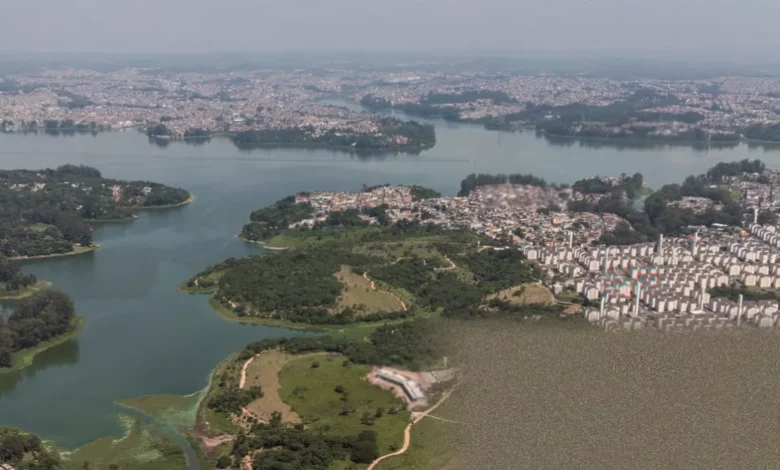
On the far southern edge of São Paulo, biologist Marta Marcondes and community activist Wesley Silvestre Rosa steer a small motorboat across Billings reservoir, a 127 sq km body of water that is Brazil’s largest urban reservoir by surface area and volume. It is a vital lifeline for the nearly 22 million people in the metropolitan area, supplying drinking water, generating hydroelectric power, controlling floods and providing a cooling effect during heatwaves. Yet as the boat approaches a polluted section called Grota Funda, bubbles of fermenting bacteria rise from the surface. “Good lord, what a smell,” Marcondes says, donning rubber gloves to collect a sample. “You could die if you drank this.”
The cost of contamination
Large areas of Billings are contaminated with household and industrial waste, pharmaceutical residues, microplastics and fecal matter. Marcondes, who runs a laboratory at the Municipal University of São Caetano do Sul and coordinates the local NGO Water Pollutant Index, says water quality and the reservoir’s storage capacity have deteriorated over the past decade. “This problem has been dragging on for decades, and if we don’t do something about it now, we risk having a collapsed system,” she warns.
The pollution poses direct health risks to the roughly 1.5 million people living around the reservoir, many in favelas or irregular housing — a dramatic increase from 110,000 in 1970. The São Paulo city climate plan identifies the area as one of the most susceptible to climate change in the city. Residents such as Wanderley da Silva, who lives in the Favela da Fumaça on the edge of Billings, endure flooding up to his knees during heavy rains. “All of a sudden it’s really hot, and then it pours down,” he says. “Everyone knows why, after humankind destroys nature, then comes the payback.”
The reservoir’s role in water security is becoming more urgent as São Paulo faces mounting water shortages due to the climate crisis. In 2015, during the city’s worst drought, Billings was used to supplement supply. The Cantareira system, a primary water source for millions, has operated at less than 20% of capacity. In December 2025, the Jaguari-Jacareí dam, which supplies nine million residents, dropped below 18% capacity. Now Sabesp, São Paulo’s water utility, is building new infrastructure to draw clean water from Billings during periods of scarcity. The NGO Institute of Water and Sanitation has warned that without planning, resilience is impossible.
How the law is broken
Almost all of Billings’ 700km of shoreline is technically protected under local environmental laws. State legislation specifically prohibits heavy construction and dense urbanisation around the reservoir. Yet using a drone from its polluted shores, it is possible to see pockets of professionally built construction in cleared patches of the Atlantic Forest — structures that urban planner and city council member Nabil Bonduki calls “clandestine allotments”, speculative builds intended for future profit.
The deforestation, mostly to clear land for these illegal developments, increases sediment levels in the reservoir and reduces its ability to store water and control floods. Bonduki blames insufficient inspections and a lack of political will. “These days, we have satellites that can detect deforestation in real time,” he says. “It’s a political issue — about having a public authority that wants to do something.”
Powerful local actors are finding ways around the law. The Guardian spoke to sources who cited collusion between local land barons, dominant political networks in the region and organised crime groups, enabled by corrupt lawyers and inspectors. Advertisements offering plots of land and properties for sale proliferate in the region and on social media. São Paulo’s public prosecutor’s office for housing and urban planning has opened a civil inquiry “aimed at investigating the structure, planning, and possible deficiencies of state and municipal bodies” in connection with illegal land subdivisions in the reservoir’s water catchment area.
Bonduki notes that the redirection of polluted water from the Pinheiros and Tietê rivers to supply the Henry Borden hydroelectric plant has turned Billings into an “environmental sacrifice zone”. Sabesp has been at the centre of several pollution incidents. In August 2025, it was fined R$22.7 million for a sewage leak into the Pinheiros River caused by a failure at the Pinheiros pumping station. In March 2026, it was fined R$100,000 for contaminating the Maresias River with hypochlorite, leading to fish deaths. In January, residents blamed Sabesp for dumping waste into Billings and the company was fined by environmental authorities. Sabesp said the incident was caused by “the irregular entry of rainwater into the sewage network and the carrying of garbage, a situation intensified by the rains, which caused a hydraulic overload of the system”.
The Atlantic Forest biome, of which the reservoir is part, is crucial for São Paulo’s water supply and climate resilience. While deforestation in the biome reached a record low in 2025 — 8,658 hectares lost — it remains highly urbanised and degraded, with only about 24% of its original cover left. Bonduki warns that Billings serves as a stark warning for what could happen to the nearby Guarapiranga reservoir, which is already facing pollution from untreated human waste and sewage.
São Paulo city hall acknowledged that environmental crimes have occurred around Billings, including the “deforestation of native vegetation”, “the disposal of solid waste, mainly construction waste and human waste”, and “the clandestine sale of land plots, non-compliance with embargos and the illegal subdivision of land”. It said it operates an integrated water defence operation (OIDA) in partnership with the state government, focused on inspection, fines, and dismantling illegal constructions. About 20 such operations have been carried out in 2026.
Meanwhile, the privatisation of Sabesp in 2024 has raised concerns that profit-driven measures could worsen inequality and scarcity, with experts suggesting private management may incentivise overuse and discourage conservation.
Defending the reservoir
Amid the degradation, activists continue to fight for Billings. Marcondes and Rosa regularly patrol the reservoir, monitoring sewage inflows and deforestation. Rosa, who lives in the lower-income neighbourhood of Jardim Apurá, says residents are unfairly blamed. “We suffer from environmental racism,” he says. “They blame us for the pollution, but we, the poor, black and peripheral people, keep our green spaces clean and alive.”
Local residents campaigned successfully to create Buffalo Park, a protected area that is home to 101 species of wildlife and where people can plant seeds. But the park has also been a site of violence: last year, authorities discovered bodies buried there bearing signs of execution. In 2022, Billings activist Adolfo “Ferrugem” Duarte was killed and his body found in the reservoir. Matthew Richmond, a lecturer in political geography at Newcastle University and Alameda Institute affiliate, says: “Environmental activists on São Paulo’s peripheries are fighting to salvage the green spaces that survived, in the face of continued state neglect and unmet housing demand, which drives new land occupations.”
Bonduki insists Billings is not a lost cause. “It is deeply compromised, but it is not a lost battle,” he says. The challenges — pollution, illegal development, violent opposition and climate stress — remain immense, but the efforts of local activists and the continued reliance of millions on the reservoir mean its fate is far from sealed.