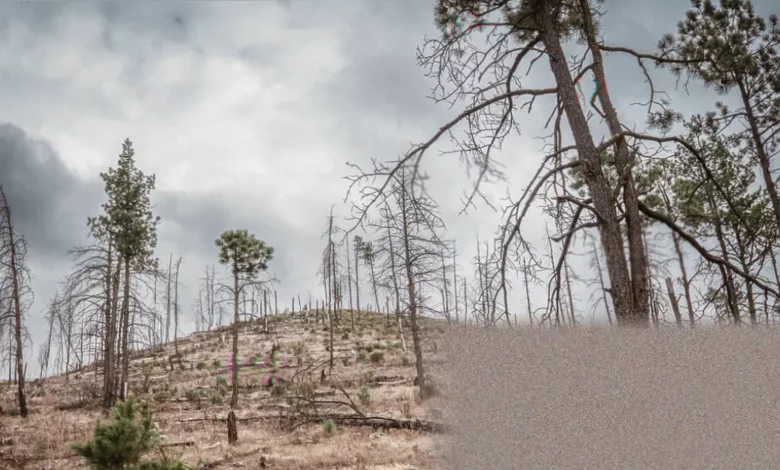
For decades, the pine forests of the Sierra Tarahumara in northern Mexico were a place of safety and tradition. Children of the Rarámuri and Ódami communities would run through the woods at night, collecting fireflies by the flicker of their glow. That peace has been shattered. Since the mid-2010s, criminal groups — including factions of the Sinaloa cartel — have intensified illegal deforestation across this rugged mountain range in Chihuahua state, seizing control of communal lands known as ejidos through intimidation, extortion and murder. The violence and environmental destruction have forced entire families from their homes, and those who remain live in fear.
Displacement and daily terror
The human cost is carved into the lives of those who survive. One mother of three from the village of Rochéachi, who asked to remain anonymous, recalls a past where “children could run and play and be together”. Now, she says, “children can’t go out to play. We don’t know what might happen.” Her father was murdered in 2016 after she openly opposed extortion by the groups controlling her ejido. Death threats forced her to flee to the nearby town of Guachochi about six years ago. “They told me that if I didn’t keep quiet or back off, the same thing would happen to me as to my father,” she told reporters. Even from a distance she continues to file formal complaints with government offices, and received the most recent threat in December.
Across the Sierra, displacement has become a weapon used by criminal groups to seize land and homes. According to the Community Technical Consultancy (Contec), a human rights organisation that supports Indigenous communities, the exact number of people forced from their homes is impossible to quantify, but it reports that 400 people have been displaced from ranches surrounding just the community of Baborigame in Guadalupe y Calvo. The Global Initiative, a non-profit research body, reports that 300 people have been displaced from Coloradas de la Virgen, also in Guadalupe y Calvo. One woman, who asked to remain anonymous and has been displaced twice — first from Coloradas de la Virgen in 1992 and again from Baborigame in 2018 — told reporters that she and her husband have lost seven family members to the violence. She added that children as young as ten have been forcibly recruited to fight for criminal groups in the area. “They kill them and dump them somewhere no one will find them,” she said.
How criminal groups control and profit from illegal logging
Illegal logging has become a central revenue stream for cartels operating in the Sierra Tarahumara, part of a broader diversification away from traditional drug trafficking as profits from crops such as marijuana have declined. “Illegal logging in the Sierra Tarahumara spread as criminal groups began to diversify,” said Isela González Díaz, 71, director of Alianza Sierra Madre, an organisation that works with Indigenous people in the mountains. “In recent years, illegal logging has been most effective for them.” The primary groups involved are the Sinaloa cartel — specifically the Los Salgueiro faction — and the Juárez cartel, operating through its armed wing known as La Línea, which is often composed of former or corrupt police officers. The Cartel Jalisco Nueva Generación (CJNG) is also reported to be allied with La Línea in the region.
Control is exercised through a combination of violence and infiltration. A Global Initiative report describes how armed groups in various ejidos extort the local logging industry, co-opt entire revenue streams, or forcibly log more timber than is legally permitted. In some cases, cartels have been documented clearing forest to make way for poppy plantations. The methods are often brutal: the Rarámuri woman from Rochéachi said criminal groups now exercise significant influence over the leadership of her ejido. According to Contec’s legal officer, who did not want to be named, “impunity is widespread” and the system for reporting, punishment and damage repair is “extremely ineffective”.
The illegal timber is laundered through a network of sawmills that falsify forestry documents. In San Juanito, in the municipality of Bocoyna, rows of sawmills operate beneath a thick mist. Trucks laden with felled timber rumble past rusting gates. “In San Juanito, there are various illegal sawmills that are not properly registered,” said Contec’s legal officer. Local people claim many are owned and operated by La Línea, which dominates the town. After processing, the wood is supplied with falsified documents before being sold on the open market. The economic scale is enormous: one academic estimates the annual value of laundered timber at up to $270m (£200m), while the US government puts the figure between $342m and $978m. The head of the National Forest Commission (Conafor) in Chihuahua has stated that there is “definitely more illegal logging than legal” in the state. A report by the National Autonomous University of Mexico estimates that at least 70% of the timber in the domestic market may have been illegally sourced.
The environmental toll is staggering. Since 2001, according to the environmental organisation Water and Forests for Life, 9,000 hectares (22,400 acres) of forest in the Sierra Tarahumara have been lost to illegal logging. Between 2017 and August 2024, deforestation in the region reached 35,900 hectares. Nationally, over 300,000 square kilometres — about 15% of Mexico’s territory — have been depleted due to illegal logging by criminal groups. The Sierra Tarahumara contains Mexico’s largest area of temperate, cold-climate forest, spanning altitudes from 500 to 1,400 metres and supporting significant biodiversity, including black bears, golden eagles and the rare cahuite conifer. But the indiscriminate felling of pine forests has left lasting scars. In Bocoyna, between 2022 and 2023, the district experienced almost a third of Chihuahua state’s tree-cover loss, according to a report on organised crime. The priest of Baborigame, who has lived there for nine years, described the scene: “There’s truck after truck hauling timber everywhere, like ants across the sierra. There’s no control at all.”
Criminal groups also use deliberate burning to disguise their activity. “Large areas have been devastated, and in some cases deliberately burned,” said Contec’s legal officer. By presenting burned areas as fire damage rather than logging, they erase evidence of wrongdoing. The deforestation has disrupted the region’s hydrological system, causing droughts, crop failures and food insecurity. People in the largely agricultural region believe that as logging has increased, rainfall has declined sharply. Combined with violence and economic failure, this has driven further displacement.
Impunity and institutional failure
Despite the scale of the crisis, residents and organisations say illegal activity goes unpunished. “The system for reporting, punishment and damage repair is extremely ineffective,” said Contec’s legal officer. Local people condemn the lack of anonymous channels for reporting forest-related crimes. Some claim that criminal groups have informants within Mexico’s environment ministry and the office of the federal attorney for environmental protection (Profepa). The Rarámuri woman who fled Rochéachi said that shortly after arriving at the ministry’s local office to file a complaint, she received a threatening phone call warning her not to proceed. Contec’s legal officer agreed that groups appear to know about every complaint filed, including who reported it, where and when, making it dangerous to turn to authorities. “At Profepa, when a complaint is filed, they find out very quickly,” she said. “Their surveillance has spread everywhere.”
Profepa acknowledges that illegal logging threatens rural communities but says this exceeds its administrative powers. The agency categorically denies any improper disclosure of information or collusion with gangs, and states that it is taking measures to improve the confidentiality and integrity of its procedures to guarantee anonymity. It has promised a 130m-peso (£5.6m) investment in forest protection in the Sierra Tarahumara. In late January 2026, Profepa conducted nationwide operations targeting illegal logging, including sweeps across 28 states, resulting in sawmill closures, timber seizures and the initiation of legal proceedings. The agency says impunity for environmental destruction is ending.
Yet institutional weakness is compounded at the national level. Despite widespread calls to strengthen environmental institutions and increase spending, the environment ministry and Profepa have had their budgets cut for 2026 — by 4% and 3.3% respectively. The National Commission of Natural Protected Areas (CONANP) also faces a 3.3% reduction. Campaigners fear that continued cuts will further stretch protection for forests, increasing Mexico’s vulnerability to corruption. The 2026 budget prioritises fossil fuels and infrastructure over environmental protection. And the phenomenon is not limited to the Sierra Tarahumara: extensive illegal logging has also been documented in states such as Michoacán, where avocado cultivation — often linked to criminal groups — drives deforestation and water depletion.
The Rarámuri woman from Rochéachi remains defiant despite the threats. “We are being left without a future,” said the priest of Baborigame. Another displaced couple, who now live in Chihuahua city, refuse to stay silent. “We’re here fighting, so let’s see what happens,” the husband said. His wife added: “As long as God grants us life.”