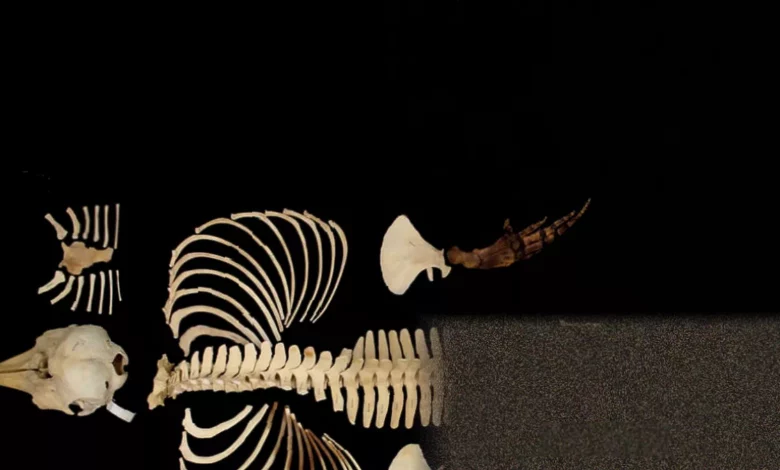
A digital replica of the world’s rarest marine mammal has been created. Scientists have produced a three-dimensional reconstruction of a female vaquita’s skeleton, using a combination of medical imaging, ultra-high-resolution micro CT scans and photography, to ensure its anatomy can be studied without risking damage to the fragile physical specimens.
The project was based on a complete skeleton collected in 1966 and involved a research team from Florida Atlantic University, the San Diego Natural History Museum, SeaWorld California and NOAA Fisheries. The skeleton belongs to the vaquita (Phocoena sinus), a small porpoise found only in Mexico’s northern Gulf of California. Because so few vaquita skeletons exist – only a handful are thought to be held in collections – access is extremely limited. The team has made the imaging freely available online so that scientists around the world can examine the animal’s anatomy in full detail.
Inside the digital reconstruction
The imaging process combined hospital-grade CT scanning with microscopic CT imaging capable of revealing structures smaller than the width of a human hair. Thousands of scan slices were then assembled into three-dimensional models of every bone, producing a highly detailed representation from the overall skeleton down to microscopic bone structures. The study was published in the journal Marine Mammal Science.
Jamie Knaub, the study’s lead author and a doctoral researcher at Florida Atlantic University, said: “We want to influence conservation and awareness of the vaquita, but what it boils down to is open access datasets for biodiversity. There’s this whole web [of information] that can be shared to study biodiversity, conservation, evolution – there’s so many things that can come from one dataset.”
The extinction threat
The vaquita’s plight is dire. A 1997 survey reported about 600 individuals in the wild; today, the WWF estimates that only seven to ten remain, making it the rarest marine mammal on Earth. The species is found exclusively in the northern Gulf of California, a limited range that makes it particularly vulnerable to localised threats. The primary driver of its decline has been bycatch in gillnets used by illegal fisheries targeting the totoaba, a large fish whose swim bladder commands high prices on international hidden markets, notably in Asia where it is prized for its supposed medicinal properties. The vaquita was only recognised as a distinct species in 1958. It is the smallest member of the whale, dolphin and porpoise family, growing to about five feet in length, and is distinguished by dark markings around its eyes and mouth.
How the digital model aids conservation and research
Because vaquita skeletons are so rare, researchers have often been unable to study them directly. Museums are wary of loaning out specimens that are fragile or irreplaceable. The digital model overcomes this by providing a permanent, high-resolution record that can be examined, measured and manipulated without any physical contact. Knaub noted: “There’s a lot of people who don’t have access to museum specimens, or museums are wary of loaning out specimens because of how fragile or rare they are.”
The open-access dataset allows scientists worldwide to study the species’ anatomy and evolution. It also enables the production of accurate replicas for museum exhibits and classrooms, helping introduce more people to the vaquita and the broader issues of marine conservation. The project aligns with a growing trend in natural history museums to digitise their collections. Similar initiatives, such as oVert in the United States and Ozboneviz in Australia, aim to make rare specimens accessible to researchers around the globe, removing the need to rely on photographs or to seek permission to handle delicate originals.
The level of detail captured by the imaging techniques – from whole-bone structure down to features finer than a human hair – means the model can support research not only in conservation but also in evolutionary biology and biodiversity studies. As Knaub put it, “There’s this whole web that can be shared to study biodiversity, conservation, evolution – there’s so many things that can come from one dataset.”