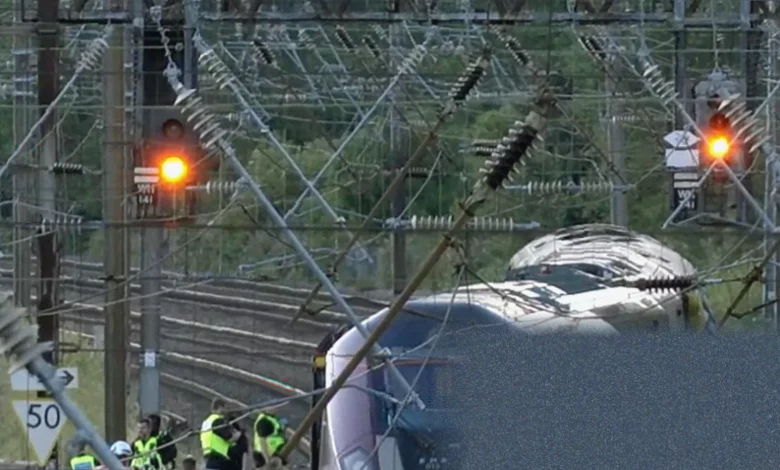
Nine people are in a critical condition after the Bedford train crash that killed the driver of one of the trains, police have confirmed. British Transport Police Chief Constable Lucy D’Orsi said on Saturday that of the 89 people injured in the collision, 28 remained in hospital.
Survivor recounts violent collision
A survivor of the crash has described how passengers were flung across the carriages, leaving a trail of broken bones, deep wounds and profuse bleeding. Brett Byatt, a teacher from Bedford, was on board the East Midlands Railway (EMR) service that rammed into a slower-travelling train south of Elstow on Friday evening. He told the BBC’s Today programme that the train was not at full speed and estimated they were only about five minutes into their journey when the collision happened.
Survivors reported a sudden, violent jolt with no prior warning – no screeching of wheels, no sirens or alarms. Some likened the impact to a bomb explosion. Byatt said the carriage layout made matters worse. “The people in first class ended up with stomach and rib injuries, because they went into the tables they have in first class, and EMR trains, the way that they’re structured with seats, was probably the worst way it could have been structured for a train crash. They [the seats] face each other in the three by three and the two by three, and … when people flew into one another, the seats that they were on, like, broke backwards into the people behind them.”
Byatt estimated that 90 per cent of passengers in his carriage were injured. “I’d probably say from three to four of us were uninjured in a full carriage; everyone else had either a serious wound that was bleeding profusely, or a situation where they couldn’t stand, or they couldn’t move their neck, and I saw a woman snap her leg.” Scenes of chaos followed, with passengers crying, screaming and smoke reported in some carriages. Byatt and other passengers began administering first aid until emergency services arrived ten minutes later. He believed he escaped injury because he was standing near the doors, clutching a stanchion.
Asked how he was feeling in the aftermath, Byatt said he initially felt shocked but was now “pretty angry”. “I don’t know at whom, who specifically, but it’s more about the, we’ve got one of the oldest railway networks, and signal failures happen a lot, and now I’m just wondering, why would a train driver lose his life over this?”
Official response and investigation
Chief Constable D’Orsi acknowledged there would be many questions about what happened on Friday evening and asked the public to refrain from speculating. “Specialist investigators from the British Transport Police are working with colleagues at the Rail Accident Investigation Branch to establish the facts and determine what happened.” She thanked the emergency services for their “outstanding” response and local people who showed “immense kindness” to those stranded.
The East of England Ambulance Service declared a major incident. Strategic Commander Paul Gates said 11 people sustained very serious injuries, a further 32 had serious injuries, and another 56 were left with minor injuries. “Those with less serious injuries were treated on scene or conveyed to hospital as required,” he said. In total, the ambulance service transferred 64 patients to hospital, deploying six air ambulances and specialist Hazardous Area Response Teams. Bedfordshire Fire and Rescue Service Chief Fire Officer Andy Hopkinson described it as a “deeply distressing incident”. He added that the ambulance service was called at 5.14pm on Friday, and more than 70 firefighters and officers attended the scene.
Network Rail said it was “deeply saddened that a railway colleague has tragically died” and confirmed teams were on site working with emergency services and industry partners. East Midlands Railway confirmed the involvement of its services – the 4.40pm from Corby to London St Pancras and the 3.50pm from Nottingham to London St Pancras – and said it was assisting with the response. The collision was a rear-end impact involving a Class 810 bi-mode multiple unit (number 810015), which entered service only in December of the previous year, and a Class 360 electric multiple unit (number 360115), which has been in service for at least two decades.
A team of inspectors from the Rail Accident Investigation Branch has been sent to the site to gather evidence. Tony Miles, a prominent railway journalist, told the Today programme that the train would have a black box data recorder. “The signal system has a data recorder, they will know every switch that was pressed, they’ll know every control that was activated in both of the trains, they will have second-by-second data from the trains as to what was going on, so I suspect that there’s probably people who’ve got a reasonable insight into what happened already, but that doesn’t mean they’ll release it,” he said. The investigation is expected to focus on the signalling system and potential faults.
Government officials responded swiftly. Transport Secretary Heidi Alexander expressed deep sadness and confirmed a full investigation would take place. Prime Minister Keir Starmer called the incident “hugely concerning” and thanked emergency services. Health Secretary James Murray was being kept updated. Buckingham Palace said the King was “greatly saddened” to hear about the crash and was being kept regularly updated on developments. “His thoughts and sympathies are with the family of the deceased and with all those injured or affected by such a tragic incident,” a spokesperson said.
The train drivers’ union ASLEF offered its thoughts for the driver’s family, friends and the injured passengers. The RMT said it was devastated at the loss of a “train driver and former RMT rep”.
All East Midlands Railway services to and from London St Pancras were suspended for the remainder of Friday, and disruption was expected to continue. Thameslink also suspended services between Bedford and Luton. Passengers were strongly advised not to travel on affected routes. The collision is the worst rail accident in Britain in over two decades, coming after a previous collision in mid-Wales in October 2024 that resulted in one passenger death and four serious injuries. The Ladbroke Grove disaster in 2000, which killed 31 people, was caused by a train passing a red signal, and concerns have been repeatedly raised about the age of the UK’s railway network and the frequency of signal failures.