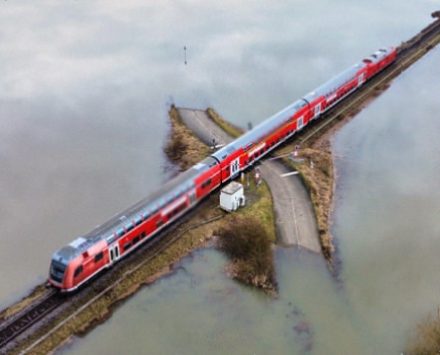
Europe is entering a new era of climate disruption, where winter is increasingly defined by relentless, deadly floods, even as political resolve to tackle their root cause appears to be ebbing. The human cost of this contradiction is being felt in communities across the continent, from the sun-baked hills of southern Spain to the riverbanks of Paris.
In the final days of last year, two friends from the Spanish town of Alhaurín el Grande, Francisco Zea Bravo and Antonio Morales Serrano, went for a meal in Málaga and never returned. Driving home, their van was caught in a sudden, violent torrent on the Fahala River. The mayor later described it as an “uncontrollable torrent,” a phrase that now echoes a wider, uncontrolled crisis. The pair were mourned as a dedicated maths teacher and a popular cafe owner; their deaths left a book club, a rock band, and a community diminished.
Their tragedy was not an isolated event but part of a relentless sequence. Since last autumn, a conveyor belt of storms has battered southern and western Europe, their rapid succession leaving no time for recovery. The season began with storms Alice, Benjamin and Claudia in October and November. David, Emilia and Francis led to a sodden December. Then, in a stark illustration of the accelerating pattern, five storms—Goretti, Harry, Ingrid, Joseph and Kristin—struck in quick succession in January, followed by Leonardo, Martha, Nils, Oriana and Pedro in just the first half of February. Meteorologists, using a collaborative European naming system designed to improve public warnings, are racing through the alphabet.
A Continent Saturated
The scientific explanation is clear. A southward shift in the jet stream, blocked by high pressure over northern Europe, has parked these weather systems in place. Global heating supercharges them, as warmer air holds more moisture. The result is rain falling on ground already waterlogged from the previous deluge, exponentially increasing flood risk.
In France this February, the consequences were recorded in historic terms. The national flood monitoring service, Vigicrues, reported unprecedented levels of soil saturation, with 81 departments under weather alert. The Seine in Paris rose four meters, shutting motorways and rail stations, while the Garonne River overflowed, isolating villages. Christophe Cassou, a climate research director at the French National Centre for Scientific Research, stated the flooding was unprecedented in area due to record cumulative rainfall since the year’s start. “What is surprising,” he noted, “is that the authorities are surprised by such an outcome.”
Neighbouring Portugal has counted at least 16 storm-related deaths since late January. Storms like Kristin, with winds over 130 km/h, have caused widespread damage and power outages, following a January 2025 that was the country’s second wettest since 2000. In the UK, records have been broken for consecutive rainy days, with December 2024 seeing above-average rainfall, particularly in Scotland.
The threat extends to Europe’s major river systems. The Rhine and Danube face compounded risks from glacier retreat, summer low flows, and winter floods. France’s Seine is projected to suffer more frequent summer droughts, while Spain’s Duero River is seeing declining runoff. The continent’s hydrological backbone is being fundamentally altered.
Warnings Ignored, Lessons Unlearned
This escalating physical reality is colliding with a faltering political response, where a dangerous form of climate denial is gaining influence even in Europe, where public acceptance of the science remains high.
The disaster in Valencia in late October 2024, which killed 229 people after delayed official warnings, was a horrific case in point. Empar Puchades, a 70-year-old former healthcare worker, recalled checking official meteorological platforms herself, distrusting assurances the storm would pass. After warning her neighbours, she watched a “tongue of water” approach her home. A subsequent study in Nature Communications found global heating increased the rain intensity in that event by 21% and expanded the area under extreme rainfall by 55%.
Such catastrophes have led the EU’s own scientific advisers to decry Europe’s adaptation efforts as “insufficient, largely incremental [and] often coming too late.” In a recent report, the European Scientific Advisory Board on Climate Change warned officials to prepare for a world 2.8-3.3C hotter than pre-industrial levels by 2100—far beyond the Paris Agreement goals. Maarten van Aalst, a board member, warned that even current warming is producing “extreme events that surprise us and that kill people when they possibly shouldn’t have if we had anticipated better.”
The Political Retreat
Yet, as rivers burst their banks, a political retreat is underway. Centrist leaders, alarmed by electoral gains for far-right parties, are rolling back green rules with surprising vigour. These far-right groups, for whom fighting climate policy is often a second priority after immigration, are increasingly collaborating in the European Parliament to delay environmental legislation and weaken sustainability rules.
Their efforts are aided by external actors like the US-based Heartland Institute, a thinktank funded by fossil fuel interests with a history of promoting climate denial. Simultaneously, pressure is coming from within the transatlantic alliance. US Energy Secretary Chris Wright, a former fracking executive, has publicly urged the International Energy Agency to “drop the climate” from its models, emphasizing energy security while questioning net-zero targets and pressuring Europe to roll back methane standards.
The cornerstone of EU climate policy, its Emissions Trading System (ETS) carbon price, is now in the crosshairs. Powerful industries, including the chemical sector, are lobbying hard for reduced costs and a greater share of ETS revenues, arguing it harms competitiveness. This pressure is being felt at the highest levels, even as European Commission President Ursula von der Leyen has defended the system.
Against this backdrop of political friction, the planet continues to warm. With global temperatures already about 1.4C above pre-industrial levels, the 1.5C threshold is nearing, a target few experts believe is still within reach. Scientists stress that “every fraction of a degree” of further warming still matters profoundly.
Back in Alhaurín el Grande, Conchi Navarro, the headteacher who lost her friend and successor Francisco Zea Bravo, articulates the weary reality for many. Having witnessed the changes first-hand over 60 years, she dismisses claims that the crisis is an invention. After the school held a silent memorial for the teacher, she observed a slow recovery from the trauma. But the rhythm of the new climate offers no respite. “Now we will wait for the fires in summer,” she said, summarising a continent caught between drowning and burning, between clear science and deepening denial.