Climate change is turning the world’s oceans into a more dangerous environment, with rising temperatures driving the spread of flesh-eating bacteria along coastlines, scientists have warned. As the seas absorb more than 90% of the excess heat trapped by greenhouse gas emissions, conditions are becoming increasingly hospitable to Vibrio bacteria, particularly the lethal Vibrio vulnificus — a pathogen so potent it can kill within 24 hours. Researchers now document this ancient lineage of marine microbes expanding into waters once too cold to support them, pushing as far north as Maine along the US east coast and appearing with greater prevalence in temperate seas around the world.
The science behind the spread
Vibrio bacteria are part of a family that likely emerged around the Paleozoic era, with more than 70 species present in the environment today. The organisms float in warm, brackish water, attaching to plankton and algae and accumulating in filter-feeders such as clams and oysters. Of these species, only a small number can sicken humans. Vibrio vulnificus is the most dangerous, capable of causing necrotizing fasciitis — the destruction of flesh — and life-threatening septicemia. Another species, Vibrio parahaemolyticus, is the most common cause of vibriosis and typically results in gastroenteritis or food poisoning.
Research consistently shows that temperature and salinity are the largest predictors of Vibrio abundance. The bacteria become active in water temperatures above 60°F (15.5°C) and multiply rapidly as coastal waters warm through summer. As sea surface temperatures rise, so does the concentration of Vibrio in seawater — directly boosting the risk of infection for beachgoers and shellfish consumers. Scientists view these bacteria as a first warning signal of changing marine conditions. In Europe’s Baltic Sea, a spike in Vibrio infections in July 2014 closely mirrored a heatwave that rapidly warmed the shallow sea, demonstrating that Vibrio spikes can herald unusual marine warmth and are now used as barometers for ocean heatwaves and sea-surface warming patterns.
The northward expansion is stark. A 2023 study analysing a 30-year database of confirmed Vibrio vulnificus infections from outdoor recreation along the US Gulf and Atlantic coasts found that the northern boundary of infections has moved at a rate of 30 miles per year since 1998. “In the 1980s, Vibrio abundance would increase in the late spring and stay high through the summer and drop in the middle of October,” said Kyle Brumfield, a microbiologist at the University of Maryland who conducts research on Vibrio in Maryland. “Now … we can pretty much find them almost year-round.” The study warned that infections may expand their range to encompass major population centres around New York, and that annual case numbers could double as temperatures rise and the elderly population grows.
Human impact and infection risks
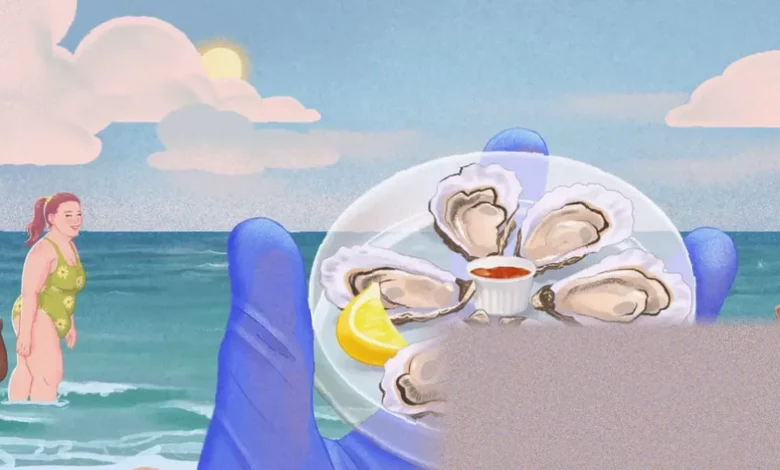
Anyone can get infected, but individuals with liver disease, diabetes, HIV, cancer, or weakened immune systems are at much higher risk of severe complications and death. The infection occurs through two main routes: consuming raw or undercooked seafood, especially oysters, or exposing an open wound to warm coastal waters. Vibrio vulnificus is so potent it can squeeze through a pinhole-sized cut. The US Centers for Disease Control and Prevention (CDC) estimates that about 80,000 cases of vibriosis occur annually in the US, resulting in around 100 deaths. While V. vulnificus causes only an estimated 150–200 cases per year, it accounts for the majority of Vibrio-related deaths, with fatality rates ranging from 15% to 50% depending on the person’s health and route of infection. Foodborne cases are fewer but deadlier: 32% of patients who contract vulnificus by eating contaminated shellfish die, compared with 13% of those infected via open wounds.
The bacteria’s astonishing speed makes it a unique public health threat. In the last five years (up to the time of reporting), the CDC registered 429 V. vulnificus wound cases and 136 foodborne cases. Most cases occur in the Gulf and Atlantic coastal regions. In 2022 and 2024, years when brackish water was pushed inland by major hurricanes, Florida’s public health department reported 17 and 19 deaths, respectively, linked to vulnificus exposure via open wounds. North Carolina, New York and Connecticut also saw small clusters of infections during a record-breaking heatwave in the summer of 2023. The CDC warned in its investigation: “As coastal water temperatures increase, V. vulnificus infections are expected to become more common.”
On the ground, researchers are witnessing the human reality. Bailey Magers and Sunil Kumar, scientists from the University of Florida, work on Pensacola Beach under the Florida sun, dressed in protective layers and surrounded by bags of disinfectant and test tubes. They study Vibrio to understand where and when harmful species are present across the state. An older woman in a swimsuit once approached them, asking directly: “Are you looking for that flesh-eating bacteria?” They answered carefully, not wanting to frighten her. Moments later, they noticed she had scrapes and bruises on her body before she stepped into the waves. The incident underscored the quiet risk that many beachgoers face without knowing it.
Predicting the future and managing risk
Magers and Kumar are part of a laboratory effort at the University of Florida to create a Vibrio early warning system for the eastern US — a programme that can alert public health departments to high Vibrio concentrations a month in advance. Alongside microbiologists from the University of Maryland, the team developed a computer model that predicts high-risk coastal counties by pairing the CDC’s count of Vibrio-related illnesses from 1997 to 2019 with satellite data on water temperature and salinity. When first evaluated, the model was only 23% precise in pinpointing high-risk counties, but it was very good at determining low-risk areas. Significantly, it performed especially well in predicting high-risk counties ahead of Hurricanes Helene and Milton in 2024 — extreme weather events that, as the climate crisis intensifies, are becoming more common.
“How many limbs would be saved,” Magers wondered, “if doctors and nurses could be warned ahead of time that their emergency rooms would soon see an uptick in these chronically underdiagnosed infections?” The tool could also help the shellfishing industry supplement existing Vibrio control plans — protocols that require harvesters to rapidly cool their catch onboard and refrigerate it within a set number of hours. These measures have proven effective, especially in states with aggressive enforcement. But the system is not a replacement for established methods; rather, it could provide advance notice when upcoming weather patterns deviate from historical norms — something happening more frequently.
The shellfish industry, however, is wary. Media attention on Vibrio infections — often using the alarming term “flesh-eating bacteria” — has a significant negative impact on consumer confidence. A 2024 study in Rhode Island found that showing participants a real newspaper article about a Vibrio outbreak reduced their willingness to bid on raw oysters and clams. Industry representatives argue that personal responsibility is the primary way to bring caseloads down. “The person is the risk,” said Leslie Sturmer, a researcher with the University of Florida’s shellfish aquaculture extension programme. “Not the climate, not the water, not the bacteria.” But that perspective does not account for the rapid marine changes brought on by the climate crisis, the patchiness of public awareness, and the fact that many Americans make decisions at odds with their own health.
Sturmer notes that the term “flesh-eating bacteria” is a misnomer — the bacteria destroy tissue rather than “eating” it — and points out that Group A Streptococcus is actually a more common cause of necrotizing fasciitis in the US. Yet the gruesome nature of vulnificus infections makes them irresistible to news headlines, even though the bacteria remain exceedingly rare. The CDC reports between 150 and 200 cases a year; by comparison, chlamydia infects more than 1.5 million Americans annually. But vulnificus’ astonishing speed and high fatality rate, combined with the expanding pathways of exposure driven by climate change, make it a distinct and growing concern.
As the world moves deeper into the 21st century, the overlap between climate science and public health will only increase. If current greenhouse gas emissions continue, most coastal communities along the east coast will be environmentally primed for vibriosis outbreaks during peak summer months by midcentury. The question will no longer be if there will be more cases, but how to manage them. Magers is blunt about what lies ahead: “In 30, 40, 100 years, these models won’t even matter because the risk is so high. When it gets to that point, it would probably be a different kind of modeling strategy where we’d be modeling case numbers instead of infection risk.”