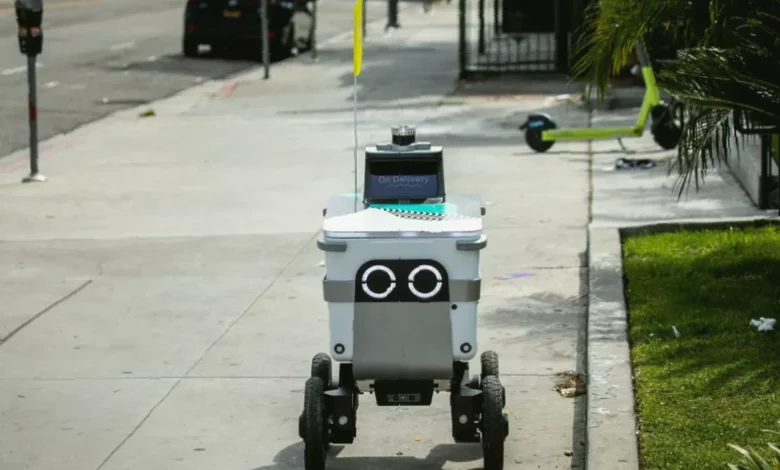
Serve Robotics, the autonomous delivery company listed on Nasdaq, has seen its shares tumble 50% from their 52-week peak, wiping out billions in market value as investors reassess the viability of its robot-driven business model. The stock now trades at roughly $9.40, well below its 50-day and 200-day moving averages — a technical signal that sentiment has turned decisively negative.
How Serve Robotics makes its money
Serve’s proposition is straightforward on paper. The company builds and operates self-driving robots — essentially boxes on wheels — that navigate pavements and roads to deliver takeaway food from restaurants to customers’ homes. The pitch is that this removes the cost, congestion and pollution associated with car-based delivery, while also cutting down on lost orders. By February 2026 the firm had around 2,000 robots in active service, according to company figures.
The so-called last-mile delivery market is enormous, with households in the UK and US spending heavily on takeaways. Serve aims to capture a slice of that by offering restaurants a cheaper, more reliable alternative to human couriers or gig-economy drivers. But the theory has run headlong into a series of practical obstacles.
Technical flaws, fierce competition and a hostile public
First, the technology itself remains imperfect. Despite years of development, Serve’s robots still get stuck on kerbs, lose their bearings and suffer from theft of the food they carry. These are not edge cases: operational data from the company and reports from early-adopting cities suggest reliability is a persistent headache.
Competition is also thickening. Rivals such as Coco Robotics and Starship Technologies are pushing similarly aggressive expansion plans. Meanwhile, the major food-delivery platforms — Uber Eats, Deliveroo, DoorDash — are experimenting with their own in-house solutions, including self-driving cars and drones, which could eventually bypass pavement-bound robots altogether.
But the most significant headwind, and the one that has drawn the loudest public and regulatory backlash, is the deep unpopularity of the robots themselves, particularly in the United States. Pedestrian groups have raised genuine safety concerns, arguing that the machines create hazards for the elderly and people with disabilities, who may struggle to step aside quickly or predict a robot’s movement. Others simply find the sight of autonomous boxes roaming the streets unnerving, and vandalism has been a recurring problem.
The backlash has translated into political action. Parts of San Francisco and Chicago have blocked or severely restricted the expansion of delivery robots, and there are widespread calls for outright bans in several other urban areas. Restaurants, too, have turned against the technology. Research compiled by short-seller Edwin Dorsey indicates that many eateries have abandoned Serve’s robots because they delivered few or no cost savings in practice — undermining the core economic argument for the service.
Financial outlook and the case for going short
All of this is playing out against a punishing financial backdrop. Serve Robotics is projected to remain loss-making for the next several years, according to consensus estimates. Yet its share price had, until recently, been priced for perfection: the stock trades at 20 times forward sales and a staggering 262 times current revenue. For context, most fast-growing technology firms command a multiple of between seven and ten times sales.
That valuation gap, combined with the operational and regulatory headwinds, has led some market participants to bet against the stock. The original analysis that flagged these figures advised going short at the current price of $9.40, with a stop-loss set at $18.40 — implying a total downside risk of £900 per £100 position. The sharp drop from the peak already vindicates that caution, though the underlying risks remain unchanged.