German defence unicorn Stark seeks €300m as Peter Thiel deepens push into European drone arms race

Germany’s defence startup Stark is in talks with investors to raise at least €300 million in a new funding round that could value the company at roughly €2.5 billion, according to reports. The deal would more than double its valuation from earlier this year, when it became Europe’s newest military technology unicorn after crossing the €1 billion mark.
The company’s rapid ascent reflects a broader boom in European defence technology, driven by surging government spending and the shift toward autonomous warfare systems. Stark was founded in 2024 by Florian Seibel, the creator of Quantum Systems, alongside Johannes Schaback. Seibel has since stepped away from day-to-day operations, with Uwe Horstmann, a general partner at Project A, taking over as chief executive.
The reported €300 million round comes just months after Stark secured funding that pushed its valuation above €1 billion. Its previous fundraising history underscores the pace of investor interest: in October 2024 the company raised €14 million at a valuation of roughly €90 million; by April 2025 Peter Thiel had invested $15 million as an angel; and in August 2025 Stark raised $62 million at a $500 million post-money valuation, led by Sequoia Capital and including Thiel Capital, the NATO Innovation Fund, In-Q-Tel, Project A, Döpfner Capital, and 8VC. Another $60 million round at a similar valuation was also reported that month.
Autonomous strike technology and the Virtus platform
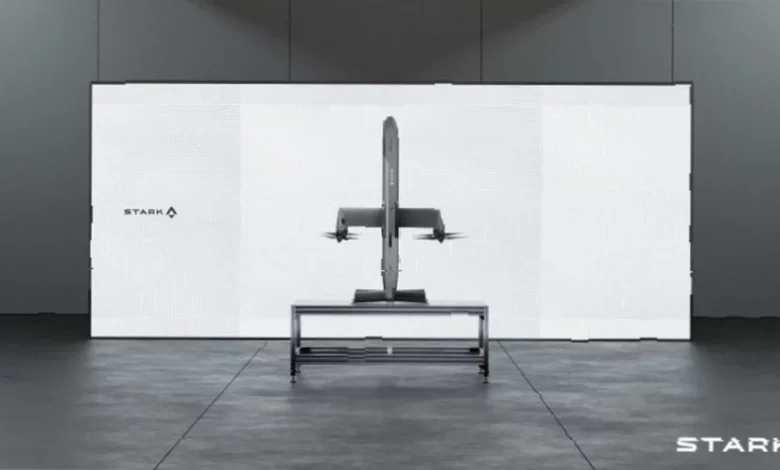
Stark specialises in loitering munitions — often called kamikaze drones — and has built its market appeal around a single flagship product, Virtus. The drone is a vertical take-off and landing (VTOL) one-way attack system capable of carrying a five-kilogram payload, diving at up to 250 kph, and reaching targets 100 kilometres away. It is designed to autonomously identify and strike an objective before self-destructing on impact, lowering the cost and risk of precision attacks compared with traditional military hardware.
The company also developed Minerva, a command and weapons control system that allows operators to swarm multiple Stark drones in coordinated strikes. Together, Virtus and Minerva place Stark at the centre of a broader shift toward low-cost autonomous warfare — a segment of the defence market that analysts expect to grow rapidly. The global autonomous weapons market is forecast to reach $29.65 billion by 2033, while the loitering munition market alone could hit $13.26 billion by 2030.
Despite the technological promise, Stark has faced setbacks. The company encountered technical difficulties during military trials in both Germany and the UK last year. Nevertheless, it has continued to secure major contracts. One significant deal — a German military contract for autonomous strike drones — was reported to be part of a wider push by European governments to strengthen sovereign defence capabilities in the wake of Russia’s full-scale invasion of Ukraine.
European defence budgets have risen sharply. Germany announced an additional €100 billion for defence in February 2022, and total defence spending by EU member states increased by more than 30 per cent between 2021 and 2024, reaching approximately €326 billion. Venture capital has followed. PitchBook data shows that VC flows into defence technology hit $49.9 billion globally in 2025, nearly double the previous year’s total. In the first half of 2025 alone, European defence startups received €946.2 million.
Rivals, investors and the Thiel factor
Stark operates in a crowded field of well-funded competitors. Munich-based Helsing develops AI-powered military software, autonomous systems and battlefield intelligence platforms. Helsing is reportedly nearing a $1.2 billion funding round at an $18 billion valuation, which would make it Germany’s most valuable startup. In June 2025 it raised €600 million at a valuation of roughly €12 billion. Helsing pitches its approach as “ethical AI” for military applications, distinguishing itself from rivals that focus purely on weaponised systems.
Another significant competitor is Quantum Systems, the surveillance drone company also founded by Florian Seibel. Quantum Systems raised €160 million in Series C funding in May 2025, followed by an additional €180 million in November 2025, bringing total 2025 funding to €340 million and a valuation above €3 billion. Its backers include Peter Thiel, Porsche, and Airbus.
On the global stage, Anduril remains the most formidable player. The US defence technology giant recently raised $5 billion at a $61 billion valuation, doubling its valuation in less than a year. Peter Thiel’s Founders Fund contributed $1 billion in a previous round, and Anduril holds a $20 billion, ten-year contract with the US Army.
Peter Thiel’s involvement across Stark, Quantum Systems, and Anduril has become a recurring — and controversial — feature of the European defence tech landscape. While his Thiel Capital has been a direct investor in Stark, his investment has drawn political scrutiny in Germany because of his past associations. The controversy has led to calls for clarification about his influence on the company’s direction. Thiel is also considered part of an ecosystem that includes Helsing, although he does not invest directly in that firm.
The same group of investors — Sequoia Capital, the NATO Innovation Fund, In-Q-Tel, Project A, Döpfner Capital, and 8VC — has backed Stark across multiple rounds. Project A, a Berlin-based venture capital firm, also supplied Stark’s chief executive, Uwe Horstmann.
The wider shift in venture capital sentiment has been dramatic. Defence technology, once largely avoided by mainstream investors, has become one of the hottest sectors in global VC. The war in Ukraine, rising geopolitical tensions, and growing demand for autonomous military systems have accelerated investment across Europe and the United States. For Stark, the reported €300 million round would mark another milestone in its remarkably swift rise from startup to unicorn. Yet execution remains the critical test. As Europe races to build its own defence champions, companies such as Stark, Helsing, and Quantum Systems are not only competing for capital but also for military contracts, technological leadership, and a central role in shaping the future of autonomous warfare. Meanwhile, ongoing civil society initiatives advocating for a ban on fully autonomous weapon systems continue to press ethical and legal questions about accountability and compliance with international humanitarian law.