The relentless march of artificial intelligence is forcing a fundamental reckoning, not just in boardrooms and tech hubs, but across society itself. A potent narrative, drawn from science fiction, is gaining traction as a metaphor for our times: the spectre of a “Butlerian Jihad”, the fictional revolt against thinking machines from Frank Herbert’s Dune. This isn’t merely pop culture reference; it articulates a deep-seated fear that AI’s unchecked advancement could lead to a new form of societal enslavement and, ultimately, a violent backlash.
This anxiety is rooted in tangible economic forecasts. While proponents champion AI’s potential to unlock unprecedented productivity and create new roles in fields like data science and machine learning, the shadow of mass job displacement looms large. Estimates suggest AI could affect hundreds of millions of jobs globally by 2030, with high-risk occupations including programmers, accountants, and legal assistants. The World Economic Forum offers a nuanced picture, predicting a net gain of 58 million jobs by 2025, but this hinges on a rapid and disruptive churn—133 million new roles emerging even as 75 million are displaced.
The Middle Management Conundrum and a Growing Skills Gap
The disruption is not confined to routine tasks. The very layer of corporate leadership is in flux. AI systems are increasingly capable of the data analysis, reporting, and coordination that have traditionally defined many middle-management roles. This threatens not just jobs but the pipeline for future leaders, creating what some analysts warn could be a “judgment gap crisis”. The question of how young workers gain essential expertise if foundational work is automated is acute. Success in this new environment, experts suggest, will demand a hybrid skillset: both AI literacy and irreplaceably human skills like creative thinking, communication, and critical judgement.
This skills transformation is monumental, with estimates suggesting 70% of workforce skills will need to evolve within five years. The risk, however, is that the benefits of this transition will not be evenly shared. There is a palpable danger that AI will exacerbate inequality, concentrating wealth and opportunity among highly skilled workers in advanced economies while leaving others behind. This widening gap, coupled with the rapid pace of change, has led serious observers to warn of potential “civil unrest” if the deployment of AI outpaces the support systems for those it displaces—a modern echo of the Luddites, who were motivated by threats to their livelihoods and craft, not a naive hatred of technology.
Investors Pivot to the Tangible World
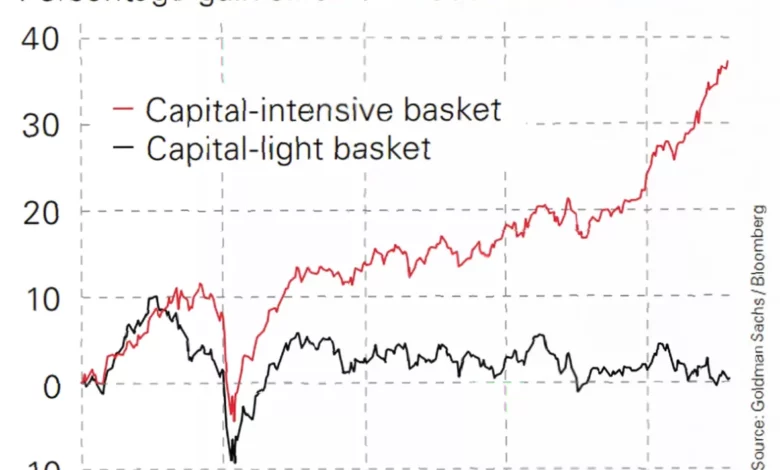
Amid this uncertainty, financial markets are already placing their bets. A significant rotation is underway, as investors shift capital away from speculative, knowledge-based sectors vulnerable to AI disruption and towards companies rooted in the physical world. This “HALO trade” (Heavy Assets, Low Obsolescence) favours tangible production capacity, infrastructure, and constrained resources—assets a large language model cannot replicate.
Sectors like energy, utilities, industrials, and commodities are attracting interest as investors seek a hedge against inflation and the volatility of a tech-driven transformation. As the investment team at Ruffer Investment Company notes, this trend is bolstered not just by AI disruption but by broader pressures including defence, energy security, and healthcare demands. It marks a stark reversal from the previous decade’s consensus, which prized asset-light, low-capital-expenditure business models. The new darlings of the cycle may well be the old-fashioned industries with hard assets and high barriers to entry.
Yet this financial hedging speaks to a deeper societal tension. The ethical terrain of AI is fraught with concerns over embedded bias, data privacy, and cyber vulnerabilities. More philosophically, fears persist that over-reliance on automated systems could erode human cognitive and social skills, while debates on AI sentience hint at future “social ruptures”. The fundamental paradox remains: if AI fails to deliver transformative economic gains, the vast capital invested may never pay off. But if it succeeds in doing everything its champions promise, the resulting social and economic dislocation could be profound. The path forward hinges on choices made today by policymakers, businesses, and individuals to manage this integration—a middle course between unthinking rejection and uncontrolled adoption that will define our collective future.