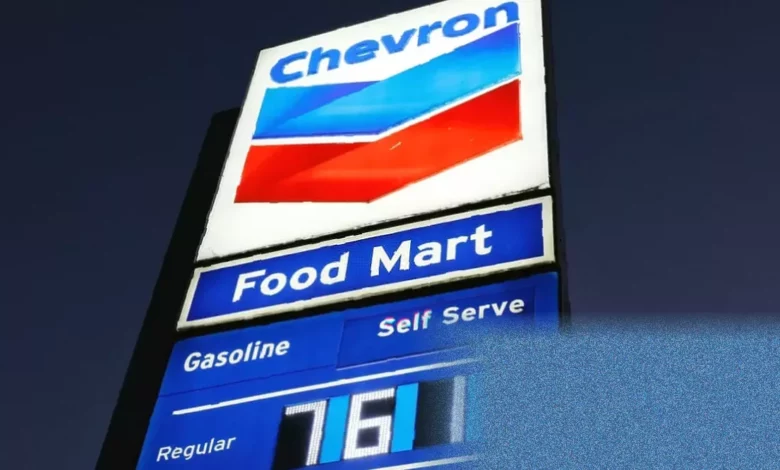
While the global shockwaves from the recent US and Israeli strikes on Iran have pushed petrol prices upwards across America, filling up in California has long felt like a uniquely punishing experience. Now, one station in Los Angeles has elevated that experience to what some customers are calling an outright “scam”.
The $8.31 Gallon and the ‘Lazy Tax’
At the Chevron station at 901 N. Alameda Street, on the fringe of LA’s Chinatown, the price for a gallon of regular fuel this week stood at a staggering $8.31. This is not a glamorous boutique but a reportedly dingy outlet that has become a recurring symbol of extreme fuel costs. Its price is a stark outlier, even for a city where the average, according to AAA, hovers around $5.37.
The station was largely deserted. During a 40-minute observation period, only two drivers purchased fuel. One, a woman with Nevada plates, quickly pumped and left. The other was Alex Markarian, a commuter from Pomona who works at the LA County Assessor’s office. He pumped 4.1 gallons at a cost of $34.56. “Where I live it’s cheaper by at least $3 a gallon,” he said, calculating he had paid a $12 premium “for just being lazy”.
An attendant, who declined to be named, initially suggested the downtown location justified the price, but demurred when asked why stations barely two miles away charged far less. The station’s ownership lies with Joe Bezerra Jr.’s Hawk II Environmental Group, a family with a history of operating independent fuel stations in Southern California. Attempts to contact the Bezerra family were unsuccessful.
Online reviews indicate a pattern of customer grievances with Hawk II operations. A mail carrier blasted its Hacienda Heights station for a $1 charge for a small amount of ice, while other reviews across its locations complain of exorbitant prices. One labelled the Alameda Street site a “scam”.
Why California’s Pain is Always Acute
The Alameda Street Chevron is an extreme case, but its high baseline is rooted in systemic factors that chronically place California at the top of the national price charts. As of March, it was the only state with an average above $5 a gallon, at $5.34, compared to a national average of $3.58.
First, the state imposes some of the highest taxes and fees in the nation, with approximately 90 cents of every gallon going to combined local, state, and federal levies. Second, stations are currently compelled to switch to a more environmentally friendly, and more expensive, summer-blend gasoline, which typically adds 15-17 cents per gallon.
Third, and critically, California’s refining market is under severe strain. The Phillips 66 refinery in Southern California has already shut down, and the Valero refinery in Benicia is set to close next month. This represents a significant loss of production capacity for a state that already imports over 60% of its crude oil from foreign sources.
The recent Middle East conflict has exacerbated this fragile situation. Attacks have disrupted oil flows through the critical Strait of Hormuz, causing oil prices to surge past $100 a barrel and pushing the national average up by roughly 20%. For California, reliant on long-distance imports, the cost of tanker shipments has reportedly nearly tripled since the strikes began.
This constrained and volatile market has long raised suspicions of manipulation. Governor Gavin Newsom’s administration has investigated potential collusion among the state’s limited number of refineries. A settlement was reached in October 2024 with two firms over collusion to manipulate spot market prices in Southern California, resulting in a $50 million settlement for purchasers.
Is It Legal to Charge $8.31?
Despite customer outrage, the exorbitant price at the Alameda Street Chevron is likely legal. Keven Chavez, a spokesperson for the LA County Department of Consumer and Business Affairs, confirmed that businesses can charge high prices unless the increases are tied to a declared federal, state, or local emergency. California’s price gouging law only caps increases above 10% during such officially declared emergencies. No such emergency for fuel prices is currently in effect.
AAA spokesperson Kandace Redd noted that wide price variations between nearby stations are not uncommon or illegal. “Prices can depend on factors such as traffic, rent or where the station gets its fuel,” she said, adding that stations in busy areas like downtown districts often charge more. The Chevron in question is wedged between tourist hub Olvera Street and the famed Philippe the Original restaurant, suggesting high operating costs.
Where the Real Profit Lies
Paradoxically, station owners like Joe Bezerra Jr. see very little profit from the petrol itself. According to the National Association of Convenience Stores (NACS), a trade group, the gross margin on gasoline was 39.7 cents per gallon in 2024, with net profits after expenses being far lower. The real money is made inside the shop.
Profit margins on drinks and snacks can easily exceed 40%. As such, the unhoused man who bought a bottle of Pepsi at the Alameda Street station may have contributed more to the outlet’s bottom line than Alex Markarian did with his $34.56 fuel purchase. This business model underscores why stations can afford to be fuel price outliers; they may not rely on pump traffic for their primary income.
For drivers like Markarian, however, the economic theory is cold comfort. His parting sentiment was unequivocal: “I won’t be stopping for gas here again, that’s for sure.” As California’s fuel market navigates refinery closures, global instability, and high fixed costs, his experience at the pump—a mix of necessity, frustration, and resignation—remains a common one, even if the price he paid was uniquely steep.