In the battered port of Odesa, a stark symbol of the war’s hidden environmental toll lies tethered and unexamined. The oceanographic research vessel Boris Alexander, damaged by Russian drones and shelling, lists in its berth. Warfare has rendered it too dangerous to inspect, a physical manifestation of a broader, terrifying reality: scientists cannot fully assess the catastrophic damage the conflict is inflicting upon the Black Sea.
“We can only wait,” says Dr Jaroslav Slobodnik, director of the Environmental Institute in Slovakia. “The biodiversity landscape is completely altered. A number of species seem to have disappeared, but we need more data. Data which the war makes it impossible to collect.” With areas like the Russian-occupied Crimean peninsula a no-go zone and constant military threat, comprehensive monitoring from the sea itself has ground to a halt. Scientists are forced to rely on distant eyes.
The Uncountable Damage
Satellite imagery reveals part of the story: dozens of Russian vessels at anchor off occupied shores, and the tell-tale slicks of oil spills from sunken ships. Viktor Komorin, a marine scientist at the Ukrainian Scientific Centre of Ecology of the Sea (UkrSCES), points to numerous sinkings and damaged vessels, particularly near Snake Island at the war’s start. “We can only monitor the multiple pollutants – very aggressive and very toxic,” he says, unable to conduct clean-up work. The pollution is a complex cocktail; research has identified at least 70 chemicals from weapons in the water, alongside unknown toxic substances. Unmoored naval mines drift, contaminating the sea with explosives and heavy metals and risking sudden detonations.
The scale of the disaster is compounded by a crippled scientific response. Mr Komorin’s institute in Odesa operates with half its former staff, as colleagues joined the army or relocated abroad. The damaged Boris Alexander remains dockside, its potential deployment deemed a high risk among the rockets, mines, and drones littering the waters. “We already know there’s a lot of dangerous objects out there,” Mr Komorin states.
Dolphins: The Sea’s Falling Sentinels
The most visible victims are the Black Sea’s cetaceans. Three species of dolphin lived here before the invasion. Since the conflict began, their carcasses have washed up with grim regularity along Ukraine’s 1,729-mile coastline. Scientists documented about 125 in the first year, and 49 last year, though these counts are acknowledged as severe underestimates given the war-weary population and inaccessible coastlines. Broader estimates suggest the war may have killed tens of thousands of dolphins.
“The dolphins are the sentinels of ecology of the sea, because they are at the top of the food chain,” explains Dr Slobodnik. Their deaths point to a multi-front assault. Aside from direct injury from munitions and the toxic burden of pollutants, a critical threat is acoustic. Military sonar and hydrolocators, used intensely by ships and submarines around strategic points like the Kerch Bridge, disorient the mammals, damage their inner ears, and lead to fatal strandings.
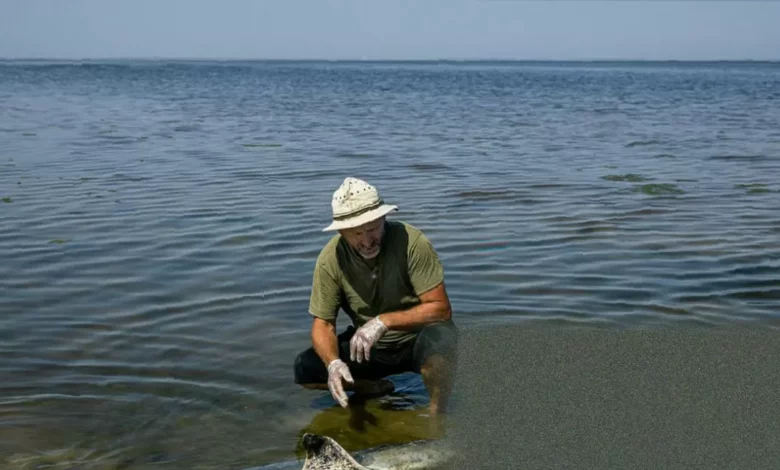
Despite the danger, Ukrainian scientists persist. UkrSCES is building a unique database of environmental DNA extracted from the stomachs of recovered dolphin carcasses, while also sampling the oils and pollutants fouling the coastline. This painstaking work offers a fragile hope for understanding and, one day, rehabilitating populations.
The Toxic Legacy of Kakhovka
If the war’s daily violence is a sustained poisoning, the destruction of the Kakhovka dam in June 2023 was a single, devastating blow. Widely believed to be an act of Russian sabotage, the collapse unleashed one of Ukraine’s largest environmental disasters. Eighteen cubic kilometres of water surged downstream, flooding hundreds of square kilometres and carrying a toxic slurry into the Black Sea.
The deluge washed in pollutants, lubricants, and chlororganic compounds. Crucially, it scoured an estimated 1.7 cubic kilometres of sediment from the reservoir bed, discharging approximately 83,300 tonnes of heavy metals – including lead, cadmium, and nickel – into the ecosystem. Dr Slobodnik describes it as “a toxic punch to the face of the Black Sea.” The long-term consequences are severe, potentially creating anoxic ‘dead zones’ as increased nutrient loads spur algal blooms. The event also caused a noticeable drop in coastal salinity and a spike in nitrogen levels from sewage, further stressing the fragile marine balance.
This disaster struck a sea already uniquely vulnerable. The Black Sea is the world’s largest anoxic basin, where 82% of its volume is a lifeless, hydrogen sulphide-saturated abyss. Only a thin, oxygenated surface layer up to 150 metres deep supports complex life. This stratified structure, coupled with limited water exchange with the Mediterranean, makes it exceptionally susceptible to pollution from its major feeder rivers, the Danube and the Dnipro.
It is a bitter irony for scientists who, before the 2022 invasion, had watched decades of recovery efforts bear fruit. By 2020, significant EU investment had helped Ukraine declare the Black Sea “alive” again, after years of battling industrial and agricultural pollution. Now, satellite images show new threats, like invasive “ugly, foaming red” plant species. The war may also be accelerating the spread of other non-native species, such as the Korean stone perch and the American blue crab, with impacts that may only be clear years hence.
EU-funded projects continue to support monitoring and capacity building, but the task is monumental. For experts like Viktor Komorin and Jaroslav Slobodnik, who dedicated their lives to the sea’s revival, the present is a period of agonised vigilance. They monitor, sample, and hope for a future where assessment and repair are possible. But for now, the true depth of the catastrophe, like the damaged hull of the Boris Alexander, remains shrouded in danger and despair.