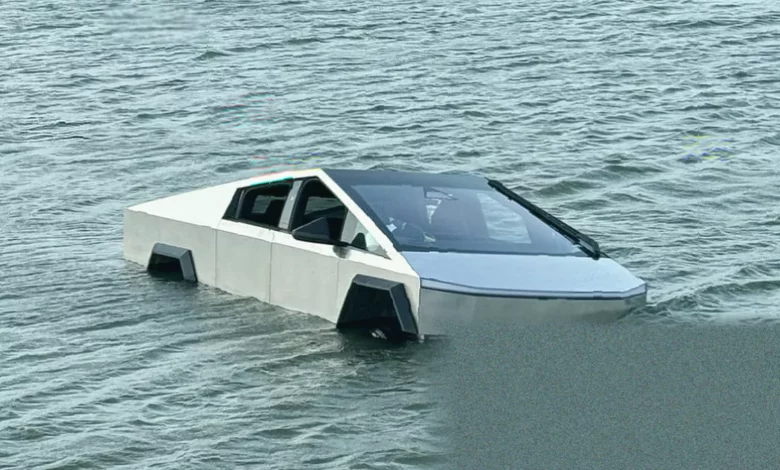
A Tesla Cybertruck was hauled from Grapevine Lake in Texas this week after its driver, 70-year-old Jimmy Jack McDaniel, deliberately drove into the water to test the vehicle’s “Wade Mode”. The Grapevine Police Department confirmed that the truck became disabled and partially submerged, prompting the driver and his passengers to abandon it before rescue crews arrived. McDaniel was later arrested and now faces a string of charges.
Arrest and Charges
McDaniel was taken into custody on allegations of operating a motor vehicle in a closed section of a park or lake, alongside multiple water safety equipment violations. According to Grapevine police, he also faces charges for failing to hold a valid boat registration and for lacking essential safety gear, including life jackets and a fire extinguisher. The incident occurred on Monday evening at Katie’s Woods Park Boat Ramp on Grapevine Lake, which reaches depths of up to 65 feet in places. Although the water near the shore was only about one foot deep, it quickly deepened. McDaniel reportedly told authorities he had used the Cybertruck’s Wade Mode on previous occasions without trouble, but this time he admitted to a “miscalculation”, suggesting water may have entered the truck’s charging port, causing a short circuit that shut down the steering system. He claimed to have driven the vehicle in the lake before, and even in the Atlantic Ocean, without problems. Two visitors from Germany were in the vehicle at the time, and the Grapevine Fire Department Water Rescue Team recovered the half-submerged truck.
How ‘Wade Mode’ Works – and Its Limits
According to Tesla’s Cybertruck owner’s manual, Wade Mode is designed to allow the vehicle to “enter and drive through bodies of water, such as rivers or creeks”. When activated, it raises the ride height to the “Very High” setting and pressurises the high-voltage battery to shield it from water and debris. The mode takes up to ten minutes to fully engage and has a maximum duration of 30 minutes, after which it automatically deactivates. The manual specifies a maximum wade depth of approximately 32 inches (815 mm), measured from the bottom of the tyre (some sources round this to 32.5 inches or 2.7 feet). Drivers are instructed to maintain a slow speed of between one and three miles per hour (two to five kilometres per hour) and to reduce speed further if water depth changes. All doors and windows must be fully closed, and the vehicle’s speed must be below 20 mph before the mode can be enabled.
Tesla’s warnings are explicit: it is the driver’s responsibility to gauge the depth of any body of water before entering. The manual cautions that the truck may sink in soft or muddy underwater surfaces, and that drivers should avoid strong currents or rapids. Critically, any damage or water ingress resulting from driving in water is not covered by the vehicle’s warranty. The company advises that if a vehicle does become submerged, the charge level should be as low as possible and the air suspension should be raised to “High” or “Very High” before abandoning it.
Tesla CEO Elon Musk has previously claimed the Cybertruck “will be waterproof enough to serve briefly as a boat, so it can cross rivers, lakes & even seas that aren’t too choppy”. Such statements have been interpreted by some owners as an invitation to test the vehicle beyond its intended limits, even though Tesla’s manual makes clear that Wade Mode is not a substitute for a boat. The Cybertruck, which weighs over 6,600 pounds, is designed to be more water-resistant than a conventional vehicle but is not truly waterproof.
Police Warnings and Legal Context
Grapevine police used the incident to issue a clear reminder: “We want to remind drivers that although a vehicle may be physically capable of entering shallow freshwater areas, doing so can create legal and safety concerns under Texas law.” Texas law prohibits operating a motor vehicle in a closed or barricaded section of a park or lake. Furthermore, any vehicle entering public waters must comply with boating regulations, including valid registration and the carrying of required safety equipment. Texas Parks and Wildlife rules mandate wearable life jackets for everyone on board and a throwable flotation device for boats 16 feet and longer; children under 13 must wear a personal flotation device on vessels under 26 feet. McDaniel’s charges reflect a lack of such equipment, including a fire extinguisher. The incident has also sparked online debate, with some users criticising the driver and others arguing that the name “Wade Mode” itself may be misleading. This is not the first time a Cybertruck has been driven into water and become stuck: a similar incident in 2025 prompted a response from Musk. Tesla’s owner’s manual remains firm: damage caused by driving in water is the owner’s responsibility, not the manufacturer’s.