Captured on a tree-mounted camera by University of Sydney researcher Bianca McBryde, a brush-tailed possum clambered into view, lowered its head over a nest and bit into an egg. The egg was a shop-bought quail’s egg, the nest a crafty construction of half a tennis ball, brown paint and coconut husk fibres. But the interaction has provided a crucial clue in the fight to save Australia’s critically endangered regent honeyeater from extinction: even infrequent raids by native possums on nests can significantly increase the species’ risk of disappearing within two decades.
McBryde’s experiment placed 40 artificial nests in trees at North Head in Sydney to measure how often brush-tailed possums would take eggs. Over two weeks, possums raided only four of the nests. As little as three decades ago, when regent honeyeaters were far more common, such occasional losses would have made little difference. “It’s likely possums have always done this occasionally and it wouldn’t have had an impact,” McBryde said. “The occasional egg here and there was probably just a part of the normal balance of things.” Yet when she fed the data into a computer model designed to assess the honeyeater’s prospects, the effect of these infrequent raids proved profound. For the small, fragmented populations of honeyeaters clinging on today, the loss of just a few eggs to opportunistic possums could increase their risk of extinction within 20 years by about 35%.
The modelling also revealed the broader consequences of nest predation by possums and gliding possums. With fewer than 250 regent honeyeaters likely left in the wild, confined to three sites on the periphery of the Blue Mountains west of Sydney, their probability of extinction over the next 20 years stands at about 90%, according to McBryde’s work. But if nest predation could be stopped or reduced, that probability could drop to 65%. “That gives us a bit more of a chance,” she said. The research, supported by BirdLife Australia and the Taronga Conservation Society, underscores how a threat that once was negligible has become critical as the population has plummeted.
Possums are not the only native animals raiding honeyeater nests. Some gliding possums, as well as native birds such as ravens, pied currawongs and butcherbirds, have also been observed taking eggs and chicks. The combined pressure on an already imperilled species compounds the challenge.
The honeyeater’s plight
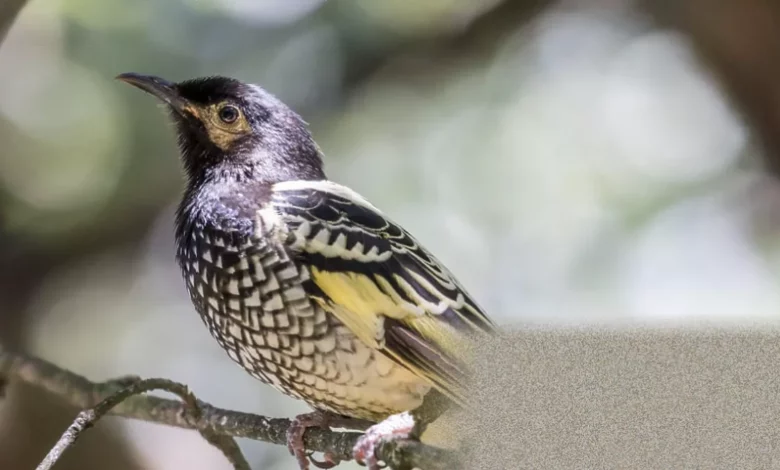
Regent honeyeaters are among Australia’s most threatened birds. Once seen in large, mobile flocks that pollinated eucalypt trees across vast distances, most of their woodland habitats have been cleared for development and farming. The species has experienced a 99% population decline, leading to a 9% loss of genetic diversity – a hidden extinction risk that increases the potential for inbreeding depression. They are now restricted to fragmented remnants of their former range. “They’re a uniquely Australian bird,” said Mick Roderick, the regent honeyeater recovery adviser at BirdLife Australia. “It can mimic the calls of other birds and it’s the only honeyeater on Earth that can do this. Their strategy was to arrive at blossom events and chase other birds away. Their flocking strategy doesn’t work any more. A flock might just be three birds.”
That talent for mimicry has become a symptom of the bird’s decline. With so few other male honeyeaters around to learn from, young males are picking up the calls of other birds instead. In a captive breeding program at Taronga Zoo, the full traditional song is played to young males through speakers so that when they are released they have a better chance of attracting a mate. Research published earlier this year outlined the success of this “song tutoring” approach: the bird’s full song had disappeared from the wild entirely, but it was rescued by teaching captive males, who could then reintroduce it when released.
Conservation efforts to buy time
With the species’ situation so dire, researchers and conservationists are exploring a range of non-lethal interventions to protect nests and boost breeding success. Roderick said the recovery team is investigating fitting collars around the trunks of trees where honeyeaters have built their nests, to discourage possums from climbing. However, the collars would do nothing to deter gliding possums, and honeyeaters do not nest in the same trees from one season to the next, making deployment difficult. The use of scent to confuse predators about nest locations is another line of inquiry, but McBryde’s research found that possums did not appear to be attracted to the smell of the nests. Ultrasonic sound is also being studied as a potential deterrent for both possums and gliders.
“It’s a wicked problem,” said Dr Ross Crates, an ecologist and regent honeyeater expert at the Australian National University (ANU). “These are urgent stopgap measures to prevent extinction.” Habitat restoration projects are underway to replant the eucalypt trees favoured by the honeyeater, but Crates noted that “their situation is so dire that we don’t have time to wait for the trees to regrow”. The captive breeding program, led by Taronga Conservation Society Australia since 1995 and involving partners such as BirdLife Australia and Zoos Victoria, has released more than 400 zoo-bred birds into the wild since 2008. Recent releases have taken place in New South Wales and Victoria, aimed at bolstering wild populations and increasing genetic diversity. Ongoing research by scientists at ANU, including Crates and Professor Rob Heinsohn, continues to inform conservation strategies, while community engagement and citizen science programs help monitor released birds and identify sightings.
“They’re in big trouble,” Crates said. “We wouldn’t want them to get any closer to extinction.”