As the Senate prepares for a critical debate on the so-called “Save America Act”, Donald Trump has issued a stark threat to his own party, vowing to withhold his endorsement from any lawmaker who votes against the sweeping election legislation and pledging to sign no further bills until it reaches his desk.
The president’s push comes as the bill, a rebranded and expanded version of the previously proposed Safeguard American Voter Eligibility (SAVE) Act, faces steep odds in the upper chamber. It would need 60 votes to overcome a filibuster, a threshold Senate leaders admit they lack.
A sweeping bill with a disputed purpose
The “Save America Act” would mandate documentary proof of US citizenship to register to vote and require strict photo identification to cast a ballot in federal elections. Proponents, led by the president, argue it is necessary to prevent non-citizens from voting—a claim experts say is baseless and for which evidence is exceedingly rare.
According to analysis by voting rights advocates, the bill’s requirements would create significant new barriers. Acceptable proof would include a US passport or a REAL ID-compliant identification; a standard driver’s licence would not suffice. The American Civil Liberties Union estimates this could disenfranchise up to 21 million Americans who lack such documentation, affecting married individuals who have changed their names, the elderly, young people, and citizens of colour disproportionately.
Furthermore, the legislation would effectively end online and mail-in voter registration and compel states to share their voter rolls with the Department of Homeland Security for verification—a process critics fear would lead to erroneous purges. David Becker, director of the Center for Election Innovation & Research, described it as “a recipe for disaster,” arguing it aims “to solve a problem that doesn’t exist.”
Trump’s all-or-nothing ultimatum
In a series of posts on his Truth Social platform, the president framed the vote as a litmus test for loyalty. He called the act “one of the most IMPORTANT & CONSEQUENTIAL pieces of legislation in the history of Congress” and declared that “Only sick, demented, or deranged people in the House or Senate could vote against THE SAVE AMERICA ACT.”
He ended with an all-caps promise: “I WILL NEVER (EVER!) ENDORSE ANYONE WHO VOTES AGAINST ‘SAVE AMERICA!!!’” This threat echoes a broader stance he outlined last week, where he vowed not to sign any further legislation until the bill is passed.
The president is also pushing for an amended version that includes a ban on most mail-in ballots—which he has said should only be allowed for illness, disability, military service, or travel—as well as bans on transgender people participating in women’s sports and gender-affirming surgeries for minors.
Political climate fuels rise in citizenship renunciations
Amidst this heated political environment, the administration has taken action on a separate issue affecting Americans’ relationship with their citizenship. The fee to formally renounce US citizenship will plunge from $2,350 to $450 in April, according to a final rule published to the federal register.
This fulfills a promise to reverse an unpopular fee hike adopted in 2015, but means the government will take a financial loss, as the new fee is below the actual cost of processing the requests. The move comes as record numbers of Americans are severing ties. Internal Revenue Service figures show 4,820 people sought a Certificate of Loss of Nationality in 2024, the third-highest annual total on record.
Analysts cite multiple factors: complicated US tax rules that require citizens abroad to file annually, banking difficulties, and, for some, a political or emotional disconnection. Notably, spikes in renunciations have coincided with political changes, including the start of Trump’s first presidency in 2017. The surge has created a global backlog exceeding 30,000 applications, according to an analysis by the Outbound Investment Group.
Funding impasse paralyses key security agencies
Meanwhile, a separate legislative standoff has left parts of the Department of Homeland Security shuttered for a month, forcing many employees to work without pay. In response, top House Democrat Hakeem Jeffries announced he will launch a discharge petition to force a vote on funding for specific agencies.
Jeffries needs 218 signatures to proceed with legislation to fund the Transportation Security Administration, the Federal Emergency Management Agency, the Cybersecurity and Infrastructure Security Agency, and the Coast Guard. The impasse stems from Democratic demands for stronger guardrails on federal immigration enforcement, which Republicans have called non-starters. Notably, Immigration and Customs Enforcement has been spared from the shutdown thanks to a billion-dollar infusion from the president’s tax bill passed last year.
A long history behind the voter ID battle
The current fight over voter identification has deep roots. While South Carolina introduced a request-only voter ID law as early as 1950, strict photo ID requirements began proliferating in the mid-2000s. Their constitutionality was bolstered by the 2008 Supreme Court decision in *Crawford v. Marion County Election Board*, which upheld Indiana’s law. A further catalyst came in 2013 with *Shelby County v. Holder*, which weakened the Voting Rights Act and allowed states with histories of voter suppression to enact such laws without federal preclearance.
Proponents argue the laws prevent fraud and increase confidence, while opponents contend they are solutions in search of a problem and disproportionately disenfranchise marginalised groups. The “Save America Act” represents the most ambitious attempt to federalise and expand these requirements.
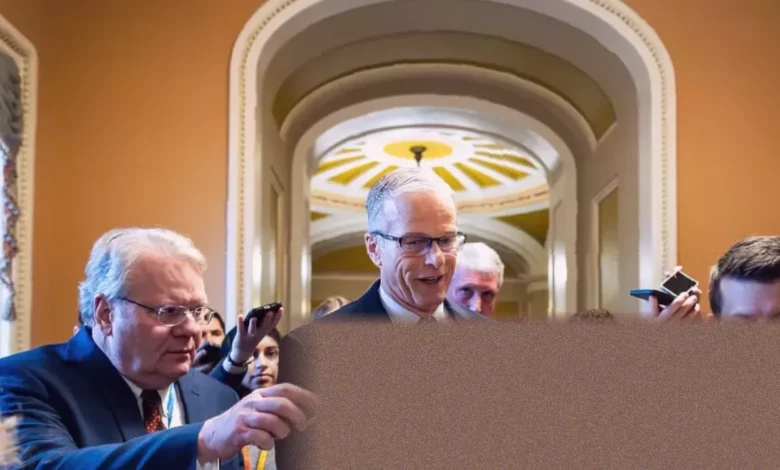
As the Senate debate looms, the political stakes are intensely personal for lawmakers. With the president framing opposition as a character flaw and vowing electoral retaliation, Republican senators, including Majority Leader John Thune, face the difficult task of navigating an uphill legislative battle while appeasing a determined standard-bearer.