The US economy defied expectations in the first three months of 2026, with gross domestic product accelerating to an annual rate of 2.0 per cent, according to the Commerce Department. The figure marks a sharp rebound from the 0.5 per cent growth recorded in the final quarter of 2025, when a contraction in government spending – driven by the layoff of 355,000 federal workers, or 11.8 per cent of the workforce since October 2024, according to the Bureau of Labor Statistics – dragged on the economy.
The turnaround was fuelled by a 10 per cent jump in government spending, which swung from a 5.4 per cent contraction in the fourth quarter to a 4.4 per cent increase in the first quarter. The rebound was partly attributed to the return of federal workers after last year’s mass cuts. At the same time, domestic investment surged 6.4 per cent, driven overwhelmingly by a boom in spending on artificial intelligence and the infrastructure that supports it. The five largest US cloud and AI infrastructure providers are projected to spend between $660 billion and $690 billion on capital expenditure this year, nearly double the 2025 level, with analysts estimating total investment could reach $5 trillion by 2030, making it the largest capital build-out in human history.
Yet beneath the headline growth, household spending – the traditional engine of the US economy – is losing steam. The pace of consumer spending growth slowed by 0.3 percentage points compared with the fourth quarter of 2025. While overall retail sales still grew 3.3 per cent year on year in March, consumer behaviour is shifting away from expensive discretionary activities and toward “cheap thrills” and essential services, according to recent data. Lower-income households remain under the greatest strain, and middle-income families are beginning to cut back on non-essentials. A slim majority of Americans – 53 per cent – set a budget for 2026, up from 46 per cent a year earlier, as many sought to increase savings, stop overspending or manage debt.
War with Iran drives energy prices and inflation fears
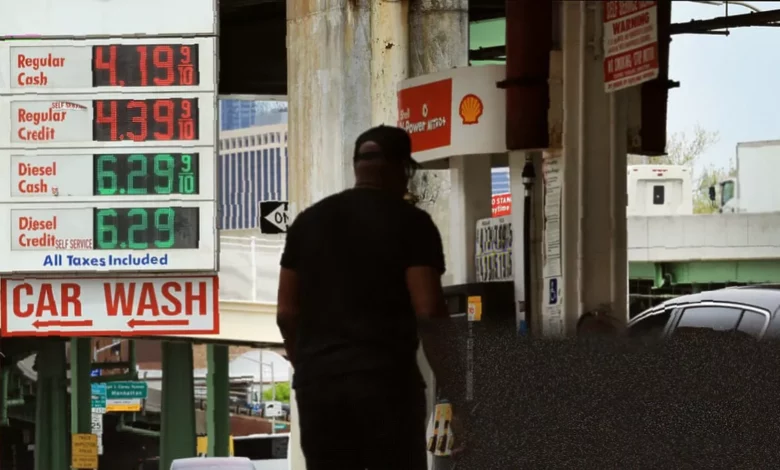
The principal force dampening consumer sentiment is the war with Iran, which erupted on 28 February 2026 with air strikes by the US and Israel and the assassination of Iran’s supreme leader, followed by Iranian missile and drone retaliation. The conflict has sent energy prices soaring. Global oil hit a wartime high of $126 a barrel on Thursday, surging 13 per cent in 24 hours, after peace talks between Washington and Tehran reached a standstill. Brent crude was trading at $105 a barrel as of Friday, up 44 per cent since before hostilities began. The average price of a gallon of petrol in the US stood at $4.06, more than a dollar higher than before the conflict, and economists forecast that oil prices will remain above pre-war levels for the rest of the year.
The crisis revolves around the Strait of Hormuz, a narrow passageway that normally handles about 20 million barrels of oil per day – roughly a fifth of global oil supply – as well as a significant share of internationally traded liquefied natural gas. Iran has largely blocked shipping through the strait since 28 February, creating what the International Energy Agency has called the “largest supply disruption in the history of the global oil market”. The blockade has stranded oil and LNG exports and triggered a systemic collapse of the economic model of the Gulf Cooperation Council states.
Inflation expectations have risen sharply, from 3.8 per cent in March to 4.7 per cent in April – the largest one-month jump since April 2025, when Donald Trump announced his “Liberation Day” tariffs. Actual inflation has already picked up: the annual rate hit 3.3 per cent in March, the highest since May 2024, driven by a 12.53 per cent rise in energy prices year on year. Petrol prices jumped 18.9 per cent and fuel oil surged 44.2 per cent. Even core inflation, which strips out food and energy, rose to 2.6 per cent. Economists warn that the full impact of higher oil prices on consumer prices has yet to feed through.
The war is also exacting a heavy fiscal toll. Defense Secretary Pete Hegseth told Congress on Wednesday that the conflict has already cost the US government at least $25 billion, and the Pentagon is asking lawmakers to approve an additional $1.5 trillion in military spending for the 2027 budget. Analysts predict the war could drag GDP down by 0.3 percentage points this year, leaving the economy growing at around 1.8 per cent for the full year – dangerously close to stagflation territory, where high inflation coexists with weak growth. The World Bank has warned that the conflict is hitting the global economy in cumulative waves: higher energy prices, then higher food prices, and finally higher inflation that pushes up interest rates and makes debt more expensive. The International Monetary Fund has flagged the risk of a global recession if conditions do not improve.
Federal Reserve under pressure as Powell defends independence
The Federal Reserve has kept interest rates unchanged at a target range of 3.5 per cent to 3.75 per cent for the third consecutive meeting, a decision taken on 29 April. The vote saw a record number of dissents since October 1992: one member favoured a rate cut, while three opposed the inclusion of language signalling a bias toward easing. Outgoing chair Jerome Powell defended the central bank’s “hold and wait” strategy, arguing that it needs to see how both the war and the lingering effects of Trump’s tariffs play out before adjusting policy. The “Liberation Day” tariffs, announced on 2 April 2025, imposed a universal 10 per cent levy on all imports plus additional country-specific duties; economists estimate they added between half a per cent and three-quarters of a per cent to inflation by the end of 2025, with the pass-through to consumers increasing over time. The administration has sealed an “underwhelming amount” of trade deals since then, and consumers have borne the knock-on effects.
Powell, whose term as chair ends later this year, announced he will remain on the Fed’s board of governors – the first time a Fed chair has done so since 1948 – citing concerns about the central bank’s ability to operate independently from the White House. “The institution is being battered over these things,” he said at a press conference on Wednesday, pointing to legal attacks and investigations by the Trump administration against the Fed. The political pressure, combined with the intensifying war and stubborn inflation, leaves the US economy navigating an unusually uncertain path.