US Vice President JD Vance has insisted that decisions over life and death must remain firmly in human hands, not ceded to machines, as he set out his deepest anxiety about artificial intelligence: its capacity to transform the nature of warfare.
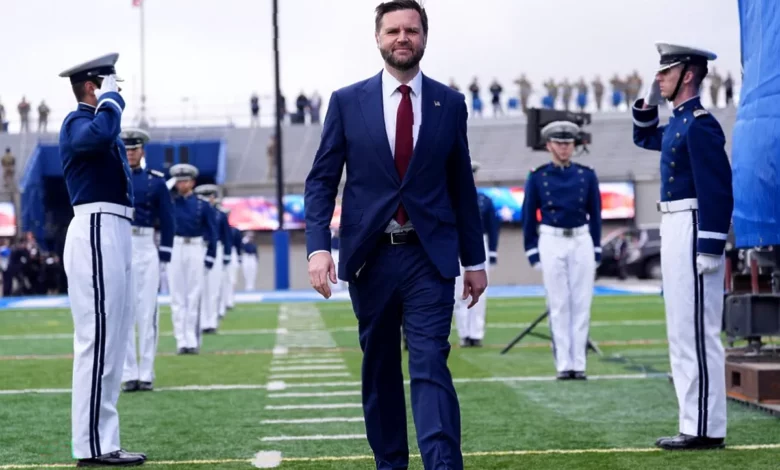
Speaking at the US Air Force Academy graduation ceremony in Colorado on 28 May 2026, Mr Vance, a Marine Corps veteran and convert to Catholicism, told the more than 900 cadets commissioning as officers to use technology to enhance their capabilities “but never submit to it”. He urged them to be “jealous and selfish” about their role as decision-makers in conflict, warning that the moral weight of lethal action could not be outsourced to algorithms.
Human conscience at the centre of just war
Mr Vance framed his argument around the principle that American forces “wage war justly”, a claim he rooted in the human element of battlefield leadership. “You are the ones who execute, you are the ones who lead on the battlefield,” he told the cadets. “You are the ones who ensure that our lethality in war, which is amazing and necessary, it also co-exists with our heart and with our conscience.”
The vice president acknowledged that AI will “inevitably change warfare” and has already begun to do so, but insisted that the unique moral character of American warfighting derived from the fact that actual people – not automated systems – took the ultimate decisions. “If the warfare of the future is to live up to the moral values of our ancestors, decisions over life and death must be made by humans and not machines,” he said. “So as AI transforms the battlefield … I ask that you be jealous and selfish about your role as a decision maker in warfare.”
Mr Vance drew direct support from the Vatican. He referred to the recent encyclical issued by Pope Leo XIV, titled Magnifica Humanitas, which was published on 25 May 2026 and focuses on artificial intelligence and human dignity. The Pope’s first major document on the subject calls for robust legal rules to govern AI development and warns against its use as “an instrument of domination or death”. Crucially, it states that “it is not permissible” to entrust lethal or irreversible decisions to AI systems, demanding a chain of human responsibility in warfare. The Pope also raised the concern that some autonomous weapons systems have advanced “practically beyond any human reach to govern them”. At the Vatican’s presentation of the encyclical, a co-founder of the AI company Anthropic was present.
Mr Vance, who had previously urged Pope Leo to be cautious about speaking on theological matters, particularly regarding war, described the encyclical as “very profound” and “the sort of thing that you would expect and hope from a leader of the church”. He said he had only read “bits and pieces” of the document but believed it would be “important”. The vice president supported the Pope’s call for people “not to outsource the most important moral decisions to digital technology”.
AI’s battlefield transformation and policy tensions
The ethical questions Mr Vance raised are not merely theoretical. In the UK, warnings have been issued in Parliament about the need to regulate advanced military technology as drones become increasingly deployed on the battlefield. The UK government’s 2025 Strategic Defence Review calls for increased use of AI and autonomy in conventional forces, backed by a £4 billion investment in autonomous systems, including drones. A new Drone Centre is being established to accelerate the exploitation of small uncrewed air systems and address legislative changes. In January 2025, a House of Lords committee urged the government to clarify the application of International Humanitarian Law to lethal drone strikes and to work towards an international agreement limiting fully autonomous weapons systems. The government responded that it would always ensure “meaningful and context-appropriate human involvement” in weapons systems. The UK Ministry of Defence has also awarded contracts for the development of autonomous targeting systems, and AI-powered drone technology has been trialled to identify landmines and explosive ordnance, demonstrating the ability to rapidly retrain AI models for evolving threats.
Meanwhile, tensions over AI policy have spilled into the open within the US administration. Reports emerged of a rift inside the White House after President Donald Trump abruptly pulled plans to sign a new executive order on AI on 21 May 2026, just days before Mr Vance’s speech. The president expressed concern that the planned order could “dull America’s edge on AI technology” and hinder its lead over China. The shelved executive order would have established a framework for the government to vet the national security risks of advanced AI systems before their public release, involving voluntary collaboration with tech companies such as Anthropic, OpenAI, and Google. Despite the postponement, the Commerce Department had already announced agreements with Google, Microsoft, and xAI to evaluate their most powerful AI models before public release. Previously, in February 2019, President Trump had ordered all US agencies to stop using Anthropic’s chatbot Claude following a dispute. The Trump administration’s earlier “American AI Initiative” via Executive Order 13859 in February 2019 focused on research investment, computing resources, technical standards, workforce development and international engagement.
Broader public anxieties about AI
The unease around AI extends well beyond military circles. Former Google chief executive Eric Schmidt was booed by graduating students at the University of Arizona on 16 May 2026 when he discussed artificial intelligence and the fear of job displacement. Students voiced anxiety about AI reshaping or replacing parts of the workforce. A Pew Research Center survey has indicated that many Americans are more concerned than excited about AI’s expanding role, reflecting growing anxieties as companies rapidly deploy AI tools, with some discussing using AI to streamline operations and reduce staffing needs.
Mr Vance acknowledged the weight of responsibility his audience carried. Comparing the air force cadets to their civilian peers graduating at this time of year, he said: “Almost none of them will have your responsibility, quite literally, (for) decisions over life and death.” He added: “It is an incredible burden to put on your shoulders, but it is one that we entrust to you with full confidence.”
The vice president’s central message echoed throughout his address: “Use technology to make you better, but never submit to it. You are the masters of warfare, and both your minds, but also your hearts, are the opposite of artificial.”