IO Interactive’s upcoming 007 First Light does not commit to a single cinematic incarnation of James Bond. Instead, the studio has built its protagonist from fragments of Ian Fleming’s novels, four decades of film history, and a performance that belongs entirely to Irish actor Patrick Gibson. The result, as the game’s senior combat designer Tom Marcham puts it, is a Bond who is not “100% competent from the start” – a younger, messier agent whose personality is still being forged.
Characterising a Young Bond
Gibson, whom narrative and cinematic director Martin Emborg cast partly for his “built-in impatience”, plays a 26-year-old Bond on the cusp of earning his 00 status. The game’s tagline, “Earn the Number”, telegraphs an origin story that draws from Fleming’s novels – Gibson’s Bond bears the facial scar described in the books – while borrowing the easy charm of Pierce Brosnan’s era and the physical brutality of Daniel Craig’s. When Bond shoves a goon into a bookcase, the choreography echoes Casino Royale’s parkour-laden brawl; when he smooth-talks his way past a guard, it is pure Brosnan. Yet Marcham acknowledges that Craig’s run remains the primary touchstone for action: “He has, arguably, the best action sequences. He uses krav maga, so we take a lot from that.” The influence of the Brosnan years, however, supplies the irreverence. “We need a little more mess in there,” Marcham says, “and we get that from Pierce Brosnan, where there are lots of bullets flying – a very high-drama combat.”
The performance itself, according to preview builds, works because Gibson anchors his Bond in an outsider’s unease that is not inherited from any previous screen version. Marcham describes Bond as someone who “kills when he needs to, but is not someone who loves killing” – a nuance codified in the game’s “License to Kill” mechanic, which restricts lethal force until survival demands it. Gibson’s Bond, Emborg has said, is developing the arrogance that MI6 will eventually weaponise, and the player witnesses that evolution across the narrative.
Balancing Playstyles
Because Bond is not yet a polished MI6 weapon, the gameplay shifts between genres and tones with deliberate variety. At a Kensington press conference, the player navigates a compact Hitman-style sandbox: eavesdrop on guests to discover routes, pose as a photographer, or redirect a weary security guard by altering a staff roster. Unlike Agent 47, however, Bond will not snap a neck. Instead, he deploys “Instinct” – a smug one-liner that buys him a second chance when he is spotted where he should not be. “We’re truly happy for you to pick whatever [style] you want,” Marcham says. “We trust you to pick the one you’ll have the most fun with. We’ve designed for all of them.”
Slip beyond the red carpet and the stealth becomes gadget-driven: a hacking device triggers electronic distractions; chemical darts send guards retching towards a bin. Detection does not mean instant failure – Bond can de-escalate, which usually involves punching one man and braining another with an ergonomic keyboard. Marcham notes that desks used for cover in a stealth run can double as improvised weapons, and a billiard table invites the temptation of throwing a cue ball. The combat designer points to the freeflow system of the Batman: Arkham series as an inspiration, alongside the cinematic destruction of Uncharted. The result, Marcham says, is a Bond who fights in “more prolonged and stylish” bursts than the clinical efficiency of Agent 47.
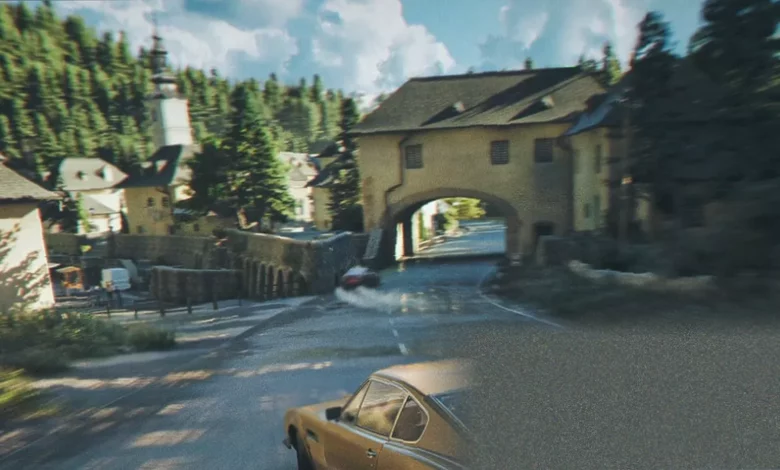
Vehicles also make their debut in an IO Interactive title. A chase sequence sees Bond flee captors in a bin lorry, shoving jeeps aside and ramraiding a fashion boutique – a set piece Marcham admits channels the tank-driving chaos of Brosnan’s GoldenEye. The game includes drivable vehicles as part of its forward momentum, a design philosophy that art director Rasmus Poulsen says separates 007 First Light from Hitman’s expansive sandboxes. “Rather than having grand, open sandboxes, it’s important for us that you feel certain things at certain times, to bring that story through and have the player feel the forward momentum,” Poulsen explains. The trade-off is less agency on a macro scale, but the density of the stealth simulation remains high. “Putting aside the complexity of the stealth simulation,” the original preview noted, “the Venn diagram of Bond and Hitman is almost an eclipse.”
One standout sequence places Bond strapped to an interrogator’s chair, requiring the player to time mocking quips to hold the torturer’s attention without succumbing to the pain – a direct interactive translation of Goldfinger’s laser table. Such moments, Poulsen argues, are where the game’s identity crystallises: “It’s really wonderful to be able to use all the aspects of my craft to try to build a world for you where you have a certain sensation – you feel like an outsider, [or] you feel like you belong – with a character who hopefully players can relate to.”
Design Philosophy: A New Identity
IO Interactive began development on 007 First Light in November 2020, immediately after completing Hitman 3. The project, announced initially as “Project 007”, was fully revealed as 007 First Light in June 2025, running on the studio’s proprietary Glacier Engine optimised for modern systems. The studio has confirmed that no generative AI was used in development.
Poulsen frames the game’s visual and thematic identity as a collision of “timeless, romantic adventure” and “a crisp, modern edge”. He says, “These are the aesthetics that are fighting, just as they are themes that are fighting. It’s longevity versus the promise of a tech utopia. How to belong, but also to challenge what came before.” The narrative, written by Emborg and his team, explores those tensions through an original story inspired by Fleming’s novels and the film series. The cast includes Gemma Chan as Dr. Selina Tan, an original character; Lenny Kravitz as antagonist Bawma; and Lennie James as Bond’s mentor, John Greenway. The original title song, “First Light”, is composed by Lana Del Rey and David Arnold.
The game is scheduled for release on May 27, 2026, for PlayStation 5, Windows, and Xbox Series X/S, with a Nintendo Switch 2 version arriving in Q3 2026. A Deluxe Edition upgrade is available for pre-order, and a Collector’s Edition is priced at $300. Pre-release interest has been substantial: the game has surpassed 500,000 wishlists on Steam. Early previews have praised its ability to balance Hitman-style sandbox freedom with cinematic set pieces, while Gibson’s performance has been singled out as a potential candidate for the film role. The Omega Seamaster watch appears as a significant gadget, and the game’s visual identity has been described as “timeless”.
Poulsen, reflecting on how the studio drew on its own experience while forging something new, summarises the design philosophy: “To me, that has been a wonderful expansion on our capabilities.”