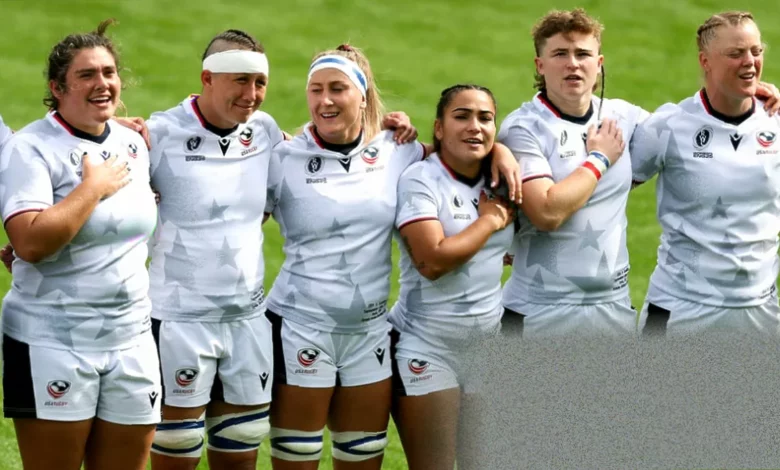
Hundreds of players threatened to boycott games after USA Rugby (USAR) banned transgender women from competing in the women’s category in February. Within days of the policy change, an emergency call involving roughly 300 people from across the country was convened to discuss a response. Dozens of clubs posted on social media announcing they would not play without their trans teammates, and a fund was set up to support players considering legal action.
Immediate backlash
The scale and speed of the opposition have surprised many. Rugby for All, a grassroots group formed in 2020 when World Rugby became the first international federation to ban trans women, quickly became the hub of resistance. “Towards the end of last year, all of us said, ‘We’re getting to the worst point now, and it’s encroaching upon our sport. Let’s go on the offensive, and let’s talk about why rugby is different,’” said Grace McKenzie, a Rugby for All organiser and former player for the Berkeley All Blues and New York Rugby Club.
Several clubs issued public statements. The Charlotte Royals, a North Carolina club that hosted the 2021 International Gay Rugby North American Championship, announced they would move all their teams into the new “open” division. “The Charlotte Royals believe that trans women are women,” they said. “Banning trans players hurts everyone in the sport and the larger community. We will be using the Open Division for any sanctioned matches we engage in, and encourage other clubs and unions to do the same.” The Mother Ruckers expressed similar intentions. Seattle Rugby Club publicly disagreed with the policy, saying they believed “trans women deserve every opportunity to play the sport they love in a safe and welcoming environment.” The Atlanta Bucks, Atlanta’s LGBTQ+ rugby club, said they stood “firmly against this decision” and in solidarity with their trans teammates and competitors. Women’s Elite Rugby also voiced disagreement and promised “alternative pathways” for inclusion.
Inclusive culture under threat
The ban has hit particularly hard because women’s rugby in the United States has long been regarded as one of the queerest and most gender-inclusive sports. “In the US, no one has cared about women’s rugby enough to hold cultural boundaries around femininity and performance, so it’s been perceived and experienced as a countercultural, queer space,” said Cameron Michels, a PhD student whose research focuses on queer and trans players’ experiences in women’s rugby. The sport’s guiding principle, Michels added, is “every body is a rugby body.”
The new USAR eligibility criteria fall in line with recent policy updates from other national governing bodies, including USA Hockey, USA Fencing and USA Climbing. Those changes were precipitated by bans from the US Olympic and Paralympic Committee (USOPC), which cited Donald Trump’s 2025 executive order “keeping men out of women’s sports”. The USOPC said it had an “obligation to comply” with the order and effectively barred transgender women from competing in women’s sports. USAR chief executive Bill Goren said the organisation did not feel direct pressure from the executive order because it is not federally funded, but it risked being decertified as the national governing body if it did not comply with the USOPC policy.
Proposed solutions and the ‘open division’
The ban applies not only to national teams and elite competition but also to local club teams that play for the joy and community of the sport. Alongside the ban, USAR created a third “open” division designed to allow people of any sex or gender designation to play. (USA Rugby and USA Club Rugby did not respond to requests for comment.)
Advocates have criticised the open division as an inadequate and potentially harmful solution. They argue that it “others” trans people by placing them in a separate category and that meaningful competition is unlikely because the number of players would be low. During the emergency meeting hosted by Rugby for All last month, several proposals were debated: forming a new, independent league separate from USAR — a significant logistical undertaking; a mass strike and collective refusal to participate in any USAR-sanctioned play, referred to as “the nuclear option”; or moving en masse to the open division in the hope of forcing USAR to develop a functional, sanctioned and funded open division for the 2025–26 season. Based on social media posts, the last option was by far the most popular.
A major obstacle, however, is that USAR has no plan for how the open division will actually operate. Minutes from a March senior council meeting of USA Club Rugby, which runs the governing body’s club teams, note that the logistics of the competition process and governance are “still in development”.
Despite this, the idea of teams moving to the open division together — effectively emptying the women’s category while making the open category a viable and competitive division — has been described as creative and potentially groundbreaking. Chris Mosier, a transgender athlete and advocate who has helped many leagues write inclusion policies, said, “The open division as a third category – I hope it backfires. I love seeing athletes finding creative ways to work around it, and every athlete can look to rugby for inspiration for ways to resist.”
The fight continues
Rugby for All organisers say USAR should have been better prepared. The governing body has had since 2020, when World Rugby passed its ban, to plan for the possibility of a similar policy reaching the United States. McKenzie was involved in a petition against World Rugby’s ban that gathered more than 25,000 signatures.
For the remainder of the 2025–26 season, most women’s teams will not be able to move to the open division while maintaining their USAR-sanctioned status. However, USAR has said that as long as no one submits a challenge regarding a player’s gender, it will not enforce the policy or require players to submit documentation or proof of their sex assignment. “If the whole community does not [report anyone], it obviously protects players, but it just sets up a ‘don’t ask, don’t tell’ policy within our sport,” McKenzie said. “That still sucks, but it is better than other sports that I think are going to come up with enforcement mechanisms because they have less opposition coming from their communities.”
Many rugby unions plan to continue allowing their trans women players to remain on teams, hoping that community solidarity holds and that no grievances are filed. But for some unions, particularly those in politically conservative states, the threat of losing their 501(c)3 non-profit or USAR-sanctioned status is too great. When the policy was first announced, Rosie M., a player with the San Antonio Riveters, was told by her team that nothing would change. A few weeks later she received a text from the team president informing her that she would not be allowed to compete during competitive play. The president cited a union decision to protect its 501(c)3 status. “Trans rugby players have been made second-class athletes by rugby unions who implement this policy without moving to create an open division,” Rosie said. “It just feels like something I really love is being taken away.”
The resistance, however, is far from over. Rugby for All is building a collective bargaining movement across the sport. The Northern California Rugby Football Union is preparing to move all its women’s teams to a new division or league if necessary. In North Carolina, the Charlotte Royals have already announced their intention to use the open division. “There’s a lot of people who are passionate on the organising side within our sport,” McKenzie said, “so it’s not like we’re going to see all these Instagram posts, and then we’re going to stop talking about this and just accept what happened.”